




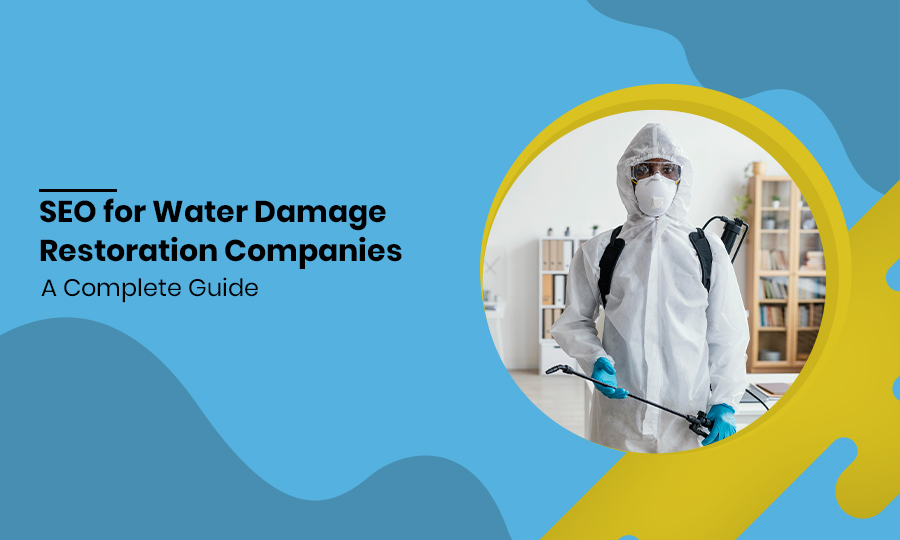
One important and quickly developing sector of the worldwide disaster restoration market is the water damage restoration sector. The market for water damage restoration was estimated to be worth 7.05 billion dollars in 2024 and is projected to increase from 7.41 billion dollars in 2025 to 12.1 billion dollars by 2035. Furthermore, throughout the predicted period (2025–2035), it is anticipated to reach around 5.1%. So if you want to establish your water damage restoration company in this restoration industry to be at the lead of this market, you need to develop your online visibility. And here comes the SEO for water damage restoration companies, which will help you dominate search engine result pages.
SEO for water damage restoration companies is very important because your potential clients start their search online when they have an emergency. In fact, organic search gives you the majority of online traffic. So SEO can be the primary channel for lead generation and visibility. Without strong SEO, many restoration businesses lose out to competitors who appear higher on search engine result pages.
In this comprehensive guide, you will learn all the important search engine optimization tactics for your water damage restoration company’s online visibility. Here, you will get a keyword research technique for restoration companies and how you can improve search engine rankings for your local businesses. Moreover, link-building strategies from reputable and relevant websites, and how to maintain technical seo for water damage restoration services, to improve website traffic. Additionally, content marketing is also very important, so you will also learn how to design your content strategy to enhance the restoration company’s online visibility. So let’s take a deep dive into the world of search engine optimization techniques to improve search engine rankings for a water damage restoration company.
What Is SEO for Water Damage Restoration Companies?
SEO is search engine optimization. It is a most useful digital marketing technique to uplift your Water Damage Restoration service website on search engine result pages. If you want to dominate your website in local searches, you need to apply local seo with the help of Google Business Page optimization and Google Maps. Moreover, SEO will give you a long-term online presence rather than other online marketing strategies. There are two kinds of leads generated by SEO: non-emergency leads, like inspections, insurance claims, and preventive services, and urgent leads, like active flooding or burst pipes. Let’s decode Water Damage Restoration SEO more in-depth in the upcoming segments.
Why SEO is Important for Water Damage Restoration Services?
You can think of it like being a client, how would you search? You will go to Google and type best Water Damage Restoration Companies near me” or any terms related to these services. Then, Google will suggest the best websites related to your search terms. If your website is perfectly optimized for SEO by focusing on high-intent keywords, then it will be the best option for them.
You can get organic traffic through seo for restoration companies. Suppose your target audience is suffering from floods or leaks; they will definitely be looking for your services. So, if you maintain your website properly with all the services you provide, create different website pages, such as service pages, and add positive reviews.
SEO improves legitimacy and authenticity. Consumers choose restoration businesses that look professional, have good reviews, and rank highly on Google. SEO helps you to achieve these goals.
Moreover, SEO Optimized content helps you to educate homeowners about prevention, claims, and inspections. This improves your business to capture non–emergency searches after the crisis. It will create long-term customer value.
SEO gives clear information into customer behavior—what they search, when they call, and which services convert the best leads. This can help your restoration services develop smarter business decisions, not assumptions.
Till now, you have an idea what search engine optimization is, so here we discuss the most effective seo for water damage restoration services.
How To Do Keyword Research for Water Damage Restoration Companies?
Keywords are those search terms that your potential customers use most to search your service pages or products. You need to find relevant keywords and put them in your website content and headings, and so on.
Water damage restoration keywords fall into three critical categories: emergency searches (immediate need), informational queries (research phase), and local service searches (finding nearby providers).
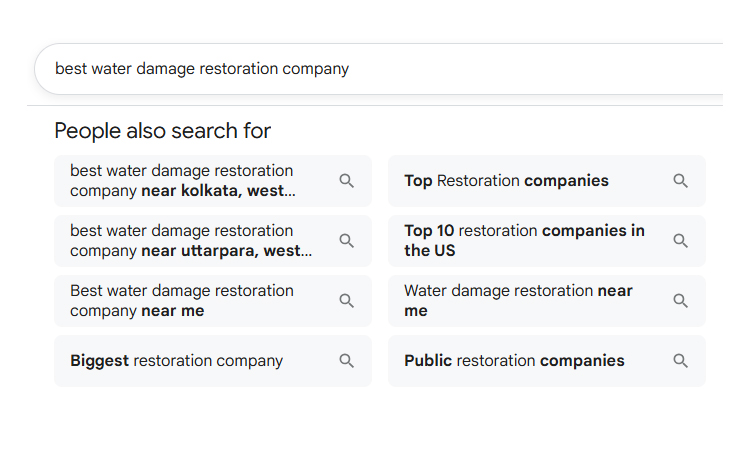
First, you need to understand your target audience’s needs and what kind of words they search for. So you can write your main keywords like “best water damage restoration company” in Google. And let Google help you with related search terms like that-

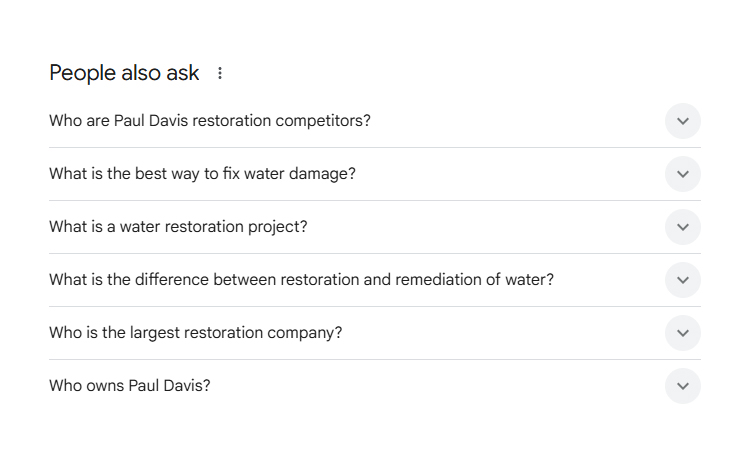
Then you can track the “People Also Ask” section and get questions and related search terms. It will improve the SEO of your content by enriching it with keywords.
Best Keyword Research Tools for Water Damage Restoration Seo
However, you can take help from the best keyword research tools, like Google Keyword Planner, Semrush, or Ahrefs.
Here, you will learn the keyword research technique with Semrush
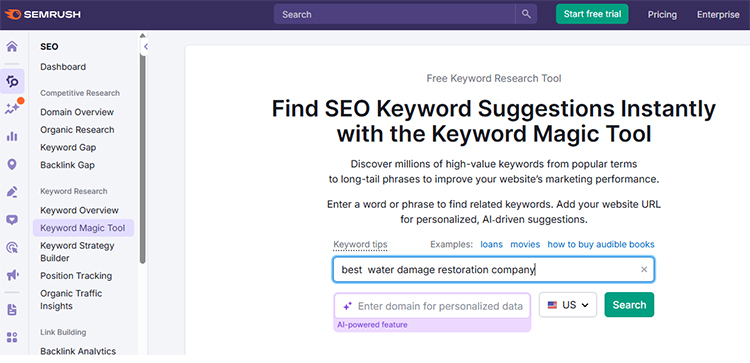
Put main keywords in the Keyword Magic Tool Search bar,

| Metric | Definition | Example (Water Damage SEO) | How to Use It | Why It’s Important |
| Search Intent | The reason behind a user’s search | “water damage restoration near me” | Match content to emergency, commercial, or informational intent | Correct intent = higher conversions |
| Keyword Volume | Average monthly searches for a keyword | 1,000–10,000 searches/month | Choose keywords with enough demand | Ensures real traffic potential |
| Keyword Difficulty (KD) | How hard is it to rank organically | KD 40–70 for restoration keywords | Balance high KD with low-KD local terms | Saves time and SEO cost |
| CPC (Cost Per Click) | The cost advertisers pay per click | $20–$90 per click | Identify high-value keywords | High CPC = strong buying intent |
| SERP Analysis | Review of current ranking pages | Local companies + Google Maps | Study competitors’ content & gaps | Helps outrank existing results |
Furthermore, you can research your rival’s website’s keywords with the help of the “Keyword Gap” tool. You can find which keywords their website ranks, but you don’t use. So you can find those keywords and put them on your website to attract more website traffic.


- High-Priority Emergency Keywords
Target urgent, high-conversion terms that indicate immediate need:
- “emergency water damage restoration near me”
- “24-hour water removal service”
- “emergency flood cleanup [city name]”
- “water damage restoration near me”
- “same day water extraction”
These keywords have lower search volume but extremely high conversion rates since users need immediate help.
- Service-Specific Keywords
Focus on specific water damage scenarios:
- “basement flooding restoration”
- “burst pipe water damage”
- “sewage backup cleanup”
- “storm damage water removal”
- “ceiling water damage repair”
- “water damage mold removal”
- Local Modifiers
Combine service keywords with location modifiers:
- “[Service] + [City/Neighborhood]”
- “[Service] + near me”
- “[Service] + [ZIP code].”
- “water damage restoration companies in [location]”
- Long-Tail Informational Keywords
Capture users in the research phase:
- “How much does water damage restoration cost?”
- “What to do after water damage.”
- “Does insurance cover water damage restoration?”
- “signs of water damage in walls”
- “How long does water damage restoration take?”
Keyword Implementation Strategy
- If you want to get the best online visibility in search engines, you can prioritize local + emergency keywords for the homepage and service pages.
- However, you can create location-specific pages on your website, each optimized with local keywords, which establishes your authority in local searches.
- Then you can use long tail keywords. Long-tail keywords are more specific, have lower competition, and often result in higher conversion rates.
How Content Marketing will Improve Seo for Water Damage Restoration Companies?
Content marketing produces more leads and is cost-effective for small to giant water damage restoration companies. According to recent research, content marketing generates 3x more leads and costs 62% less than traditional marketing. This will be an extremely effective strategy for businesses looking to increase organic visibility and conversions over time. If you maintain quality content, it helps you rank for relevant keywords naturally.
High-Impact Content Ideas
- Emergency Response Guides: First, you can develop extensive articles like “24-Hour Water Damage Response Checklist” or “What to Do in the First Hour After Flooding.” These focus on urgent searches and position you as the go-to expert. Engaging and informative content can improve search engine rankings.
- Location-Based Content: Then you need to put together city-specific instructions addressing local concerns: “Hurricane Season Water Damage Prevention in [City]” or “Common Causes of Water Damage in [Region] Homes.” This improves local search engine results.
- Video Content: After that, you should produce before/after restoration videos, customer testimonials, and educational content showing your process. Videos dramatically increase time on site and improve rankings.
- FAQ Pages: Answer common questions about insurance claims, restoration timelines, mold prevention, and cost estimates. Then you need to implement FAQ schema markup to appear in featured snippets.
- Seasonal Content: Publish timely articles around weather patterns: winter pipe burst prevention, spring flooding preparation, or storm damage recovery guides.
Content Optimization Tools
- Semrush/Ahrefs: Research relevant keywords, analyze competitor content gaps, and track ranking improvements for your SEO for water damage restoration efforts.
- Google Search Console: Identify which queries drive traffic and optimize existing content for better search engine results.
- AnswerThePublic: Discover question-based keywords customers actually search for, helping you create content that matches search intent.
- Grammarly/Hemingway: Ensure content readability and professionalism, improving user experience and dwell time.
- Yoast SEO/Rank Math: Optimize on-page elements, meta descriptions, and internal linking structure.
Implementation Strategy
You need to publish 2-4 high-quality articles monthly, update existing content quarterly with fresh information, and promote content through social media and email newsletters.
Then you should be Consistent with content creation. It can target relevant keywords and steadily improve search engine visibility. Furthermore, it will give you qualified leads to your water damage restoration business to establish long-term organic traffic growth.
What are the Best Local Seo Strategies for a Water Damage Restoration company?
Local SEO for water damage restoration focuses on helping your business appear in nearby search results when people need immediate help. Your company shows up on Google Search and Maps when local customers search for emergency water cleanup or restoration services. As a result, your business reaches people at the exact moment they need fast action and trust.
Your water damage restoration business depends on location-based visibility. Therefore, local SEO strategies focus on Google Business Profile optimization, accurate business details, local keywords, and customer reviews. You target specific service areas so nearby customers find you before competitors. At the same time, strong local signals build credibility and improve search rankings.
You gain more emergency calls because local SEO connects your services with high-intent searches. Additionally, consistent local optimization helps your business stand out during floods, leaks, and storm-related damage. In short, local SEO turns online visibility into real, local leads and steady business growth.
Steps of Optimizing Google Business Profile
First, you need to go to Google Business Profile and type in “Start Now” and log in to your business account.

Put your official name carefully. You need to make sure that the spelling is perfect on the website as well as on social platforms.
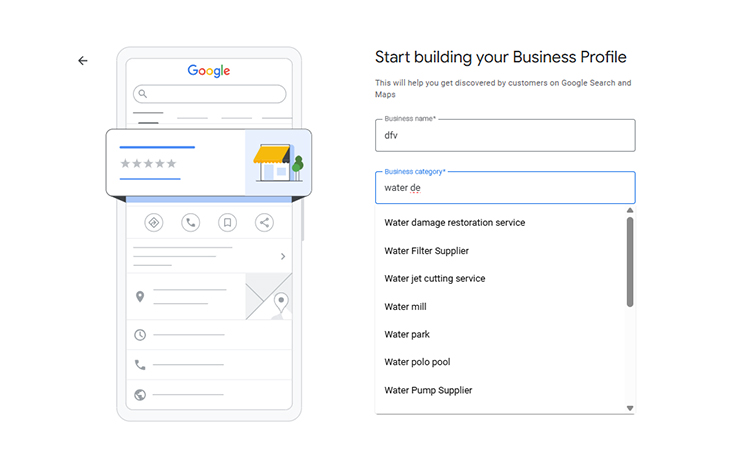
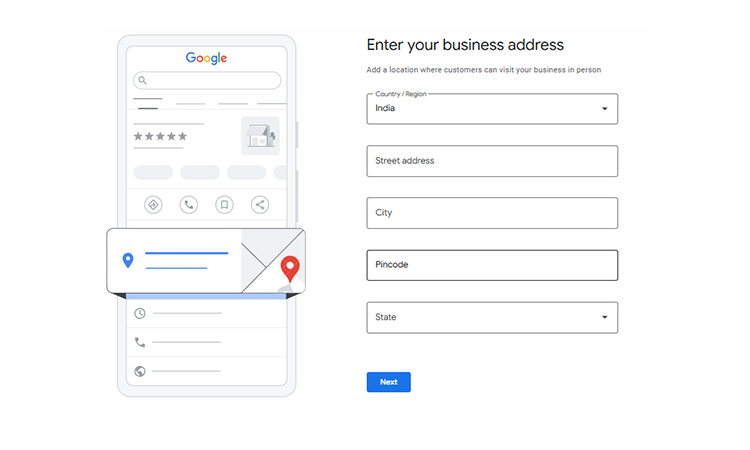
Then write your business address carefully.
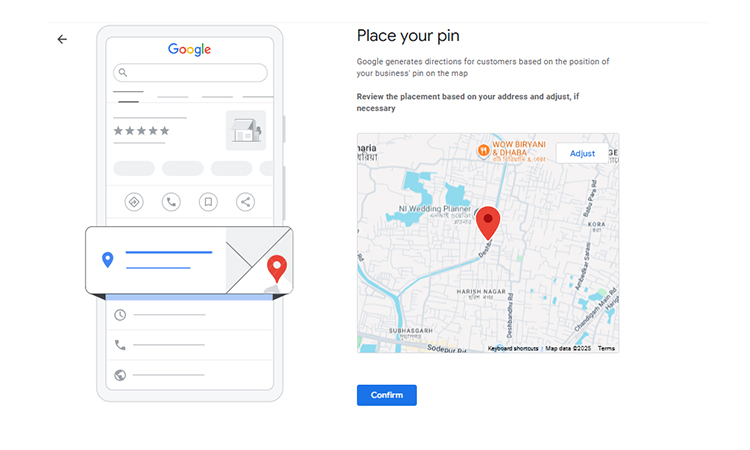
Point to the map where your water damage restoration company is located.
Then add your official contact details.
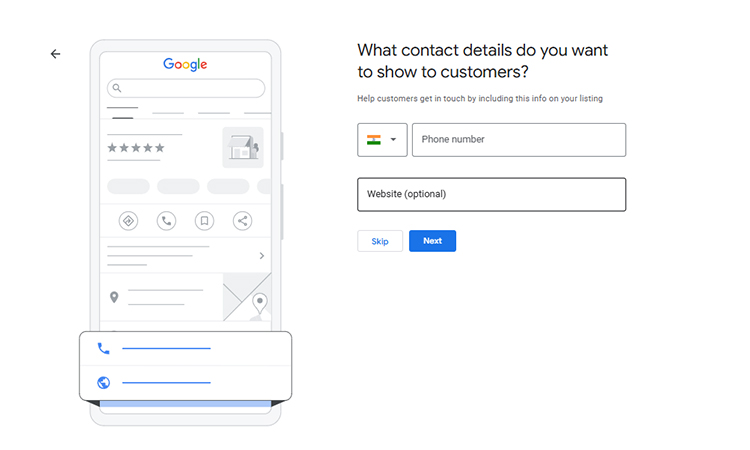
Add your business hours carefully to ensure that customers know when you are available to assist them. You need to provide accurate and up-to-date information on your hours of operation. It can help manage customer expectations and improve overall satisfaction.

Furthermore, you can add before and after pictures of your water damage restoration services. It will improve your legitimacy and authenticity of your services.

Google Business Profile optimization usually takes 7 to 14 days to complete properly. Basic updates like business details, categories, and photos show impact within days. However, ranking improvements and increased visibility typically appear within 30 to 60 days, depending on competition and review activity.
- Local Citations and NAP Consistency
Your business information must appear identical across every online platform. NAP stands for Name, Address, and Phone number. Search engines verify your legitimacy by cross-checking this information on hundreds of websites.
Steps to maintain NAP consistency:
- First, you need to create a master document with your exact business name, complete address, and primary phone number
- Then check your current listings on Google, Yelp, Facebook, and Yellow Pages for discrepancies
- Correct any variations in how you write your business name (LLC vs L.L.C., Street vs St.)
- Update your phone number format to match everywhere (avoid mixing formats like 555-1234 and (555) 123-4567)
- Monitor quarterly for new incorrect listings that competitors or data aggregators create
Consistent NAP signals tell Google your business operates legitimately and deserves higher rankings in local search results.
- Collect & Respond to Customer Reviews
Reviews serve as the most powerful local SEO ranking factor. Google prioritizes businesses with recent, authentic reviews.
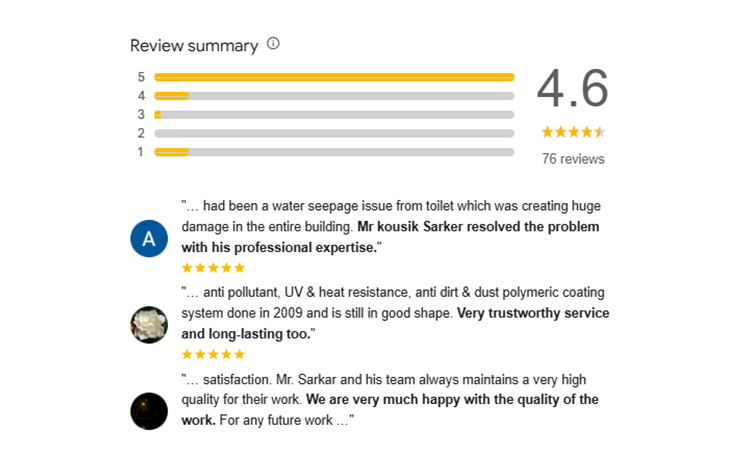
Steps to build your review profile:
- Send review requests within 24-48 hours after job completion, while satisfaction remains fresh
- Create a simple process: text message with a direct Google review link works best
- Ask satisfied customers face-to-face before they leave; you’ll get 3x more responses
- Train technicians to mention reviews: “If we did great work today, we’d appreciate a Google review.”
- Respond to every review within 24 hours, including 5-star reviews, with personalized thank-you messages
- Address negative reviews professionally without making excuses; offer to resolve issues offline
- Never buy fake reviews; Google detects and penalizes this practice severely
Your response rate matters as much as the reviews themselves. Potential customers see how you handle feedback.
- Embed Google Maps on the Contact Page
A Google Map embed on your contact page serves multiple purposes for local SEO.
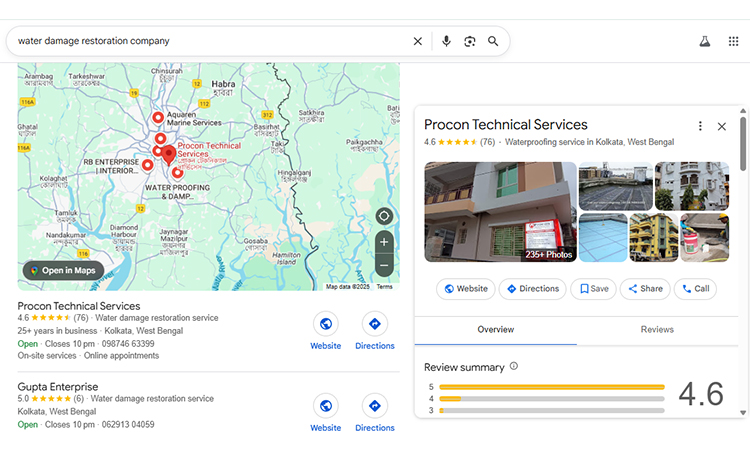
Steps to add Google Maps properly:
- Search for your business on Google Maps and click the “Share” button
- Select “Embed a map” and copy the HTML iframe code
- Paste this code into your contact page where customers expect to see location information
- Ensure the map loads quickly and displays correctly on mobile devices
- Add text directions below the map for a better user experience
- Include landmarks and local references to help customers find you
This embed creates another verification signal that connects your website to your Google Business Profile.
- Create Location-Specific Service Pages
Generic service pages don’t rank well in local searches. You need dedicated pages for each city you serve.
Steps to create effective location pages:
- Build separate pages for each major city and the surrounding neighborhoods you serve
- Write unique content for each page (never duplicate content across locations)
- Include specific local references: landmarks, neighborhoods, and common water damage issues in that area
- Add testimonials from customers in that specific location
- Embed a map showing your service area for that city
- Create unique meta titles and descriptions with the city name and main service keywords
- Include local statistics: “We’ve restored over 500 homes in [City] since 2015.”
Each location page targets “water damage restoration [city name]” and related local searches.
- Local Backlinks (Chambers of Commerce, Directories)
Backlinks from local organizations signal your business belongs to the community.
Steps to build local backlinks:
- Join your local Chamber of Commerce for an immediate directory link and credibility boost
- Partner with local plumbers, roofers, and contractors who can link to your site
- Sponsor local events, schools, or sports teams for website mentions
- Contribute expert articles to local news websites about flood prevention or water damage
- Get listed on city government resource pages for emergency services
- Connect with local insurance agents who recommend restoration companies to clients
Quality matters more than quantity. One link from your city’s official website outweighs dozens from random directories.
- Use of “Near Me” & Geo Keywords
Customers search for immediate help with location-based terms.
Steps to optimize for local keywords:
- Include “near me” variations naturally in your content: “When you search for water damage restoration near me…”
- Use city names in page titles, H1 tags, and first paragraphs
- Create content around “[Service] in [City]” and “[City] [Service]” patterns
- Target neighborhood names for hyper-local searches
- Add location keywords to image alt text descriptions
- Use schema markup to specify your service areas explicitly
- Getting Listed in Local Aggregators
Platforms like Justdial and Sulekha help customers find local services quickly.

Steps for aggregator listings:
- Claim your free listings on all major platforms in your service area
- Complete every profile field with detailed information about your services
- Upload high-quality photos of your team, equipment, and completed projects
- Keep your NAP information identical to other platforms
- Respond promptly to inquiries from these platforms
- Monitor and update listings monthly
- Use of LocalBusiness Schema Markup
Schema markup helps search engines understand your business details precisely.
Steps to implement schema:
- Add LocalBusiness schema code to your homepage footer
- Include the EmergencyService schema since you offer 24/7 water damage response
- Specify your service areas with geographic coordinates
- Add your hours of operation, including emergency availability
- Test your schema with Google’s Rich Results Test tool
- Update the schema whenever business details change
Schema markup doesn’t guarantee rich snippets, but it dramatically improves your chances of enhanced search visibility.
Proven On-Page SEO Strategies For Water Damage Restoration Services?
On-page SEO for water damage restoration services focuses on optimizing website elements to improve search visibility and conversions. Key strategies include clear headings, fast page speed, mobile optimization, internal linking, trust signals, and strong call-to-action placement. These elements help search engines understand services and attract emergency leads.
- Title Tags (With Target Keyword)
Title tags serve as the clickable headline in search engine results and appear at the top of browser tabs. Search engines use title tags as a primary ranking factor to understand page content.
Steps to Optimize Title Tags:
- Place your primary keyword near the beginning of the title tag for maximum SEO impact.
- Keep titles between 50-60 characters to prevent truncation in search results.
- Include your location for local SEO: “Emergency Water Damage Restoration Chicago | 24/7 Service.”
- Add your brand name at the end, separated by a pipe or dash.
- Make each title unique across your entire website to avoid duplication issues.
- Write titles that encourage clicks while accurately describing the page content.
- Avoid keyword stuffing; focus on natural, readable phrases that appeal to human searchers.
Example: “Water Damage Restoration Miami | Fast 24/7 Emergency Response – [Company Name]”
- Optimize Meta Descriptions
Meta descriptions provide a summary of your page content below the title in search results. While meta descriptions don’t directly affect rankings, they significantly influence click-through rates.
Steps to Optimize Meta Descriptions:
- You need to write compelling descriptions between 150-160 characters to avoid cutoff in search results.
- Include your target keyword naturally within the first sentence.
- Add a clear call-to-action like “Call Now” or “Get Free Estimate” to encourage clicks.
- Highlight unique selling points: 24/7 availability, licensed technicians, and insurance assistance.
- Match the description to the actual page content to reduce bounce rates.
- Create unique meta descriptions for every page on your website.
- Include contact information or service areas when space allows.
- Meta Title Tags
Meta title tags define the main title of a webpage that appears in search engine results and browser tabs. They directly influence click-through rate and help search engines understand page relevance.
How to Write Meta Title Tags (Steps)
- Start with the primary keyword.
- Add the service or benefit clearly.
- Include a location for local SEO.
- Keep the length between 50–60 characters.
- Use simple, action-focused language.
Example (Water Damage Restoration):
Title: Water Damage Restoration in Dallas | 24/7 Emergency Cleanup
- Header Tags (H1, H2, H3)
Header tags organize your content hierarchically and help search engines understand the structure and main topics of your page. Headers also improve readability for visitors.
Steps to Optimize Header Tags:
- Use only one H1 tag per page as the main headline, incorporating your primary keyword.
- Structure H2 tags as major section headings that cover subtopics related to your service.
- Deploy H3 tags for subsections under H2 headings to create logical content flow.
- Include relevant keywords naturally in headers without forced repetition.
- Write headers that clearly describe the content that follows each one.
- Maintain proper hierarchy: never skip from H1 to H3 without an H2 in between.
- Keep headers concise and scannable for users who skim content.
Example Structure:
- H1: “Professional Water Damage Restoration Services in Boston”
- H2: “Our Water Damage Restoration Process”
- H3: “Emergency Water Extraction”
- H3: “Structural Drying and Dehumidification”
- Internal Links Between Pages
Internal links connect different pages within your website, helping search engines discover content and understand site structure while guiding visitors to relevant information.
Steps to Optimize Internal Links:
- Link from high-authority pages to newer or less visible pages to pass link equity.
- Use descriptive anchor text that includes relevant keywords instead of “click here” phrases.
- Connect related service pages: link water extraction to mold remediation services naturally.
- Add contextual links within blog content to relevant service pages.
- Create a logical site structure with main service pages linked from your homepage.
- Include 3-5 internal links per page to maintain healthy site architecture.
- Fix broken internal links regularly to maintain proper site navigation.
- Link to your contact page from service pages with action-oriented anchor text.
- Image Optimization (Alt Text, Size)
Image optimization improves page load speed and accessibility while providing additional ranking opportunities through image search results.
Steps to Optimize Images:
- Compress images to reduce file size without sacrificing quality; aim for under 100KB per image.
- Use descriptive file names with keywords before upload: “water-damage-basement-chicago.jpg” instead of “IMG_1234.jpg.”
- Write detailed alt text that describes the image content and includes relevant keywords naturally.
- Choose appropriate image formats: JPEG for photos, PNG for graphics with transparency.
- Implement lazy loading so images load only when users scroll to them.
- Add image schema markup for before/after restoration photos to enhance search visibility.
- Include captions when helpful for context, as search engines can read these.
- Serve responsive images that adjust to different screen sizes for mobile optimization.
- URL Structure (Clean, Readable, Keyword-Rich)
URL structure represents the web address of your pages. Clean URLs help search engines, and users understand page content at a glance.
Steps to Optimize URL Structure:
- Keep URLs short, simple, and descriptive of the page content.
- Include your target keyword in the URL slug for SEO benefit.
- Use hyphens to separate words, never underscores or spaces.
- Avoid unnecessary parameters, numbers, or special characters in URLs.
- Create a logical hierarchy that reflects your site structure: domain.com/services/water-damage-restoration
- Use lowercase letters consistently throughout all URLs.
- Remove stop words like “and,” “the,” or “of” to keep URLs concise.
- Make URLs readable so users understand the page topic before they click.
Good Example: yoursite.com/emergency-water-damage-restoration-miami
Bad Example: yoursite.com/page?id=12345&service=wd&location=mia
Why Fast Page Speed Matters For a Water Damage Restoration Website?
Fast page speed means your website loads quickly for users, especially during emergencies. A fast website improves user experience, search rankings, and call conversions for water damage restoration services.
Steps to Optimize Page Speed:
- Compress images without losing quality
- Use lightweight themes and clean code
- Enable browser caching
- Reduce unnecessary plugins
- Use a reliable hosting provider
What Is Mobile Optimization?
Mobile optimization ensures your website works smoothly on smartphones and tablets. Most emergency water damage searches happen on mobile devices.
Steps to Optimize Mobile Performance:
- Use a mobile-responsive design
- Add click-to-call buttons
- Improve font size and readability
- Optimize images for mobile screens
- Test pages on multiple devices
How to Earn High-Quality Backlinks for Water Damage Restoration Seo?
High-quality backlinks serve as votes of confidence that boost your search engine rankings 86% of marketers include link building in their SEO strategy. Acquiring high-quality backlinks can give you the best valuable insight for your website ranking.
Most Useful 7 Link Building Strategies-You Need To Know
- Local Business Partnerships: Partner with plumbers, insurance agents, property managers, and real estate professionals. These partnerships create natural backlink opportunities and referral relationships that benefit both parties.
- Industry Directory Submissions: Submit your business to restoration industry directories, local chambers of commerce, BBB, Angi, HomeAdvisor, and Yelp. These authoritative platforms pass valuable link equity to your site.
- Guest Posting on Home Improvement Blogs Write expert articles for home improvement websites, real estate blogs, and property management publications. Include author bio links back to your water damage restoration website.
- Create Linkable Assets: Develop comprehensive resources like “Complete Water Damage Prevention Guide” or “Insurance Claims Checklist” that naturally attract links from other websites and local news sources.
- Local News and Press Releases: Distribute newsworthy stories about community involvement, emergency responses, or company milestones to local media outlets for coverage and backlinks.
- Broken Link Building: Find broken links on industry websites and offer your relevant content as a replacement using tools like Ahrefs or the Check My Links Chrome extension.
- Testimonials and Reviews: Provide testimonials for suppliers, equipment manufacturers, and software providers you use. Many companies link back to customer websites from their testimonial pages.
Essential Link Building Tools
- Ahrefs: Analyze competitor backlinks, identify link opportunities, and track your backlink profile growth over time.
- Semrush: Research competitor link-building strategies and discover websites that link to multiple competitors but not to you.
- Moz Link Explorer: Evaluate the domain authority of potential link sources and monitor your link profile health.
- Hunter.io: Find contact information for outreach to website owners and editors for guest post opportunities.
- BuzzStream: Manage outreach campaigns and track relationship development with potential link partners.
Implementation Steps
Any reputable SEO company follows these steps: identify target websites in your industry, create valuable content worth linking to, reach out with personalized pitches, build genuine relationships rather than just asking for links, and monitor your backlink profile monthly. Quality beats quantity—ten high-quality backlinks from authoritative sites outperform 100 low-quality directory links for search engine rankings and lead generation success.
What Technical Seo Strategies Do You Need to Follow for Water Damage Restoration?
Technical SEO for water damage restoration focuses on building a strong website foundation that search engines can easily crawl, understand, and rank. Here, you get a clear idea of how secure HTTPS certificates, XML sitemaps, robots.txt optimization, structured data, canonical tags, clean site architecture, and proper redirects improve visibility, fix crawl errors, prevent duplicate content, and support faster, user-friendly performance for emergency searches.
- SSL Certificate (HTTPS)
An SSL certificate encrypts data between your website and visitors, which creates a secure connection. Search engines prioritize secure websites in rankings and display warnings on non-secure sites.
Steps to Implement:
- Purchase an SSL certificate from your hosting provider or use free options like Let’s Encrypt.
- Install the certificate on your web server through your hosting control panel.
- Update all internal links from HTTP to HTTPS across your entire site.
- Set up 301 redirects from HTTP versions to HTTPS versions of all pages.
- Update your Google Search Console property to reflect the HTTPS version.
- Change all external links and CDN resources to use HTTPS protocols.
- Test the certificate with SSL checker tools to verify proper installation.
Best Tool: SSL Labs by Qualys provides free SSL configuration tests and identifies security issues.
- XML Sitemap Submission
An XML sitemap lists all important pages on your water damage restoration website. This file helps search engines discover and crawl your content efficiently.
Steps to Create and Submit:
- Generate an XML sitemap through plugins like Yoast SEO or RankMath for WordPress sites.
- Review the sitemap to ensure it includes all service pages and blog posts.
- Exclude thank-you pages, admin pages, and duplicate content from the sitemap.
- Upload the sitemap file to your root directory at yoursite.com/sitemap.xml.
- Submit the sitemap URL through Google Search Console under the Sitemaps section.
- Submit to Bing Webmaster Tools for additional search engine coverage.
- Update the sitemap automatically whenever you publish new content.
Best Tools: Screaming Frog SEO Spider creates comprehensive sitemaps, while Yoast SEO handles automatic updates for WordPress sites.
- Robots.txt Optimization
The robots.txt file tells search engine crawlers which pages they can or cannot access on your site. This file controls crawl budget and protects sensitive pages.
Steps to Optimize:
- Create a robots.txt file and place it in your root directory at yoursite.com/robots.txt.
- Allow search engines to crawl important service pages and blog content.
- Block admin areas, duplicate content, and thank-you pages from search engines.
- Add your XML sitemap location at the bottom of the robots.txt file.
- Test the file using Google Search Console’s robots.txt Tester tool.
- Avoid blocking CSS, JavaScript, or image files that affect page rendering.
- Review the file quarterly to ensure it reflects the current site structure.
- Fixing Crawl Errors
Crawl errors occur when search engines cannot access pages on your site. These errors damage user experience and waste valuable crawl budget.
Steps to Fix Errors:
- Review crawl error reports in Google Search Console under the Coverage section.
- Identify 404 errors for pages that no longer exist on your site.
- Set up 301 redirects from deleted pages to relevant existing content.
- Fix server errors (5xx codes) by resolving hosting or configuration issues.
- Correct soft 404 errors by adding proper content or implementing real 404 status codes.
- Remove broken internal links that point to non-existent pages.
- Monitor crawl stats weekly to catch new errors early.
Best Tool: Screaming Frog identifies broken links and crawl issues across your entire website in minutes.
- Structured Data/Schema Markup
Schema markup provides structured information about your business to search engines. This code helps you appear in rich snippets and local pack results.
Steps to Implement:
- Add the LocalBusiness schema to your homepage with business name, address, phone, and hours.
- Implement the Service schema on individual service pages for water extraction, mold remediation, and flood cleanup.
- Add Review schema to display star ratings in search results.
- Include the FAQ schema on question-and-answer pages for featured snippet opportunities.
- Add the Emergency Service schema to highlight 24/7 availability.
- Test your schema implementation with Google’s Rich Results Test tool.
- Monitor the search console for schema errors and fix them promptly.
Best Tools: Schema.org provides markup templates, while Google’s Rich Results Test validates your implementation.
- Canonical Tags
Canonical tags tell search engines which version of a page serves as the primary version. These tags prevent duplicate content issues across similar pages.
Steps to Use Canonicals:
- Add canonical tags to the head section of every page on your site.
- Point the canonical to the preferred URL version for each page.
- Use self-referential canonicals on unique pages to reinforce the primary version.
- Set canonical tags on pagination pages to point to the main category page.
- Apply canonicals to similar service pages that target different locations.
- Verify canonical implementation through page source code inspection.
- Avoid Duplicate Content
Duplicate content occurs when identical or very similar content appears on multiple URLs. Search engines may penalize sites or choose the wrong version to rank.
Steps to Prevent Duplication:
- Create unique content for each service area page rather than copying text.
- Use canonical tags to consolidate similar pages under one primary URL.
- Implement 301 redirects for old URLs that duplicate existing content.
- Add unique introductions and conclusions to location-specific pages.
- Block parameter URLs from indexation through robots.txt or meta robots tags.
- Use noindex tags on thin content pages like thank-you pages.
Best Tool: Copyscape detects duplicate content across the web and within your site.
- Proper 301 Redirects and Handling 404s
301 redirects permanently move one URL to another while preserving link equity. Custom 404 pages guide lost visitors back to valuable content.
Steps to Implement:
- Set up 301 redirects for any deleted pages to the most relevant existing content.
- Redirect old service pages to updated versions when you redesign your site.
- Create a custom 404 error page with links to popular services and contact information.
- Monitor 404 errors monthly through Search Console and fix priority issues.
- Test all redirects to ensure they lead to working, relevant pages.
- Avoid redirect chains where one redirect leads to another redirect.
- Lazy Load for Images/Videos
Lazy load defers the download of images and videos until users scroll to them. This technique dramatically improves initial page load speed.
Steps to Enable:
- Add lazy load attributes to image tags in your HTML code.
- Exclude above-the-fold images from lazy load to prevent layout shifts.
- Use native browser lazy load with the load=”lazy” attribute.
- Implement lazy load plugins for WordPress sites like WP Rocket.
- Test page speed improvements with Google PageSpeed Insights.
- Clean Site Architecture & Breadcrumb Navigation
Site architecture organizes your content logically, while breadcrumb navigation shows users their location within your site hierarchy.
Steps to Organize:
- Create a clear hierarchy with a homepage, service categories, and individual service pages.
- Keep important pages within three clicks from the homepage.
- Add breadcrumb navigation to all pages below the homepage level.
- Implement breadcrumb schema markup for enhanced search results display.
- Link related services through contextual internal links throughout content.
- Create a logical URL structure that reflects your site hierarchy.
Best Tools: Slickplan creates visual sitemaps, while MindMeister helps plan site architecture before development begins.
How to Measure Efforts of SEO for Water Damage Restoration Companies?
To get better results for the Water Damage Restoration Seo strategy, you need to check the following approaches.
- Organic Traffic Growth– First, you need to track monthly visitors from search engines through Google Analytics. Then compare month-over-month increases to identify trends and seasonal patterns in your restoration business.
- Keyword Rankings-Moreover, you should examine your position for target keywords like “emergency water damage restoration” and location-specific terms. Track improvements weekly using Semrush or Ahrefs tools.
- Local Pack Visibility-Check your appearance in Google’s local 3-pack for service area searches. Document your ranking position for critical emergency restoration queries in each city you serve.
- Conversion Rates-Then you may measure how many website visitors become leads through phone calls, form submissions, or chat messages. Calculate the percentage of organic traffic that converts to actual customers.
- Click-Through Rates-After that, you can review Search Console data to see how often people click your listings when they appear in search results. Improve titles and descriptions for low-performing pages.
- Backlink Profile-Count new quality backlinks each month from industry directories, local businesses, and media outlets. Quality matters more than quantity for restoration websites.
- Page Load Speed-Test site speed monthly with PageSpeed Insights. Faster sites rank better and convert more emergency callers who need immediate help.
- Lead Quality-Track, which keywords and pages generate the highest-value customers for your water damage restoration business services.
FAQ’s
Ans. SEO typically takes 3–6 months to show strong results. However, local optimizations like Google Business Profile updates can generate emergency leads sooner for water damage restoration companies.
Ans. SEO delivers long-term visibility and consistent leads, while paid ads offer instant traffic. A strong SEO strategy reduces ad dependency and improves search rankings for restoration companies over time.
Conclusion
SEO for Water Damage Restoration Companies requires dedication and consistent effort across multiple channels. Your web page must load fast, target the right keywords, and provide value to emergency searchers. Proper keyword research helps you understand what customers search for during water crises. List your business in relevant local directories to boost local visibility and trust.
Focus on immediate restoration services in your content since most searches come from people facing urgent water damage situations. Effective restoration digital marketing combines technical optimization, quality content, and local SEO strategies. Track your SEO performance monthly and adjust your approach based on results. Start with one strategy today, stay consistent, and watch your organic leads grow steadily over time by partnering up with a professional SEO agency.

