







In today’s highly competitive digital ecosystem, brands are constantly looking for the finest way to boost their online visibility and trust. They, of course, come across a myriad of options – journalist outreach is one of those. It’s considered to be the most common and effective strategy for everyone, be it startups, marketers, brands, PR professionals, or even media teams.
Popularly termed as third-party coverage, earned media is considered to be a reliable option, especially compared to paid ads. According to Medical Marketing and Media, approximately 78% of consumers across the world say they rely on earned media compared to traditional advertising.
Whether you own a small company or even an established brand, getting coverage in any reputable publications maximizes your visibility. It also boosts your brand credibility, reputation and creates investor confidence. More and more, it also ensures the success of your search engine optimization (SEO) by letting you create quality-driven backlinks, boost long-term traffic, and more.
So, now the million-dollar question arises here: how to proceed with journalist outreach in India? Well, you can do it in several steps with an impeccable strategy. We will discuss the same in this post. Let’s start.
Understanding the Indian Media Landscape
As far as the Indian media landscape is concerned, it’s vast and growing tremendously in today’s fast-evolving world. Let’s understand it through some impressive stats. In India, there are:
- 17000 registered newspapers
- 900+ television channels
- 500 radio stations
Well, the above stats reflect the diversity of the Indian media landscape. So, reaching out to journalists in this country brings a huge advantage for your business. With them, you can reach your niche and thus mass audiences.
Apart from this, regional publications also have a stronger influence, especially in Tier II and Tier III cities. The reason is that in these cities, local language content boosts both engagement and thus reliability.
Growth of Digital News Portal
According to the TOI, 71% of Indians rely on online news, and they prefer to access various digital news portals. This caused a significant growth of online magazines and news portals in the country. Another reason for the growing popularity of digital news is the growing number of smartphone users.
Many popular platforms, such as Times of Indian, The Hindu BusinessLine, Moneycontrol, YourStory, and others, play an indispensable role in sharing industry narratives and public opinion.
Meanwhile, the growing media landscape also indicates that journalists get thousands of daily pitches. It becomes highly important to pitch them with more clarity and also at the right time.
You need to take into account that every publication is known for its unique tone, own editorial style, audience expectations, and more. National media focuses on impact-based stories, while regional media often has some kind of propensity towards community relevance. Industry-based publications often look for relevant insights, data, and expert commentary instead of any promotional messaging.
Steps to Outreach Journalists in India
Now, we will discuss every important step to make journalist outreach successful. Let’s go through each step thoroughly to understand it better:
- Identifying the Right Journalists and Publications
You need to start the process of selecting the best journalist, which is highly important and also a backbone for successful media outreach. Since India has a diverse and huge media ecosystem, your pitch will be effective only if it reaches someone who covers your industry with perfection.
This ensures the effectiveness of targeted journalist identification compared to sending generic or mass emails. The process starts with understanding your horizon. Every niche has thousands of journalists who report this with a higher consistency, be it healthcare, SaaS, fintech, e-commerce, education, or consumer brands.
It’s advisable to determine the relevant beats. These can indeed be important categories such as business, technology, finance, startups, lifestyle, policy, mobility, lifestyle, health, and more. Once you align your story better with the best beat, you can indeed maximize your chance of being noticed.
- X
Formerly known as Twitter, X is a robust social media platform to find the right journalist. A large number of reporters are always active on this platform. They share their opinions, stories, live updates, etc., on this platform.
How to Use X to Search Journalists?
Well, to use this platform for journalist outreach, you can use the following important hashtags:
- #technews
- #startupnews
- #journalist
- #businessnews
- And more publication-related tags.
Once you use the above hashtags, you will come across many journalists who are reporting the same.
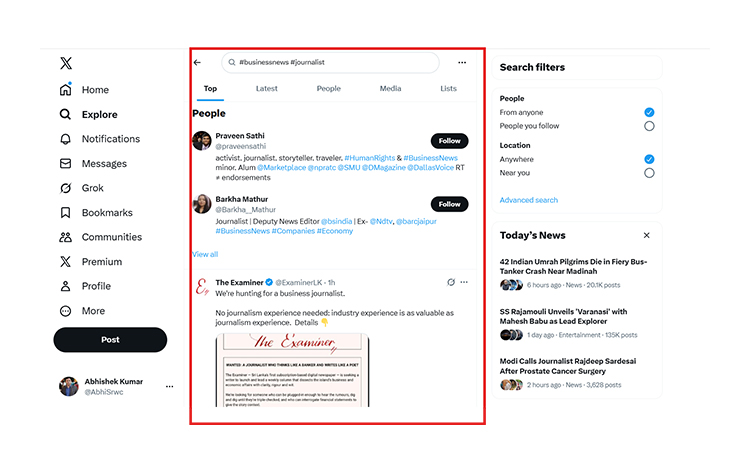
The above image reflects the results that you can go through. You need to look for someone who reports the same story that is similar to yours. It’s advisable to go through your latest work, and thus observe angles they prefer better.
A large number of journalists often mention their beats along with their contact details, including email. You can easily find their email IDs in their bios. It makes your journalist outreach effort quite convenient.
This is another social media platform that you can use to find the right journalists to reach out to. Here, you can use various search filters, like job titles, which are as follows:
- Correspondent
- Reporter
- Senior Writer
- Editor
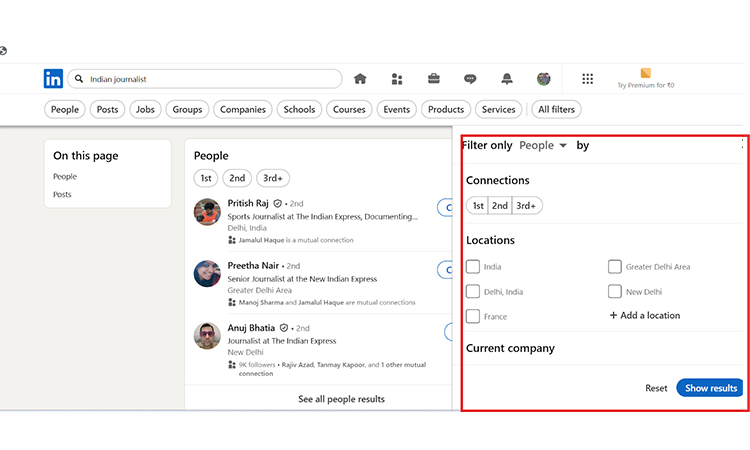
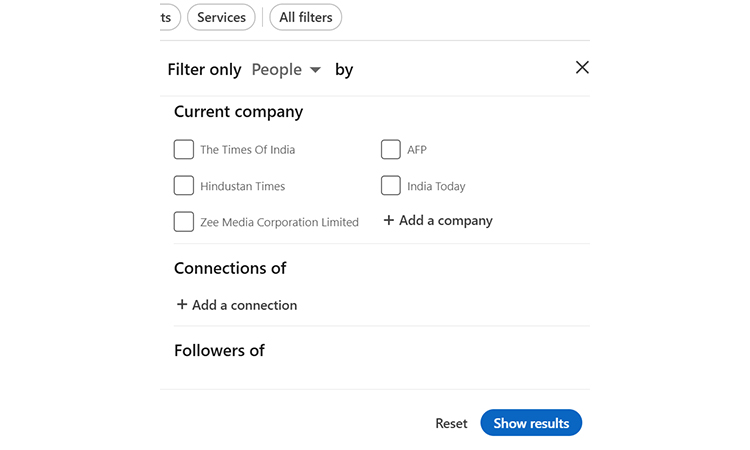
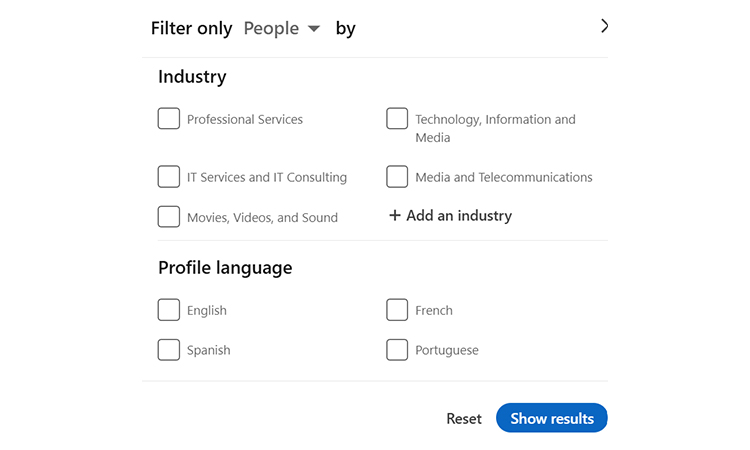
The above image reflects available filters, which you can use to find the right journalist.
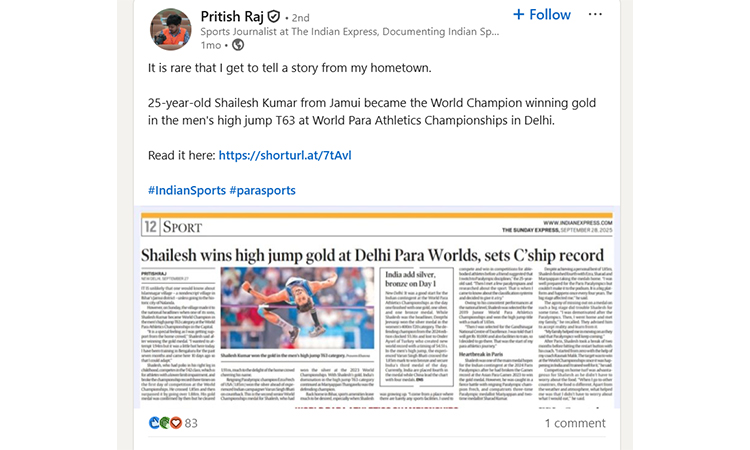
With LinkedIn, you will be able to see various posts journalists share and engage with. It gives you a complete idea of their interest, preferred storytelling formats, writing style, etc.
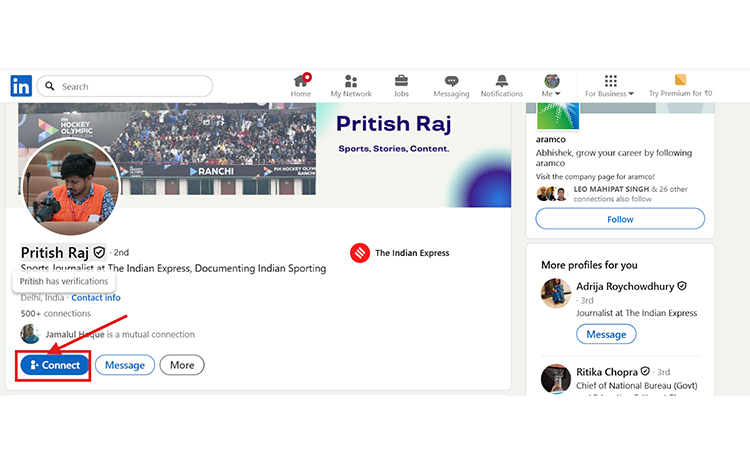
If you wish, you can send them a connection request.
But it’s certainly a good option to follow their content, as it helps you personalize your pitch accordingly.
- Media Databases
Apart from some social media platforms, you can also use media databases, which improve the process dramatically. The following are some of the tools you can categorize journalist lists according to beat, publication, language, and geography.
- Quruz
- Meltwater
- Wizikey
- Supernewsroom
- Indian PR Distribution
- And global services like Cision
These are indeed the most effective platforms that often include recent articles, email IDs, past brand interactions, and more. These indeed simplify segmentation as well. If you own a small business, you can leverage various important tools:
- RocketReach
- Hunter.io
- Notion-based Media Lists
While finding out the best publications, it’s advisable to always think beyond national giants. These mainly include the Indian Express, The Hindu, Economic Times, Mint, and more.
One thing you need to always keep in mind is that the media consumption of India is mostly regional, with the domination of several local-language publications. These are as follows:
- Malayala Manorama
- Dainik Bhaskar
- Anandabazar Patrika
- Eenadu
- And more
You need to understand that higher credibility is required for any business targeting specific states. If you are a startup, you can boost your visibility by leveraging a number of platforms:
- TechCrunch India
- Medianama
- Inc42
- YourStory
- Moneycontrol
- BusinessLine
After shortlisting some top journalists to promote your business, you can refine your list completely by reviewing the following important things:
- Make sure you go through their 10 to 15 articles.
- Go through their depth and tone of their reporting. Know how often their coverage covers your industry.
- You need to figure out whether they prefer data-based insights or accept expert quotes.
- Understand their audience demographics.
- Crafting the Perfect Pitch
You need to understand that crafting a better pitch tends to make or break your journalist outreach. Even if you discover the right journalists, you can’t impress them without creating a perfect pitch. You need to ensure your pitch stands out in a cluttered inbox filled with promotional emails, press releases, breaking news alerts, and more..
We will discuss several tips you can implement to make your pitch more relevant, concise, and tailored:
- The Art of the Subject Line
When it comes to the subject line, it creates the first impression and the best possible chance to get noticed. It encourages journalists to open an email – they can even decide in two seconds.
Make sure your subject line is timely, specific, and value-driven. You should always avoid some generic lines such as “important updates”, “press release”, “brand announcement”, and more.
Make sure you highlight the relevant data, news angle, and uniqueness that you offer with your subject line. Let’s explore certain examples of the best subject lines:
- Exclusive: 70% shift in automation – Revealed by New Indian SaaS Report
- HealthTech Businesses Now Minimize Wait Times by 70%: YourStory-Ready Story.
- Personalizing Your Email
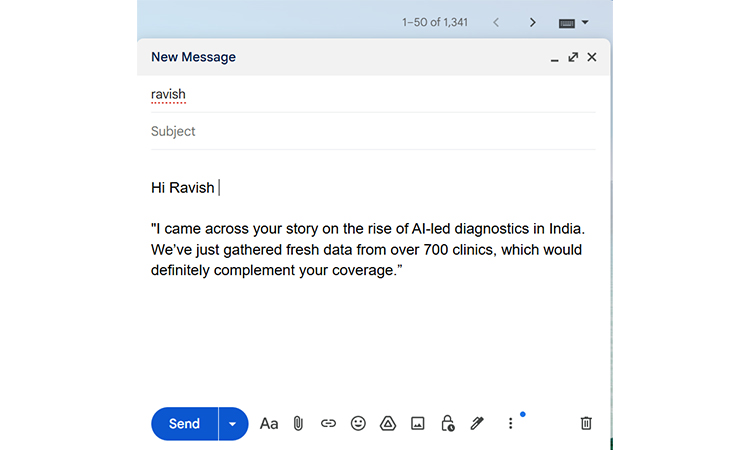
You need to take into account that journalists can spot mass emails quickly, and nothing can turn them off quickly. One thing you need to take into account is that personalization is not only about including the name of the journalist you outreach.
Personalization is also about showing you have a complete understanding of their writing style, beat, recent work, and more. Let’s discuss more to better understand how to personalize email:
- It’s advisable to mention their recent story and then relate your pitch accordingly.
- You need to then connect your angle to the coverage pattern, be it founder interviews, data-driven stories, or regulatory updates.
- Make sure you keep your intro in either one or two lines.
What to Include and What to Leave Out
When you write a perfect pitch email, it should include the following important things:
- Crisp Introduction: Your introduction should be just as who you are and your purpose for writing.
- Main Story: Your story should include relevant insights, data, impact, trends, human angles, etc.
- Importance: Make sure it has relevance, exclusivity, and timeliness.
- Supporting Details: You should always link to a website, press kit, expert quote, or report.
- Bold and Clear CTA: It should include a request for coverage, an interview request, or provide exclusive access.
- Your Availability: You should also share the right time slots, or provide to adapt to theirs.
Things to Avoid
To refine your mail, you need to avoid the following things:
- Over promotion words like game-changing, revolutionary, industry-first, etc.
- Lengthy brand introductions.
- Vast attachments
- Use of several CTAs in a single email
- Any claims without evidence.
- The Follow-Up Strategy
One thing you need to remember is that journalist outreach is incomplete without following up. It prevents you from disappearing under a large number of emails they get on a daily basis. So, the most important factors are timing and tone of your outreach. And make sure you have a follow-up incredibly short.
When to Follow Up?
Well, the right time to follow up is 24 to 48 hours, after your initial pitch. You need to understand that journalists work rapidly in new cycles. So, they have a higher possibility of responding to many relevant emails. You can take a gap of at least 3 to 4 days when it comes to research-based or evergreen stores.
No matter what, you need to aim for one or two follow-ups, which should be a maximum. While following up, you need to ensure it doesn’t repeat your entire pitch. It’s advisable to keep your follow-up within two to three lines maximum.
To become cordial, you need to acknowledge their busy schedule, remind them of their earlier mail, and also mention the value of your main story in one short sentence.

The most important thing you need to do is to avoid using phrases like “Reply Fast”, “You didn’t respond yet”, or something like this. Journalists never entertain pressure. Instead, they value clarity and professionalism. Therefore, you need to behave like you support them rather than demanding their attention.
Another important thing you can do to make your follow-up more effective and interesting is to add a small new detail, an additional expert quote, an updated data point, and more. It reflects your active value instead of getting coverage.
- Building Long-Term Relationships
Your media strategy can be successful only when you focus on building a strong relationship with journalists. With a trusted relationship with a journalist, you will be able to get more expert quote opportunities, ongoing coverage, priority access, and more, especially when journalists seek to get insights fast.
The goal is simple – you need to become a reliable and go-to source they can rely on. You need to start the entire process by showing up consistently, not just when you wish to receive coverage.
Make sure you access many platforms like LinkedIn, X, and others and engage with their content. You should share and comment on their stories. Don’t forget to appreciate their work without reflecting that you want anything from them. Journalists often keep an eye on those people who value their reporting.
Another important and effective way of developing trust is by providing useful information proactively. Whenever you discover any dataset, trend, industry update, etc., matching their beats, you can share it privately. This makes you someone who contributes value, not just interested in publicity for their own brand.
When you come across a journalist’s reply for any clarifications or comments, you need to respond fast and also with higher accuracy. Make sure you meet deadlines fast, as it helps you build credibility.
You can invite your journalist to roundtables, webinars, behind-the-scenes briefings, expert Q&A sessions, and more. These help them get complete details of the perspective of your brand better. You need to keep it more informative and follow the below provided tips and tricks:
- Engage social media regularly.
- Share many useful resources on various occasions.
- Respect their time always, and also editorial boundaries.
- You should pitch only when you have a reliable and relevant story.
The most important thing you can do is to avoid pitching quite often and also over-communication. Journalists often remember those people who are reliable, respectful, and easy to work with.
Best Practice Examples and Pitch Templates
Rather than sending a large number of emails, you need to follow the top practices that make your pitch easy to read, relevant, and also likely to earn responses. Here are some of the key principles you can implement:
Top Practices
Let’s understand some of the top practices you can implement to get better outcomes:
- Create your Email Under 120 Words
As we already mentioned the fact that journalists often work with tight deadlines and get a number of pitches on a regular basis. You need to take into account that long emails always take a huge time and also attention. It reflects that they are mainly skilled.
An ideal pitch should be 80 to 120 words. Therefore, you need to focus on staying concise, removing all fluff, and also highlighting the story angle rapidly. A tight and clean reflection of professionalism and thus maximizing your open and reply rates quickly.
- Use Data to Grab Attention
When it comes to data, it’s one of the powerful hooks. Be it sharing a trend, launching a feature, or announcing research findings, it causes a great statistic. You need to take into account that numbers are important for credibility, which allows journalists ready-made angles. It indeed makes your story powerful compared to a generic promotional message.
- Match your Pitch with Their Beat
You need to take into account that sending any pitch to the wrong journalists is indeed a convenient way to get ignored. A tech reporter will not be able to include any HR trends, and also a policy journalist will not be keen, especially in product design updates.
It’s necessary to get details about the right beat, be it fintech, startups, climate, business, mobility, and more. These ensure your pitch seems to be more relevant based on the actual work of the journalist.
- Offer Exclusively Whenever Possible
Journalists love to publish breaking news, latest insights, etc., before others publish. Therefore, if you reflect on these things, they respect their work and also create an urgency around your news.
You can write as:
“Elated to provide you with this interesting story exclusively to you. Share it before others.” This line indeed improves the actual chance of coverage.
- Make your First Email Free From attachments
Make sure you don’t include any attachments in your first email. The reason is that attachment often slows down the email loading, makes it heavy to open, triggers spam filters, and more.
Journalists always prefer to link to files, especially during the first interaction. Instead, you can use Google Drive for various purposes like linking your screenshots, press kit, report, product deck, etc. This makes your pitch clear, clean, and also easy to scan.
Best Journalist Pitch Templates
You can use a ready-made template to save your valuable time and thus boost the success of your outreach dramatically. Let’s have a look at some of the ready-made templates for journalist outreach:
- Product Launch Pitch Template
Subject: Newly Launched Product: (Product’s Name) Resolving (Issues Details)
Hi (Recipient’s Name)
Happy to share with you related details about the newly launched product, matching your beat (or coverage). We have launched (product name) that serves (target audience) and resolves (specific issues).
I have provided more details about my products by sharing a press note, screenshots, etc. Connect with us for a quote.
Warm Regards
Your Name
- Template for Data Pitch
Subject Line: Exclusive Data: Latest Trends in (Industry) in India
Hi (Recipient’s Name)
We have recently conducted a survey by including (numbers) of people and found the latest insights, which will complement your recent coverage ( or beat). If you find it helpful, I will be happy to share the complete dataset, quick expert quote, visual charts, and more for your story.
Waiting to hear from you.
Warm Regards
Your Name
- Funder Story Pitch Template
Subject Line: Get Interview Opportunity: Insights on Industry Shift from (Name of Founder)
Hi (Recipient’s Name)
I have come across your recent coverage on (Name of Topic) and thought these details would be a good fit. Our founder possesses enormous experience with (industry or market) and thus can share related insights on (specific issue).
If you want to explore it further, I would be happy to arrange a short meeting.
Warm Regards
Your Name
- Follow-Up Templates
Subject Line: (Story Angle): Quick Follow-up
Hi (Recipient’s Name)
Just reminding the story I shared earlier about you (topic). I think it may align you perfectly with your post on (beat).
If you find it helpful, I would be happy to share more details.
Warm Regards
Your Name
Common Mistakes to Avoid
No matter how powerful your journalist outreach strategy is, you will not be able to get the desired outcomes when you commit several mistakes. Let’s find out several important details of these mistakes:
- Sending Mass, Generic Emails
This is indeed the fastest way of getting ignored. Journalists find it quite convenient to discover a bulk-sent pitch, including irrelevant intros, generic subject lines, zero personalizations, and more. Rather than approaching 200 reporters, you should always focus on 10 to 15 reporters who are related to your topic. Make sure you tailor your pitch based on their beat, writing style, previous post, etc.
- Writing Long, Overloaded Emails
Be it unnecessary background, long paragraphs, or dense explanation, these indeed kill interest rapidly. The actual reason is that journalists often avoid digging into the core angle. Make sure your story is crystal clear, especially during the first 40 to 60 words.
You need to ensure your writing pitch is under 120 to 150 words. Rather than stuffing unnecessary information, you need to link to any additional resources and also highlight the news value.
- Pitching Irrelevant Stories
When you send even a well-written pitch to the wrong journalists, it will fail to deliver results. You should always avoid any temptation and focus on random reporters. When you approach those journalists who cover political beats with software product updates, they will definitely not entertain you.
- Overselling or Using Clickbait
Avoid using any hyper-loaded objectives, exaggerated claims, or any misleading subject lines. These have the potential to damage your trust and reliability. You need to pitch them with market impact, data, expert quotes, user growth, etc., instead of a revolutionary AI app.
Conclusion
To make your journalist outreach in India successful, you need to proceed with a robust strategy, focus on building relationships, and timing. When you personalize your pitch, respect any journalist’s time, provide real value, and more, your chance to get featured raises dramatically.
You should always follow up thoughtfully, stay consistent, and also keep refining your approach. You need to work with the perfect outreach framework to get meaningful media coverage. It indeed helps you develop a healthy and long-term relationship that boosts lasting visibility. Approach a professional social media marketing services provider to make your journalistic outreach successful.

