





The internet is now dominated by videos as a primary content format. Using videos to learn, compare products, master a new task, teach someone to do something, and to answer many other types of questions is on the rise. YouTube is now a large search and discovery platform, with billions of monthly viewers collectively watching more than 1 billion hours of video every day, and related videos are now search results on Google. Having a video on your channel is not a guarantee of high search rankings. Even if you make a quality video, there is a high chance that it will be very difficult for the target audience to find the video. This is because of factors like search intent, value, and overall context.
This is where you need Video SEO. It is a process that is used to enhance video content and the ecosystem surrounding it in order to enable search engines and other platforms to understand, discover, and present your video content to the target audience.
What Is Video SEO?
Video SEO is the practice of increasing the probability that your video content will show up in search results for relevant queries on platforms like YouTube and Google. It covers the optimization of the video as well as surrounding content. This means optimization of video content can include the title, description, thumbnail, transcriptions, chapter markers, metadata, captions, web pages, supporting links, and even viewer engagement.
It has two main components. The first is signaling to the platform what the content is. The second is designing the content and the signaling in such a way that the viewer actually engages with the content itself.
Why Video SEO Is No Longer Optional
Video SEO will become a necessity in the near future, since more people will use videos for searching for info, learning, comparison, and for making decisions. Since YouTube is currently the primary channel for both search and discovery, and since Google now displays relevant videos to user queries, creating high quality videos will no longer be sufficient. Wyzowl’s 2026 research found that 82% of video marketers say video has helped increase web traffic.
To help your content rank higher for search queries, optimize your search intent, editing videos and uploading descriptions with title and upload thumbnails, providing transcripts, and supporting webpages. Creating engaging videos will not matter if users can’t find it. Video SEO helps with that.
Strategies To Improve Video SEO
There is no one factor that dictates how videos rank. Content platforms look at hundreds and even thousands of signals. The quality, context, and satisfaction of the content are all considered along with viewer behavior and signals of the content’s relevance. This means that Video SEO must be a continuous effort.
Step 1 – Start With Video Keyword and Search-Intent Research

To understand how a potential audience would engage with a video, one must first understand how they search. While keyword research helps find search language, ranking search volume is not an indication of a focus keyword. High search volume may not correlate to the most high-value topic. Consider relevance to your audience and how specific lower volume queries may indicate Intent.
Knowing search Intent is essential for key topics and supporting research efforts. The search query “how to create a digital marketing strategy” indicates the searcher is looking for something practical. So your topic, format, and depth are all determined and influenced by understanding search Intent in order to strengthen SEO.
Step 2 – Build the Video Around Search Intent

The search Intent should be the main focus and inspiration behind your video. Your video should not be a jack of all trades and then need to be edited to fit specific search Intents. The structure, leading examples, explanations, and overall flow of your video should be inspired by a user’s search Intent.
A search for “how to improve website speed” indicates a user’s need for a step by step guide for website speed improvement. In the video SEO, you could clearly state that website performance is relevant, how to easily identify website performance issues, and showing best practices for speed improvements.
Step 3 – Optimize Videos for Google Search and YouTube
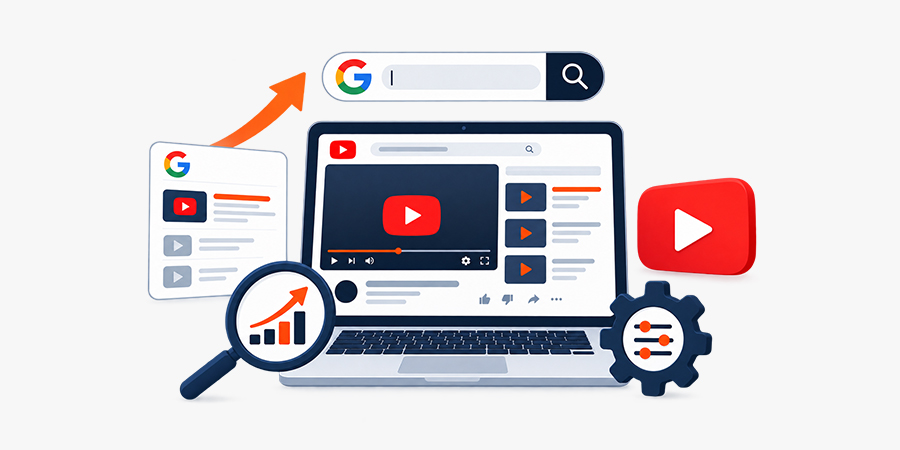
In the case of optimization for google search and YouTube videos, be clear about the topic in your video with a suitable title, description, and thumbnail. For effective SEO, avoid stuffing keywords and ensure the content matches the promise given by the title. In the case of Google Search, you should also take care of the webpage on which your video is hosted, as you need to place your video among useful content on the page.
Step 4 – Use Transcripts as an SEO Asset
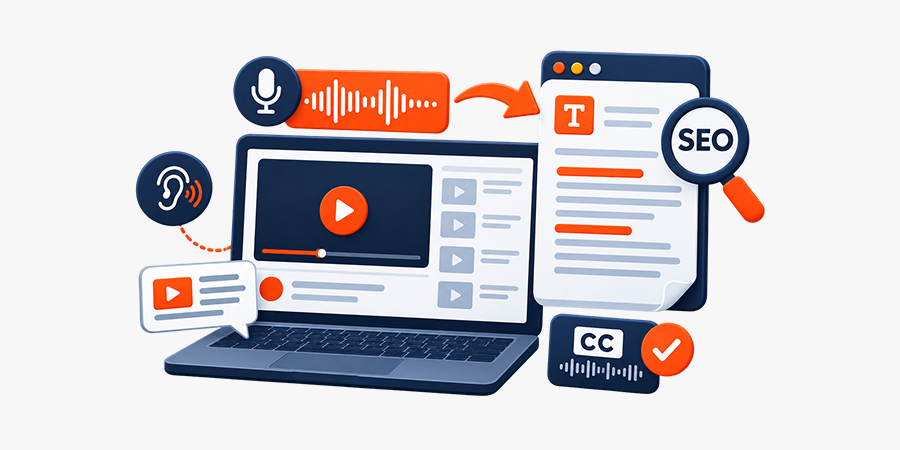
The bulk of a video’s information is delivered via audio. Transcripts provide textual delivery of the information, which can also serve to present the information in the context of the topic. Transcripts increase the value of videos that are educational, technical, or presented by an expert. They also increase the value of videos and provide an accessibility delivery method for viewers who are unable to listen to audio or prefer to consume the content in a different format. Closed captions provide similar benefits for viewers who watch videos without audio.
Errors can occur in automated captions when a video contains terminology, product names, acronyms, or other language specific to a profession. There can be more accuracy and a better overall viewing experience from reviewing captions and transcripts if video SEO is performed correctly.
Step 5 – Improve Video CTR Without Resorting to Clickbait
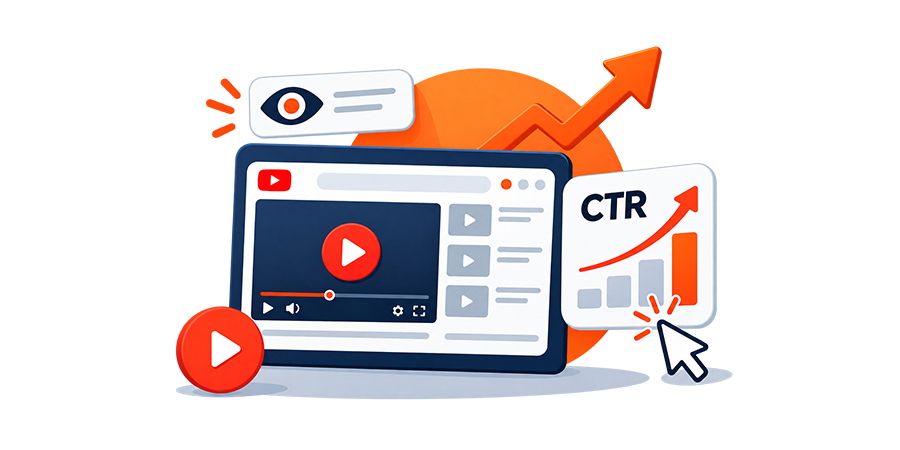
Just because videos are visible to potential viewers does not mean they will be engaged with. While clickbait has a temporary solution, it is a losing strategy in the long run. When viewers discover a video’s content does not fulfill the promise they clicked on, they quickly navigate away from the video.
The best title is the most accurate one that shows the value that you are promising in your click through. If your video receives an ample amount of impressions but poor CTR, review your title and thumbnail. For better SEO, only change your title and thumbnail if the performance says you should, and not because you felt like changing it.
Step 6 – Build Authority Around Your Videos

A single video can answer a single question, but a linked set of videos can establish authority and further explain a concept. Moreover, the creation of many videos, though related, provides many opportunities for a viewer to discover your content and to continue to explore.An SEO-centered channel may cover topics like technical SEO, keyword research, content strategies, competitor analyses, website audits, link building, and even search trends. Each of these videos can naturally be linked to supporting materials and articles found on the site.
Building authority does not come from publishing more videos, it comes from being consistent and useful. A stronger content ecosystem will build trust and cause people to visit the site repeatedly.
Step 7 – Measure Video SEO Performance

Once a piece of video content is published, it is essential that you measure the performance of the video to understand how well it is working and to identify opportunities for improvement. The reach of your video can be evaluated by impressions, search visits, and search queries. The engagement of your video can be evaluated by CTR, watch time, average view duration, and audience retention.
You also need to evaluate what business outcomes were achieved from the video. Based on the goal of the video, these metrics may include website visits, leads captured, user sign ups, contact form submissions, or a goal completion on the site. Analyzing performance data helps to determine specific problems.
Common Video SEO Mistakes to Avoid
Many SEO problems occur when people single out individual ranking signals to the exclusion of thinking of the potential viewers’ experience. It is a myth to think that you can rank poorly but justify that decision with a keyword laden video title. A relevant keyword in a title means nothing if the topic is off the mark. Likewise, simply placing an embedded video in a Webpage of little content value, does not make that page a better value resource.
A much better approach is to take the entire process from the search query to the title, video and supporting content, to the post viewing analysis. Longer lasting SEO strategies will be built avoiding the mistakes cited.
- Keyword Stuffing Titles and Descriptions
Repeating a keyword multiple times does NOT equal more relevance. Titles and descriptions should use the primary topic naturally. Stuffing Titles and descriptions should be avoided as this makes videos and content unnecessarily lengthy and confusing. A majority of people find content with unnatural keyword stuffing less valuable.
- Choosing Topics Based Only on Search Volume
Search volume helps define a demand. However, it should not be the defining factor in topic selection. Topics that receive a lot of searches may have a lot of competition or be generally related to a broader topic. Other topics, though more specific, may have a still relevant audience. Determining a topic based on demand, competition, search intent, and relevance will help a user provide genuine value.
- Making the Introduction Too Long
An extended introduction may lead users to exit your post before reaching the main content. An extended introduction should clearly define the topic, provide value, and concisely introduce the main content. For strengthened SEO, viewer attention should be most effectively and efficiently captured by quickly providing content that is most relevant to the particular agenda of the introduction.
- Using Clickbait Thumbnails
A thumbnail should pique interest, not mislead users. While misleading thumbnails may be used to attract more clicks, users will become distrustful of the video when they do not fulfill the intent set by the thumbnail.
- Ignoring Transcripts and Captions
However, disregarding the use of transcripts and captioning will only limit your ability to ensure accessibility as well as the quality of your video content. Captions enable your audience to be able to view your videos without audio while transcripts facilitate easy access to information that is spoken within the video. They are essential in the case of informative videos that contain technical terms and information.
- Embedding Videos on Irrelevant Pages
A video is useful if it is in context to whatever it is relevant to. Embedding a video on unrelated pages does not add relative value if the only reason to do so is to increase the video’s usage.
- Treating YouTube and Google as Identical
While YouTube and Google have a synergetic relationship, the two operate independently. YouTube is a video-centric discovery platform whereas Google evaluates video as one of many components of the web. A strategy that yields results on YouTube may very well result in inefficacy on Google Search. Accordingly, each should be optimized respectively for better SEO.
- Failing to Monitor and Update Video Performance
Publishing should not be considered the end of Video SEO. Search behavior, competition, and audience expectations change over time. Reviewing performance can reveal opportunities to improve titles, thumbnails, supporting pages, and future content.
A Video SEO Checklist
A pragmatic checklist can help you simplify the steps to accomplish better SEO. Optimizing as you publish is not efficient; optimization should be a continuous process during the lifecycle of your videos. Generating a video is more than just a single step process. Before recording, focus on understanding your audience and preparing your content. Prior to publishing, focus more on how you will ensure viewers can find your video. After publishing, focus on the performance of your video and improving it for the future.
- Before Recording
- Define your primary search query and explain how your video will answer the query.
- Analyze search intent and determine if the audience wants a video with information, a comparison, a demonstration, a guide, or another type of content.
- Take a look at competing video content and analyze how they attracted viewers and what secured a ranking in search results.
- Determine what unique information, perspective, demonstrations, or expertise your video can provide.
- Analyze related long-tail queries and questions that can provide structure to your video.
- Develop a clear audience persona so that you can customize the depth, examples, and language to the audience.
- Plan your video framework around the most important questions audiences have, not around your internal business messaging.
- Decide on the main value your video will provide to the audience.
- Plan an opening that provides context for your title, and be sure to fulfill the eventual video thumbnail expectation.
- Before Publishing
- Write a descriptive video title that captures your video’s primary topic, and use it to naturally describe your video content.
- Make your subject clear to your audience using a great thumbnail while maintaining conciseness. Your title should work hand in hand with your thumbnail.
- Write a useful video description that explains what your video content is about and what resources are included.
- If you’re using a video that has a lot of information, use chapters as a guide for your viewers.
- Review your video transcript and captions for accuracy as they are likely containing technical terminology, names, acronyms, or industry specific vocabulary.
- Always ensure the video is placed in an appropriate location on your website.
- Make sure the supporting page of your video content and the written content serve the same goal.
- Use VideoObject Structured Data to describe your video content.
- Add relevant internal links on your video page to other pertinent website pages.
- Confirm your video is accessible on the platforms in which you hope to present it.
- Make sure all content from your video, your title, thumbnail, web page description, and your video are clear and consistent.
- Post-Publish
- Observe how often your video gets seen in order to determine what the interest is around your content.
- Assess how intrigued your target audience is to click on your video content based on your thumbnail and title.
- Find out where you lost your audience and why viewers skipped sections by viewing your audience retention metrics.
- Learn how your target audience discovers your content by viewing search queries and traffic sources.
- Monitor your video’s Google search visibility in relation to your website content strategy.
- Evaluate your video performance as a cohesive unit with competitor content to determine its success as compared to other content, rather than analyzing views in isolation.
- While avoiding changes to content that’s performing well, add to packaging issues and potentially improve the title and thumbnail.
- Update supporting content when new insights or changed facts become available.
- Basing future content on already strong engaging sections of videos will increase content creation efficiency.
- Useful insights from a video can be converted to multiple formats including but not limited to articles, short videos, social media content, frequently asked question responses, and Newsletters.
- Use questions, comments, and search behavior to generate ideas for future videos.
- Review older videos to check accuracy, relevance, and competitiveness.
From Search Visibility to Viewer Value
Video SEO goes beyond simply keywords and metadata now. Search engines are beginning to understand content and how users interact with it, and so, optimization relies on how well a video fulfills the requirements of the user.
The first of these requirements is discovery. It’s about using appropriate keywords in the title, thumbnail, and supporting content to help users find a video. The next requirement is experience. With this, content needs to provide clear, accurate, and useful information which is designed to engage the user. Eventually, valuable content will create authority for the user on that topic.
The main concept of this is that to achieve benefits from SEO, you’ll need to find the right requirements for search intent, content, and user satisfaction.
FAQs
Ans. There isn’t really a hard timeline to this. Some videos explode in popularity and get trending when they’re posted to align with a strong search query and completely fulfill the expectations of their viewers. Others can take longer to gain traction when compared to videos posted on competitive topics. If you’re consistent about posting, optimizing, and engaging then you should see better visibility soon.
Ans. Go for it, but do them with totally different goals. Think of YouTube as a promotion tool. Think of your site as literally everything else. You never want to put the same copied thing around your video with nothing new to add.
Ans. First of all, you need to know what your target audience searches and why. Next, pick up a title which would reflect the essence of the video, using the terminology that is natural to this topic.
Ans. You can definitely run video seo. Take a look at title, description, thumbnail, chapters, caption, supporting pages, etc. Look at analytics to see what kinds of things gave your videos success, then narrow your focus around those things.
Ans. If we think in terms of search intent and the complexity of what we are covering, one video may work if we are covering a complex topic. However, several related topics may be better as individual videos. We should consider if people search for a single large answer or many small and specific answers.
Conclusion
Video optimization is no longer about stuffing a YouTube video title with keywords or hoping that people discover your videos. Video SEO involves understanding search intent and quality. It incorporates understanding content, user behavior, and ranking authority.
Video Optimization involves adjusting video titles, adding descriptions, thumbnails, glass-level captions, and adding web pages. It also includes using schema to support internal links and video chapters.
While it is crucial for SEO to be optimized, quality content is the most crucial matter that should be taken into account. Want your videos to be easily discovered and find the appropriate audience? Hire professional SEO services to enhance the presence of your videos on various search engines and attract appropriate audiences. With the right video SEO strategy, you can ensure that your video content reaches the right people.

