





Imagine you spend hours crafting compelling and SEO-friendly content, but it still struggles a lot to appear in search engine results pages (SERPs). Your content may have been written professionally, but it may have failed to match the actual requirements of Google for that search. And this is where you can go for SERP analysis for a smarter approach.
A thorough analysis helps you check those pages that already rank. It thus helps you understand your competitor’s strategies, discover ranking opportunities, content gaps, etc. Besides, you can also go through various search features like videos, featured snippets, People Also Ask, local results, etc.
According to BrightEdge, AI Overviews appear for approximately 48% of its overall tracked queries by February 2026, which is 30% more from a year ago and an increase of 58%. It also reflects how fast search outcomes evolve. In this guide, we will discuss how to do search engine results analysis in-depth. Let’s explore.
What is SERP Analysis?
SERP is a short form of Search Engine Results Page. It’s mainly the page you see once you type any search query into Google. SERP analysis involves analyzing this page to help you understand why several websites rank where they rank and what you actually learn from them.
This analysis is not just about checking the Google ranking position of your website. It’s also about analyzing the bigger picture in terms of what type of content Google shows, what your competitors do, and what format works best. When you check the SERP for a keyword, you in fact decode what Google actually thinks searchers want.
A thorough search engine result page analysis involves the following important things:
- Featured snippets
- SERP features
- People Also Ask
- Top-ranking pages
- Search intent behind keywords
- Domain authority
- Backlink strength of competitors
What is the Importance of SERP Analysis for Small Businesses?
For small businesses, SERP analysis provides a clear picture of what works better for competitors in their niche. They can use these important details to shape a highly focused and smart SEO strategy. Let’s understand more about why it matters a lot:
- Check Content Gaps
When you analyze high-ranking pages for your targeted search queries, you often discover things that they may have missed. These mainly include a subtopic with little detail, an unanswered question, or any outdated information.
You can treat these gaps as opportunities and craft content that fills these gaps. Small businesses offer complete details compared to pages that already rank and thus give them an improved chance to outrank your competitors.
- Check Featured Snippet Opportunities
Featured snippets appear just above the organic results and gain more visibility and thus clicks. Small businesses can identify the queries that trigger snippets and see how competitors structure their content. This helps them structure their own content in the right format and claim the top position, even without higher domain authority.
- Access Competitor’s Backlink Strength
SERP analysis reveals those backlinks that lead to top-ranking pages. A small business can analyze the link profile of its competitors to discover realistic link-building opportunities. These include guest posts, niche directories, local partnerships, etc.
- Determine the Strength of Ranking Websites
To check the strength of any ranking website, businesses need to review several factors like content depth, domain authority, site experience, etc. It helps them understand whether targeting a particular keyword is worthwhile or should be saved for later, once they build higher authority.
- Grab Ranking Opportunities
Several times the SERP reflects easy and perfect opportunities. For instance, a featured snippet that is not optimized perfectly or a “People Also Ask” question with irrelevant or poor answers. Small businesses that are able to find these gaps craft useful and clear content.
How to Do SERP Analysis?
- Do Keyword Research
Before you initiate the process of SERP analysis, you need to do keyword research first and foremost. After this, you need to create a complete list of important keywords for your specific niche.
If you use keywords with low search volume or high keyword difficulty, you need to put a lot of effort into optimizing your content, which can’t bring important results in traffic and rankings. It’s equally important to analyze keyword search intent to ensure it’s a great fit for your content, which maximizes your chance to rank and thus convert the traffic that comes with it.
You can leverage various Keyword Explorer tools to find vital data and metrics to check the right targeted keywords. It depends on whether you wish to improve underperforming keywords or also target some new keywords.
- How to Find New Keywords to Target
You need to first find those keywords you wish to target. It’s vital to leverage an important tool like SEMrush’s Magic Tool. To do this, you need to first enter the seed keyword into this tool to explore the right keywords, along with many other important details such as search intent, search volume, keyword difficulty, etc.
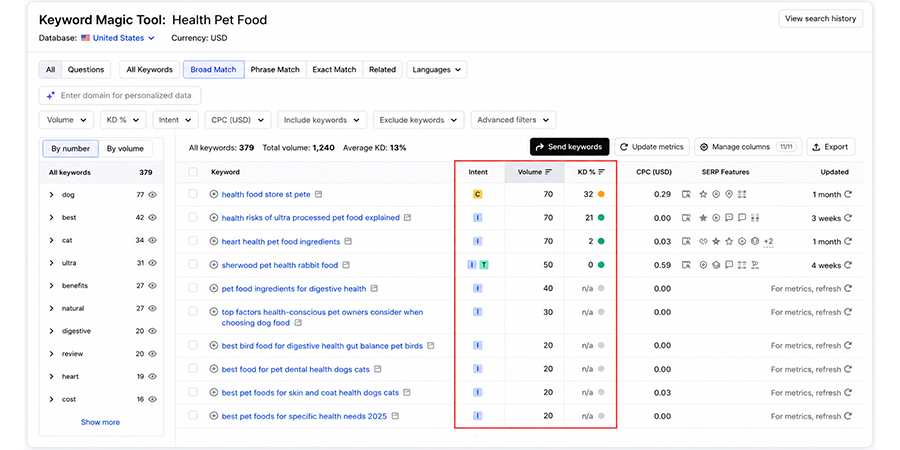
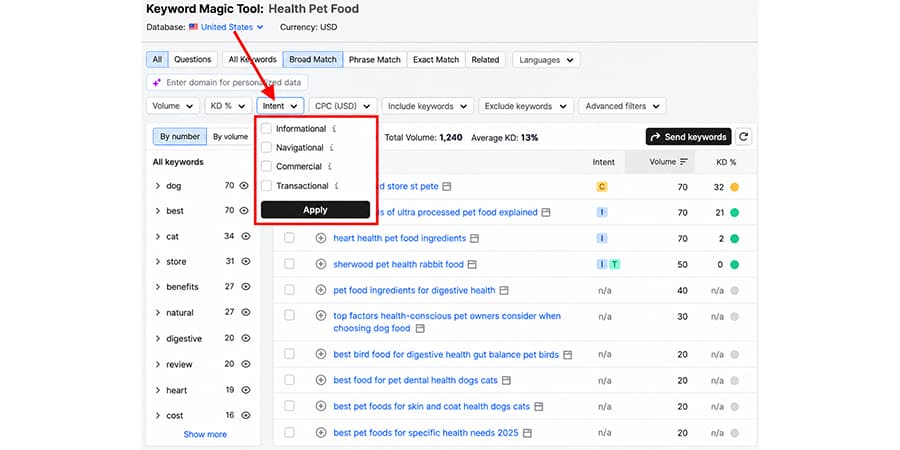
If you want to use a specific search intent while selecting keywords to optimize a particular page, you will be able to filter this list. It helps you discover keywords that can match the intent of your page.
- Examine SERP
When you analyze the SERP in-depth, it allows you to do the following important things:
- Check whether the top results align perfectly with the search intent of keywords.
- You need to confirm that your content is similar to the top results.
- Discover SERP feature opportunities.
If you rely on the competitiveness of the keyword, you may find the top search results don’t align perfectly with the topic and search intent. For instance, if you look for “healthy food for pets” and the results are related to the actual benefits of healthy food for pets. This gives you an actual opportunity to publish more relevant content to gain a chance to outrank competitors in the SERP results.
Whether it’s local packs, featured snippets, or knowledge panels, they are often featured on search result pages of Google. They also intend to have improved click-through rates and offer unique opportunities to rank on the first page of the website.
While performing your SERP analysis, you will be able to easily identify a featured snippet that doesn’t align perfectly with the target keyword. You need to create a dedicated section in your blog or other form of content to answer those questions. This maximizes your chance to appear in the featured snippet and rank at the top of the page.
- Determine the Search Intent
So, you already found those keywords that might be crucial for you. It’s vital to check their SERPs and then find out whether they are apt for your website or not. The importance of keywords can also be determined with the help of the search intent behind these keywords.
Some of these keywords may appear to be topically relevant, but they can’t be relevant in terms of search intent when users type them into Google Search. As far as search intent is concerned, it can be divided into the following important categories:
- Navigational Intent: It reflects that users often look for a specific brand or website
- Informational Intent: It indicates users search for information regarding something
- Transactional Intent: Users seek to buy some products and services
- Commercial Intent: It reflects users seeking to research a product first before they purchase it.
While doing a brief SERP analysis, it allows you to uncover search intent even behind the keyword. Therefore, you can easily decide whether any specific query is relevant for you or not.
For instance, if you have a blog website related to “healthy pet food”, you want to create an informational blog related to the best pet food selection guide to help readers buy the right product.
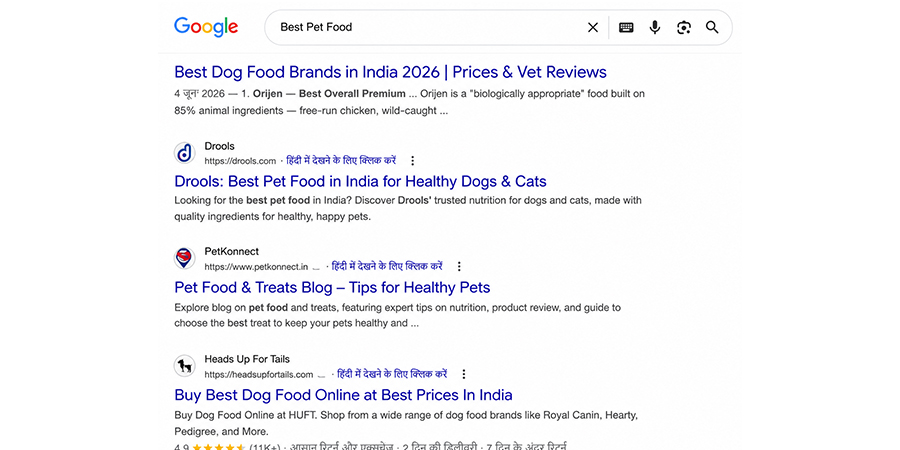
In the above result, you can easily see that the keyword is the best fit for both informational and transactional purposes. So, it’s the best fit for your blog.
Apart from the search intent behind every keyword, you should also focus on the actual type of content that ranks at the top of the SERP. Though you can easily find those keywords that match your search intent for your pages, the displayed content may indeed be different from the one you offer.
- Assess Your SERP Competitors
Your next step is to check those websites that already rank in the search results and determine how tough it would be to beat them. If you want to perform a thorough competitive analysis, you can leverage the right tool for this purpose to do it conveniently.
Some of the popular tools SERP analysis for analyzing competitors are as follows:
- SEMrush
- Ahrefs
- SE Ranking
- SpyFu
By using any of these tools, you will be able to analyze your competitors and thus also gather various important information below:
- Domain Authority
- Keyword Difficulty
- Page Authority
- Citation Flow
- Trust Flow
- Number of External Backlinks
- Link Profile Strength of Every Ranking Page
- Average CTR
Once you gather the above metrics, you can compare them with your website’s metrics. It gives you a complete picture of the difficulty of gaining the top position on the SERP.
Now, again, we will take an example of the keyword “Healthy Pet Food”. This keyword has a search volume of approximately 590 per month with keyword difficulty of 69%.
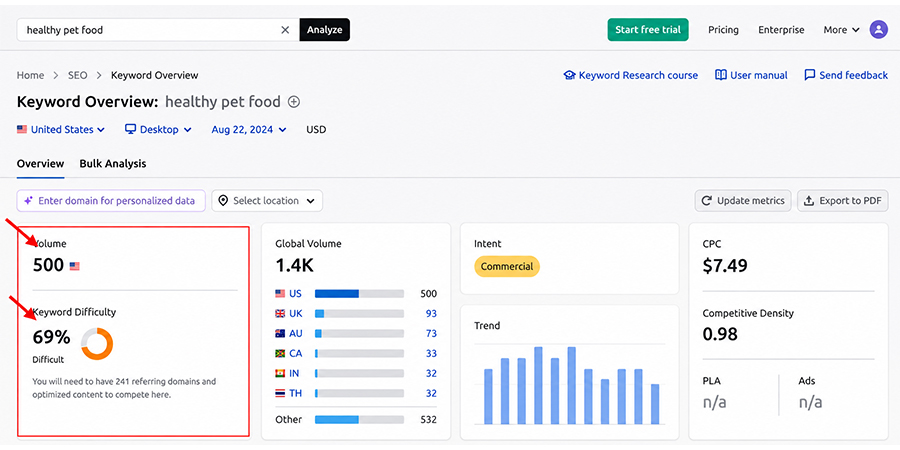
This reflects that the keyword is, of course, best for your website to rank if you sell the same product. But it’s really hard to rank with this keyword in search engines due to its higher keyword difficulty. Besides, the website that already secured its position is on the SERP with these keywords and has enough backlinks and domain authority (DA).
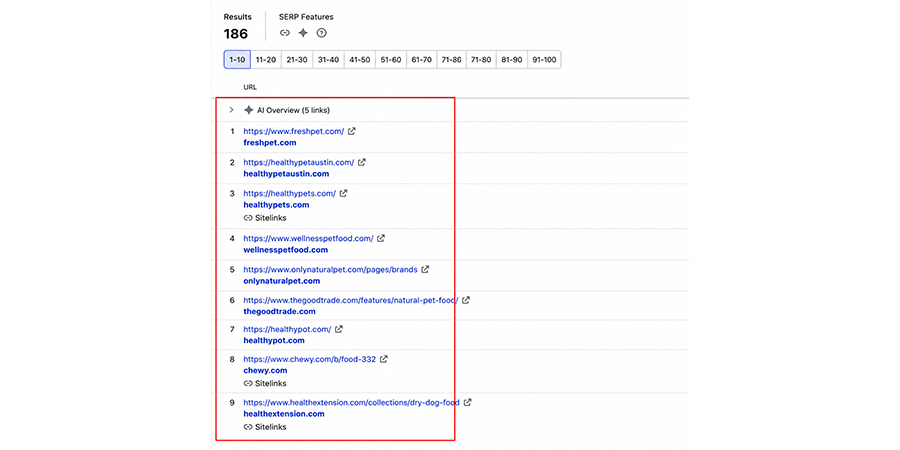
- Discover Opportunities to Appear in SERPs
A thorough SERP analysis gives you a wonderful opportunity to secure your position at the top of the SERP and thus can outrank your competitors fast. Aside from organic search outcomes, SERP may also include paid ads and several SERP features that you can go through during such analysis and thus can use to your advantage.
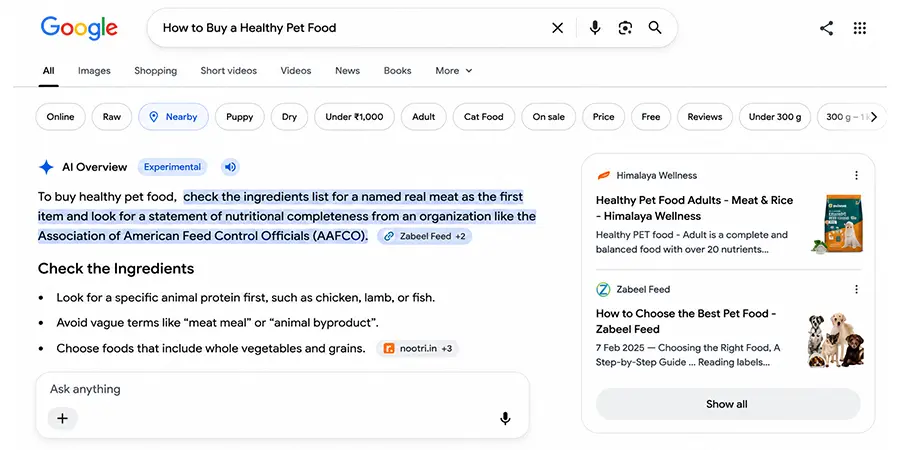
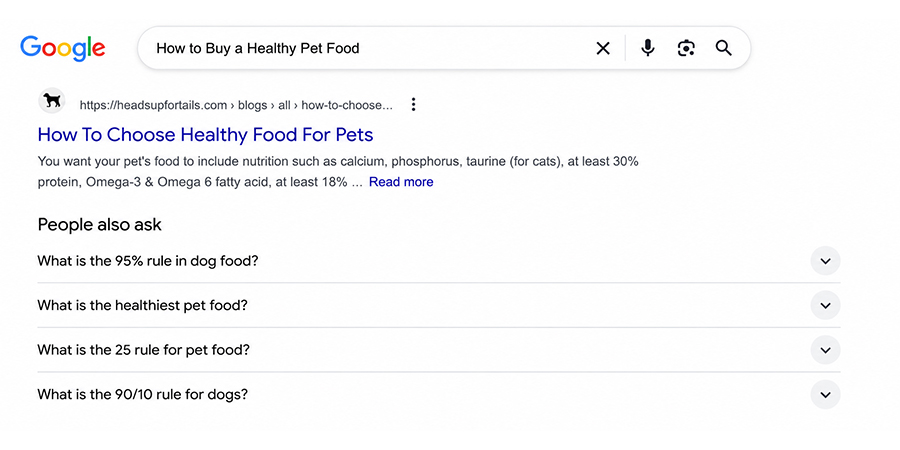
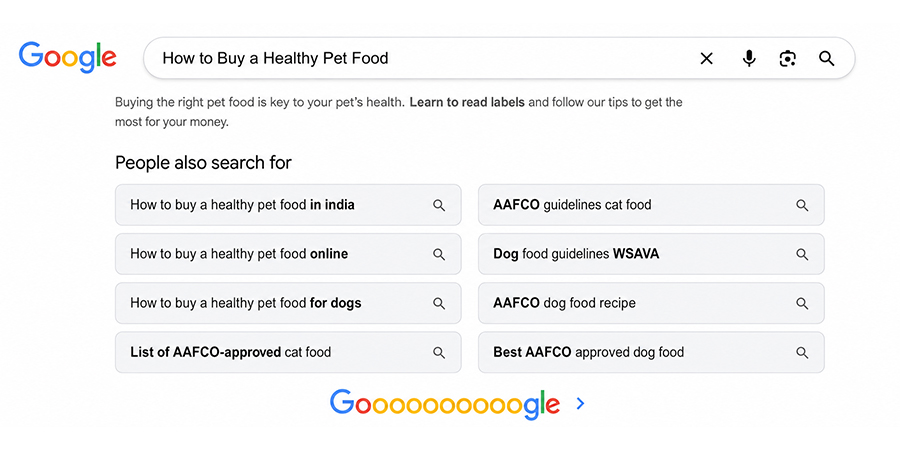
With SERP features like People Also Ask, Featured Snippets, or any Related Searches, you will get some important ideas related to what people search for. And you can use the same for optimization purposes as well. It enables you to rank on the SERP faster.
For instance, when we search for “How to Buy a Healthy Pet Food”, it not only highlights organic search results but also other sections like People Also Ask and Featured Snippets.
- Use Your Findings to Create an Action Plan
So, now you have already completed the process of SERP analysis — it’s crucial to sketch out a strategy to get ahead of your competitors in terms of ranking. If your competitors have a higher DA, your first task is to create backlinks for your website.
Moreover, if your competitor has eye-catching content, you should do on-page optimization better. Your search engine result analysis will help you to find even those areas that you need to work on properly to gain a position on the first page.
Therefore, you need to use everything you found from your analysis properly to create the best action plan that yields impressive outcomes. The following are the ways you can use your data from the search engine result page analysis in your overall SEO strategy:
- Optimize your content for SERP features
- Focus on SERPs your website has the ability to rank for
- Replicate competitors’ backlinks.
- Use Structured data
- Analyze your competitor’s content and craft the right one.
- Improve your meta description, title tag, URL, and other important HTML tags.
- Look at the People Also Ask section and Related Searches to gather more content ideas.
- Track SERPs
Of course, SERP analysis is important, but it’s equally important to track it to know what you rank for and gather some vital details. You need to take into account that changes in SERPs often take place over time, be it a change in the ranking position of your pages, a change in the search intent for the SERP, or the appearance of SERP features.
To keep an eye on these changes, you need to use the right tool that keeps you informed about any changes over time. The tool lets you check the performance of pages for any specific keywords and thus how they perform in SERP with the time.
With the tool, you will be able to gather the following crucial details:
- The actual ranking position of your website page for a specific keyword
- The complete performance of your website for the selected keywords
- Change in rankings over time in the SERP.
- The appearance of your web page in the featured snippet form.
What Are Important Tools for SERP Analysis
There’s no denying that SERP analysis can be done manually. But leveraging the right tools for this purpose is indeed faster and also more accurate. These tools gather vast data, including keyword difficulty, rankings, SERP features, backlinks, etc. Let’s explore some of these tools as follows:
- Ahrefs SERP Checker
As one of the top-rated tools for SEO professionals, Ahrefs is a leading tool that reflects your top-ranking pages for any keyword. It also includes important metrics such as estimated traffic, referring domains, word count, etc.
With this tool, you will be able to compare your various competing pages side by side. It allows you to spot patterns in terms of what works.
- Semrush SERP Checker
SEMrush provides a similar feature that gives you a complete breakdown of the overall search outcomes for any important keyword. You gain important insights into search volume, keyword difficulty, SERP features present, etc., including image packs or featured snippets. It’s indeed quite useful to analyze how SERP changes over time. This also helps you to know the ranking trends instead of only a single snapshot.
- Google Search Console
Being a free-to-use tool from none other than a leading search engine, Google Search Console is a necessary tool for every important website. Though it doesn’t reflect competitor data, it offers you an accurate insight into how your own page performs, including average position, clicks, impressions, and more. Combining this with competitor tools lets you have a fuller picture of your SERP standing.
- Moz
Moz also comes with a SERP analysis tool that is best for beginners. It makes them a great starting point even for small business owners who are completely new to SEO. It reflects domain authority, page authority, and many other ranking factors for competing pages.
- AccuRanker
When it comes to AccuRanker, it’s built specifically to analyze rankings. The tool updates the ranking of your website regularly and thus lets you monitor closely how your ranking position shifts when introducing SEO changes. It also reflects SERP features tied mainly to every important keyword.
Common SERP Analysis Mistakes to Avoid
Search engine result page analysis offers more advantages and thus helps you know how they perform well. But even a single mistake deprives you of getting these advantages as well. We have discussed some of these mistakes as follows:
- Copying Competitors
A large number of people often look at high-ranking pages and just replicate them. They copy everything properly, be it headings, structure, or even their ideas word for word. But you need to understand that copying them doesn’t help you outrank them in any way. You need to understand that Google prefers only useful and original content rather than any duplicate.
Solution: You can use your competitor’s page only for inspiration. Go through in-depth what they already covered and find more techniques to add value in terms of updated data, better examples, or even answers to those questions they already missed.
- Avoiding Search Intent
Most businesses just focus on keyword volume, and they don’t focus on what users search for. If you create content that is not based on the search intent, it will definitely not rank in search engines. For instance, you write a product page for a keyword where people wish an informational content.
Solution: You need to first check what users actually want when they search for any keywords. It’s a great idea to analyze top-ranking results to know whether the search intent is commercial, informational, transactional, or navigational. You can then create content that directly matches that intent.
- Focusing Just on Keyword Difficulty
When it comes to keyword difficulty scores, it’s indeed quite useful. But when you rely only on this, it could be misleading as well. A keyword may reflect “less difficulty” yet still be complex to rank mainly because of powerful domain authority among competitors, or it may reflect “high difficulty” but also be easy to beat.
Solution: You need to combine keyword difficulty with a manual look at the actual SERP. Make sure you check content backlinks, quality, domain strength, etc., of the pages ranked there.
- Avoiding SERP Features
Businesses often focus on the standard blue links and also avoid SERP features completely, including People Also Ask, featured snippets, or image packs. This clearly indicates missing the major visibility spots that often get higher clicks compared to regular listings.
Solution: You can also check important SERP features that appear in your target keyword. And you can craft your content to have a great shot at capturing them.
- Ignoring Device and Location
One thing you need to understand is that SERP analysis varies based on location and devices. Rankings tend to differ between desktop and mobile, or also between different countries and cities.
Solution: You can analyze rankings across multiple devices. When you serve a local audience, you should analyze the SERP form completely from a specific location instead of depending on generic outcomes.
Why Should You Hire a Professional for SERP Analysis?
SERP analysis is not as simple as taking a look at search results exclusively. In fact, it requires a perfect interpretation of data and turns it into an actual strategy. And this is where you need the assistance of professional SEO services.
They are aware of how to explore different lines of competitor gaps, ranking patterns, search intent, etc. They also prevent you from costly guesswork. The following are some other advantages you could expect from a professional service provider:
- Accurate insights with premium tools
- Avoid the learning curve and save time.
- Build content strategy based on data.
- Avoid those mistakes that hurt rankings.
- Stay updated with changing SERP features.
FAQs
Ans. Yes, SERP analysis changes for different search engines. Google focuses on featured snippets, E-E-A-T, and AI Overviews. On the other hand, Bing mainly emphasizes multimedia and social signals.
Ans. Search Engine Result Pages analysis reveals the type of content actually. It gives you detailed information regarding content in terms of depth, format, gaps, intent, etc. This helps you plan your content accordingly, based on search intent and missing angles.
Ans. Yes, SERP boosts click-through rates by letting you analyze what searchers actually click on in terms of snippets, titles, and format rankings. Analyzing these helps you make a compelling meta description and match search intent. Target featured snippets, etc. These are crucial to boost click-through rate directly.
Ans. Well, Search Engine Result Pages analysis is basically an in-depth, one-time review of search results to understand competitors and ranking factors. SERP monitoring involves ongoing tracking of various ranking changes over time to discover shifts and trends.
Ans. Yes, Search Engine Result Pages analysis is useful for an eCommerce website for various reasons, such as identifying keyword opportunities, understanding competitor rankings, optimizing product listings, etc. These are necessary to improve website visibility and increase the conversion rate.
Ans. Well, Search Engine Result Pages analysis offers detailed insights into competitor strength, ranking difficulty, search intent for target keywords, content gaps, etc. It helps you focus your resources on various high-impact and achievable opportunities first, instead of wasting effort.
Conclusion
With a thorough SERP analysis, you get complete information regarding things that are necessary to earn visibility for a keyword. Whether you wish to check ranking patterns, SERP features, content formats, content gaps, or competitors, you will gather every crucial element through this analysis.
You can use these insights to chalk out a practical strategy to attract relevant traffic, enhance visibility, and support long-term growth. Partnering with a leading SEO company helps you do it in the most effective way.

