





The emergence of AI Overviews and many other changes in online searches heavily impact how users interact with search results. And it makes future organic traffic quite tough to predict. This prompts businesses to look even beyond rankings and analyze changes in CTR, search demand, competition, etc., and their impact on future performance. SEO forecasting helps them do it hassle-free.
It helps them project everything, whether its keyword rankings, search traffic, conversion, or visibility. With forecasting, they can discover potential opportunities, set a realistic objective, allocate their resources according to the expected outcomes. In this guide, we’ll explain how search engine optimization forecasting works.
What is SEO Forecasting?
SEO forecasting is a process of predicting and estimating the future organic search performance of a website. It’s done using current SEO metrics, historical data, expected changes, search trends, etc. It works effectively in projecting potential results like keyword rankings, organic traffic, search visibility, conversions, etc., over a particular time period.
It also helps you make a well-informed decision in terms of how to optimize your website better for search engine results pages (SERPs). For instance, if you observe that your website loses traffic caused by changes in the SERPs. you can do SEO forecasting to discover the potential issues that create this problem. After doing it successfully, you can improve the visibility of your website.
Why SEO Forecasting Is Important for Any Businesses
Since SEO is an ongoing process and thus a long-term investment, only a few businesses spend on it without getting details of what to expect in return. Forecasting helps in converting organic search into the right strategy. We have discussed below some other reasons why SEO forecasting is crucial:
- Help Focus on High-Impact Work
SEO forecasting helps teams in discovering potential growth opportunities and focus on important areas where there are maximum chances of gaining more visibility and thus traffic. It prevents them from spreading resources across a range of tasks. Instead, they can focus those activities according to their potential to boost rankings, traffic, and conversions.
For instance, when a team updates any page that ranks for high-intent keywords on the first page, it can generate more leads, conversions, and revenue than creating a newer one. Forecasting helps teams determine the potential outcomes of multiple SEO activities and thus focus their effort, time, and budget on other tasks aligned with their core business objectives.
- Build Reliability and Justify Budget
SEO forecasting performed based on keyword demand, past data, realistic ranking improvements, etc., helps businesses get a complete idea in terms of investment returns. It also helps them know when they can expect the results. This is something that contributes effectively to making budget discussions easy and fast.
So, rather than asking for money based on assumptions, you can highlight leads, expedited traffic, revenue, and then you will be able to compare them with costs. Comparing forecasts with actual outcomes helps in building more trust and credibility over time. It also reflects that your predictions are based on data.
- Improve Your Sales Pitches
SEO forecasting helps businesses highlight the potential value of their search engine optimization services during sales pitches. It lets them demonstrate estimated organic traffic growth, conversion potential, potential revenue gains, and more. This helps them show their potential clients how their strategy can contribute to the client’s business goals.
With this demonstration, clients have a genuine reason to invest in SEO services. For instance, if an agency approaches an eCommerce service provider with SEO services, they need to estimate how improved rankings for high-intent keywords can maximize visitors and sales. Though these figures don’t ensure guaranteed results, they help clients understand potential ROI.
- Resourcing and Internal Planning
With SEO forecasting, teams can do several tasks smoothly, whether it’s assigning responsibilities, budget planning, or deciding when they require additional resources to achieve their major objectives. It enables businesses to estimate future workloads and the timing of high search demand. Based on this, they decide when to approach SEO specialists, content writers, developers, and many other professionals.
It also helps SEO align better with many other departments, including sales, products, and finance. Sales departments plan for lead growth, financial models revenue, and product teams launch based on demand with higher confidence.
- Boost Client Retention
When it comes to SEO results, they often take months to yield major improvements, which tends to make clients unsure about the exact value of their investment. But SEO forecasting addresses these concerns through realistic performance expectations and by determining clear milestones for rankings, traffic, and conversions. Clients can consider these factors to know what the SEO strategy focuses on achieving.
It’s necessary for an agency to compare actual outcomes with predicted results, enabling them to describe performance changes and adjust their strategies when required. For instance, if organic traffic increases at a slower pace than expected, the agency needs to identify responsible factors and define certain corrective measures.
Types of SEO Forecasting
SEO forecasting is not done through a single method. It’s done through several ways depending on your core objectives, be it demand, visibility, content results, AI search presence, ranking, or revenue. Some of the most popular types of this forecasting are as follows:
- SEO Visibility Forecasting
This forecasting is useful to determine the overall search visibility your website gains over time. It looks at the share of impressions and clicks your website gets for the targeted keywords and also how the share can increase as you boost links, content, and technical health. It allows you to track the overall growth, and thus you can capture the progress easily with your competitors.
- Search-Demand Forecasting
Search-demand forecasting helps you forecast the actual interest in any topic that tends to rise or fall. Whether it’s industry trends, seasonality, or emerging queries, they all determine the demand.
It also helps you know how to publish your content before peaks arrive rather than later on. We can take an example here: a tax software brand often plans its content before filing season arrives.
- Keyword Ranking Forecasting
Keyword forecasting is the process of identifying keywords that are likely to attract higher search volume and generate more organic traffic in the future. It involves analyzing keyword difficulty, current rankings, backlink profiles, competitor performance, planned SEO improvements, and more. This helps in determining potential ranking changes.
We can take an example here: a page that ranks #12 for a specific keyword; forecasting helps determine whether it could reach the first page after proper optimization. This helps SEO professionals prioritize keywords, set realistic ranking objectives, plan optimization activities, etc. Meanwhile, actual positions vary due to factors like competition, algorithm updates, changes, etc., in search intent.
- Content Performance Forecasting
Content performance forecasting helps determine how existing content on a website works in search results. It also estimates how performance can go up or down over time. This is possible by analyzing several crucial metrics like impressions, keyword rankings, organic traffic, clicks, click-through rates, etc.
These factors help you determine which pages perform and which may require improvements. They help you get a clear understanding of the right topics that are best to focus on and also whether updating old posts is a better option than crafting the latest ones.
- AI Search Visibility Forecasting
The emergence of ChatGPT, AI Overviews, and many other chat-based answer engines have a lot of impact on how users search online. This new search engine estimates how frequently your brand is mentioned or cited in AI-generated answers.
Since AI results minimize clicks, SEO forecasting should involve both citations and traffic loss on those information queries. All you need to do is treat these projections cautiously since the data is still maturing.
- Conversion and Revenue Forecasting
This is an important stage where traffic becomes a business value. With the correct implementation of average order conversion rates or even a lead value to the projected traffic, you can often predict leads, sales, conversions, and revenue through organic search. It’s something that one needs to care about most since it ensures SEO connects directly to financial objectives.
Steps on How to Do a Practical SEO Forecast
Doing a practical SEO forecasting is something that involves multiple steps. We have discussed all those steps below. Let’s have a detailed look:
- Know What You Want to Forecast
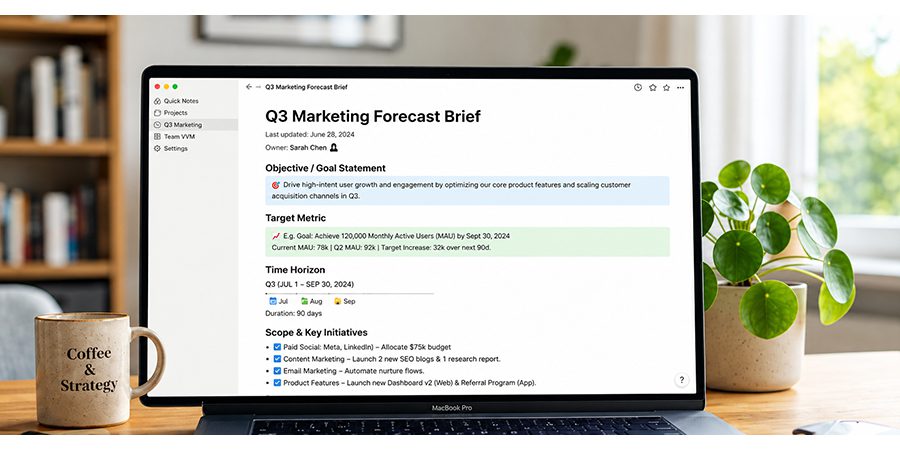
Before you build SEO forecasting, you should determine what you seek to predict and which keywords and pages the forecasting will include. You can select a measurable result, including non-branded traffic, monthly organic clicks, organic conversions, keyword rankings, etc.
More importantly, you should set a defined forecasting period, be it three months, six months, or even twelve months. It helps you gather important data and then make an effective comparison of future predictions against the actual outcomes.
To set your forecasting goal, you should ask the following questions:
- What are the numbers of additional non-branded organic clicks one can earn in the next 12 months?
- How much revenue will a content cluster produce with six months of publishing?
- What are the numbers of demo requests that your top products and comparison pages will generate by the end of a certain period?
All you need to do is note your goal in a single sentence and then agree on the same with your stakeholders before you create anything. Apart from this, you should also confirm your overall time horizon.
A three-month forecast is something that often relies on current rankings, whereas a 12-month forecast should consider content you have not crafted yet and also competitors who change the search landscape.
- Gather Historical Search Engine Optimization Data
One thing you need to understand is that your own performance history and the related data are the most valuable input in the model. You can gather at least 12 months of data or even more if you need it. This helps you observe the seasonality and also the actual impact of your past algorithm updates.
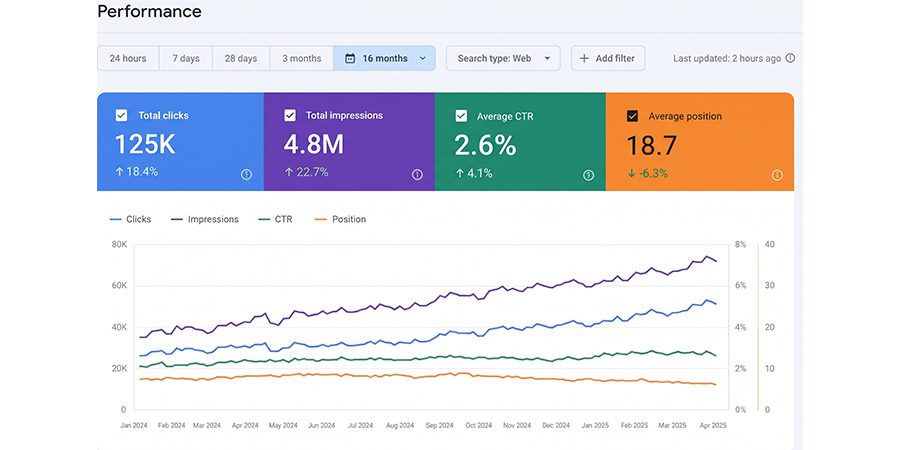
You can leverage Google Search Console to export impressions, clicks, average position, CTR, etc., by page and query. Besides, you can also leverage Google Analytics to export organic sessions, revenue, engagement, and conversions.
You can then add both your ranking history and keywords through a rank tracker, along with a complete record of important site changes, content launches, migrations, etc. It helps you understand any unusual changes later on.
You can start doing the same as early as possible since Search Console stores data for only 16 months. It’s a great practice to implement your data in a database or even Google Sheets on a monthly basis to create your long-term record. Teams that ignore this often face issues when they require yearly comparison, especially when they find their past data is no longer available.
- Create Your Current Baseline
Your current baseline is very important and appears as a “do nothing” scenario. It reflects the overall search traffic you can earn when you stop investing. It involves comparing all future forecasts against the same.
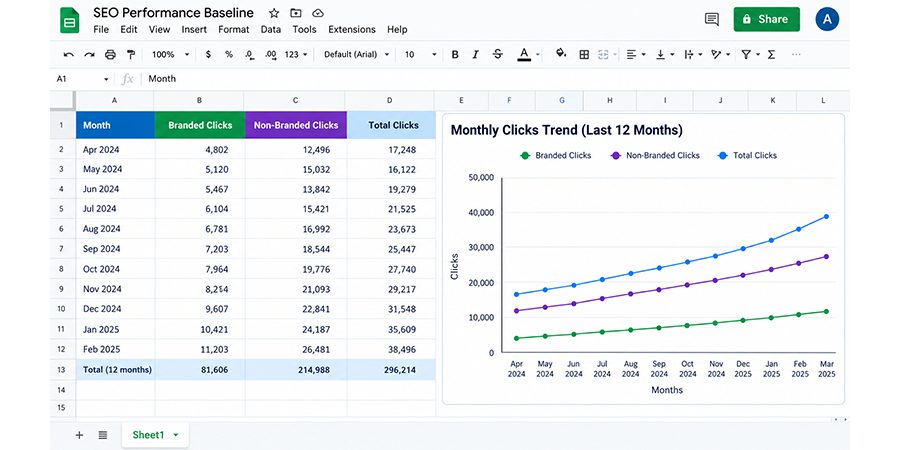
So, it should be highly accurate. You can start the entire process by getting the last 12 months of overall organic clicks. After this, you can separate your branded searches from those searches that are non-branded. The main reason is that they both perform differently.
When you combine both properly, it helps you predict your wrongly credited SEO efforts for growth that comes through brand awareness.
You should then take a look at unusual traffic spikes and seasonal changes as well. We can understand it through an example. Suppose a SaaS company generates 50,000 organic clicks on a monthly basis, and 28000 comes from non-branded searches.
It clearly means the non-branded baseline is 22,000 clicks. It indicates this is the traffic your SEO program can definitely increase. And it’s an important figure you will use to determine the actual progress.
- Discover Existing Ranking Opportunities
When it comes to discovering the existing ranking opportunities, you can do it in the easiest and fastest way through those keywords your website already ranks for. To do the same, you can go through the following steps:
- Filter your Search Console data.
- Check those queries that already rank between positions 4 and 20 with a high impression count.
- Update these pages as Google considers them more relevant.
- You can update your page by adding more internal links, improving the title, etc.
These are indeed some great steps that let your website rank in search engines with less effort rather than doing everything from scratch.
For every ranking opportunity, you should take note of the following crucial factors:
- Current position
- Monthly search volume
- Keyword difficulty
- Your pages compared with the top three results in backlinks and content depth.
- Understand Future Search Demand
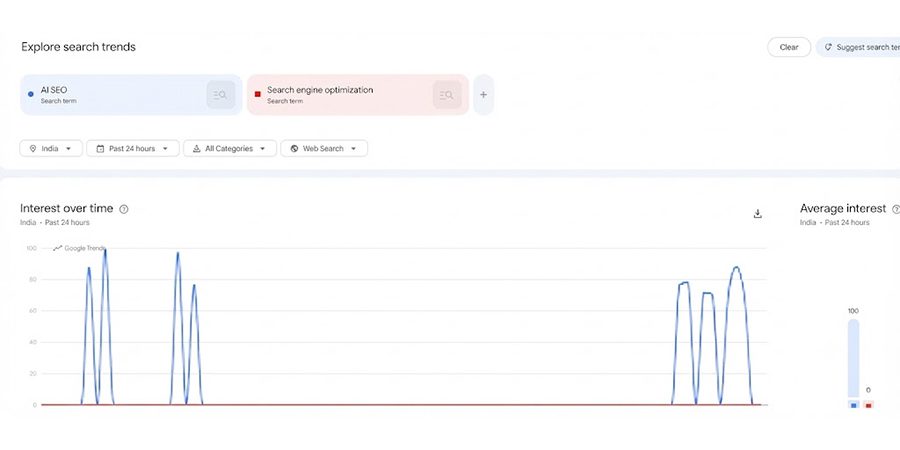
When your website ranks, it generates a lot of organic traffic from people who continue searching online for products and services. You can access Google Trends to check users’ interest in each topic. Gather complete information regarding whether their interest is stable, growing, falling, etc.
Besides, you can also make an effective comparison to differentiate the actual growth from seasonal spikes. You can also check the result trends in some popular tools such as Google Keyword Planner, SEMrush, Ahrefs, and others.
After this, you can craft a monthly seasonality index as well. For instance, when you notice January is 30% above a yearly average, and August is 20% below, you can then use these important figures in your prediction rather than assuming steady growth. It thus helps you avoid some common mistakes such as worrying about a normal summer drop.
The most important thing you can do is to check for emerging queries. Topics that gain vast momentum should be published as soon as possible since it helps you build authority before competition becomes fierce.
- Implement Realistic CTR Estimates
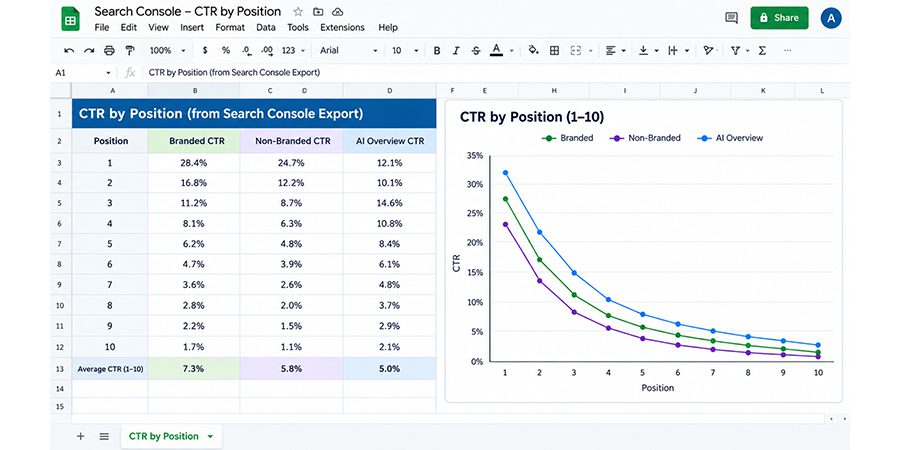
This is the step where the majority of SEO forecasting often becomes inaccurate. Many published CTRs highlight different outcomes. One review reveals that the first position gets approximately 19% and 39.8% of clicks.
This depends on the device, study, and presence of an AI Overview. So, when you use the highest figure, it makes your traffic estimates quite high.
Another report published by Ahrefs says that AI Overviews are linked to a 58% lower click-through rate for many top-ranking pages. The drop ranges from 50.8% at position 2 to 19.4% at position 10.
Since these studies reveal different outcomes, the right approach is to craft your complete CTR curves using Search Console. It’s also advisable to make a separate curve for both non-branded and branded queries without any AI Overviews.
- Keep Eyes on SERP Changes
The next step you can take is to track SERP changes continuously. Search engine results keep updating after every six months. Therefore, you should check the current results for all your targeted keywords.
You should check whether each result highlights featured snippets, AI Overview, video carousel, People Also Ask section, shopping results, ads, etc. Every important feature pushes organic listings down and minimizes the overall clicks they gain.
As far as AI Overviews are concerned, they are not visible across every search. According to research, they appear in 95% of overall comparison queries, 86% of question-related queries, and only 5% for transaction-related queries.
This reflects that it’s indeed quite risky to forecast traffic for the keyword “best enterprise management software” compared to “enterprise management software cost”
Apart from this, zero-click also keeps a great relevance. According to research, approximately 68.01% of Google searches in the US ended even without a single click.
This necessitates minimizing the value of informational keywords and then focusing on your prediction of commercial queries where most of the clicks are more likely to take place. You can review the data quarterly and then check whether your website appears in AI searches or not.
- Turn Traffic Forecast into Results
Traffic can be useful for any business only when it converts into leads and revenue. All you need to do is implement a simple formula as follows:
Forecasted revenue = Projected clicks × conversion rate × average deal value
We will simplify this with an example. Assume that the ranking improvement of your website brings more than 6,000 non-branded clicks on a monthly basis. So, if an organic visitor begins a trial at 2.5%, it generates 150 trials.
If 20% convert to paying customers at $600 yearly, you gain an overall 30 customers and $18,000 in annual recurring revenue for every month at the traffic level.
You should gather information regarding conversion rates through Google Analytics 4. It helps you analyze landing page type, comparison-page visitors, blog readers, pricing-page visitors, etc.
After this, you can build some important scenarios like expected, conservative, and optimistic. Highlighting a range and also listing your assumptions along with the same indeed builds huge trust with leaders and finance teams compared to providing only one confident number.
- Check Actual Performance Against SEO Forecast
SEO forecasting can deliver you an actual value only if you continue testing it. On a monthly basis, you should compare rankings, actual clicks, conversions, and revenue against the overall projection. Besides, you also need to calculate the actual variance as a percentage.
Once you do it successfully, you should then investigate the actual cause. You should get the answer to the following questions?
- Does any important update change the SERPs?
- Is there any competitor that publishes strong content?
- Have you found your own content ship late?
Every important answer is useful to improve the model. All you need to do is update your CTR curves, ranking estimates, seasonal trends, and more.
Most Popular SEO Forecasting Tools
While searching, you will come across many SEO forecasting tools. But selecting the right one is highly important to make the overall forecasting process quick and accurate. Go through the following tools to select the best for your project:
- Google Analytics
As one of the most sought-after tools, Google Analytics 4 highlights everything that takes place once visitors land on your website. It helps you analyze the overall organic traffic over several months and discover many seasonal patterns that can shape your projections better. When you combine this tool with your conversion data, it lets you convert your traffic estimation into quality leads and thus revenue as well.
Features:
- Organic traffic data analysis
- Traffic acquisition analysis
- Track landing page performance
- Track engagement metrics
- Google Search Console
Google Search Console is considered to be the most trusted source of first-party search data as it comes directly through Google. It highlights the actual performance of your web pages in search, including queries that bring more clicks and impressions. This makes it a perfect baseline before you forecast future growth.
Features:
- Check Page-level performance
- Query-level data
- Data comparison
- Search appearance
- SEMRush
SEMrush is popular as an all-in-one platform that performs well in highly competitive SEO forecasting and also keyword planning. With proper use of this tool, you can analyze the performance of your competitors and thus determine the actual traffic your website can generate. It delivers reports that make it convenient to present projections to both stakeholders and clients.
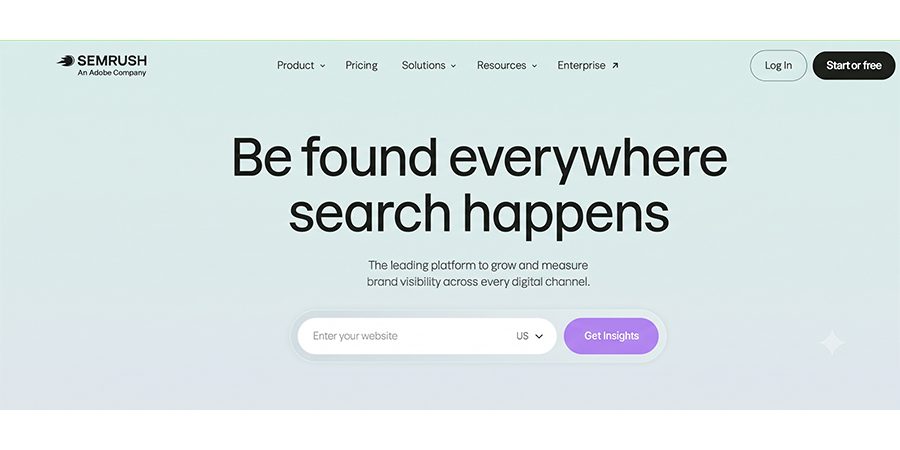
Features:
- Keyword research
- Competitor analysis
- Position tracking
- Keyword gap analysis
- Ahrefs
Ahrefs is another SEO forecasting tool, which is well-known for its vast backlink base and large keyword database. It helps you decide on strategies that enable you to improve the search engine ranking of your website. It provides you with complete details about strategies of high-ranking pages to earn their position. This is useful when you actually analyze your competitive keywords where links matter a lot.

Features:
- Keyword search volume forecasting
- Competitor analysis
- SERP analysis
- Keyword clustering
- Google Sheet
Google Sheets is another tool for SEO forecasting where most predictions actually come together. The actual reason is that it helps you combine data from different tools. It allows you to create custom models with click-through rate curves and growth assumptions. Besides, it comes with sharing features as well, which makes it simple to analyze the prediction with your clients or even your team.
Features:
- Historical data analysis
- Data validation and dropdowns
- Charts and visualization
- Scenario planning
Some Common SEO Forecasting Mistakes You Should Always Avoid
In SEO Forecasting, you’re trying to predict your websites’s future traffic based on past performance, however we can’t be sure if the estimates are gonna work. With the rise of AI Overviews, zero-click behaviour and LLM models, the figures have become even harder to read. Here are some common mistakes specialists make when forecasting SEO that you should avoid:
- Using Just Search Volume
Search volume is just a reflection of the number of people actually looking for a keyword rather than how many users will click your page. Even if you use a high-volume keyword, it indeed delivers far less traffic than expected. Features such as AI Overviews, ads, featured snippets, etc., tend to absorb clicks. So, when you focus only on search volume, it causes inflated projections.
Solution: You should always combine this with search intent, SERP features, and expected click-through rate. It’s better to use Search Console data to reflect how similar queries perform on your website.
- Avoiding Seasonality
It’s indeed true that a large number of industries have clear dips and peaks. So, if you predict growth in a straight line, you may be able to promise traffic in a slow month or even panic over a normal seasonal drop. That’s the reason why the SEO forecasting often looks inaccurate when your search engine optimization works.
Solution: You should analyze at least two, or in fact three, years of historical data wherever possible and also leverage Google Trends with Analytics to check seasonal patterns. All you need to do is build a monthly adjustment into your model instead of only using an average growth rate.
- Applying Just One CTR for all Keywords
When you use just a single click-through rate for every important keyword, it is indeed convenient but at the same time unrealistic as well. Whether it’s informational searches, branded queries, or commercial searches, they generate different result pages, and CTRs with ads or snippets change the number further.
Solution: You should perform keyword segmentation based on type, including non-branded, branded, transactional, and informational. It’s necessary to assign a CTR curve to every group.
- Not Focusing on Competitors
If your SEO forecasting focuses only on your own website, you assume the rest of the market stands still. In the actual scenario, competitors often publish content, improve their pages, and thus earn links. This makes a projected ranking gain quite tough to achieve.
Solution: You should do in-depth competitor analysis while determining future rankings. You should analyze their backlink profiles of pages that currently rank for specific keywords, compare content quality and authority with your own pages, and track rankings over time. You can consider these factors to improve your website rankings.
- Using Outdated Data
One thing you need to take into account is that search behavior, SERP layouts, and algorithms, etc., change with greater consistency. A forecast developed on stale rankings, old keyword volumes, last year’s CTR, etc., may no longer reflect reality, especially when a major algorithm update takes place.
Solution: You should always refresh your inputs before every forecast and then analyze the model on a monthly or even quarterly basis. You should always make an effective comparison of projected numbers with actual outcomes, and then you can adjust your assumptions accordingly.
FAQs
Ans: Well, for SEO forecasting, you need to use various types of data. These mainly include historical organic traffic, keyword search volume, rankings, seasonality, conversion rates, CTR, backlink data, competitor performance, analytics data, and Google Search Console. These help you predict your future search performance with higher accuracy.
Ans: You can present forecasting to stakeholders using realistic traffic projections, clear charts, potential revenue impact, expected rankings, risks, and assumptions. You should always focus on business results instead of technical metrics and then explain scenarios with the use of evidence-based and achievable estimates.
Ans: Not completely, the main reason is that forecasting helps in predicting future organic traffic based on search volume, historical performance data, CTR, keyword rankings, search trends, etc. Meanwhile, factors like changes in Google Algorithms, search behavior, AI Overviews, competition, etc., can impact actual outcomes. SEO forecasting can give realistic projection, but it can’t guarantee complete accuracy.
Ans: Well, one can do SEO forecasting on a monthly basis for routine performance tracking and also update quarterly for strategic planning. Meanwhile, it’s also important for businesses to revisit forecasts whenever major market changes, algorithm updates, seasonality shifts, or important ranking fluctuations take place.
Ans: SEO forecasting generally takes from hours to several days, which depends on the types of analysis you perform and also your major goal. You can perform basic analysis in an hour. Meanwhile, a comprehensive forecast can take several days as well.
Conclusion
SEO forecasting is the most useful approach when it comes to converting your organic search from guesswork into a complete plan you can defend. Once you are familiar with different forecasting types and leverage the right tools, you will be able to set a realistic objective and then justify your actual investment. You should always keep in mind that a forecast is a living estimate rather than a promise.
So, you should do it regularly, compare the results, and then improve your strategy accordingly. Partnering with a reliable SEO company helps you strategize your forecasting effectively by letting you achieve your core objective accordingly.

