



SEO for Software Companies is often overlooked, and that is where most businesses struggle. Leads are inconsistent. Paid ads feel expensive, and CAC keeps rising. The moment ads stop, traffic drops. Many websites get visitors, but they do not convert. Content fails to match what buyers are actually searching for. Technical SEO issues stay hidden. Meanwhile, competitors keep ranking for high-intent keywords and capture the best leads.
According to Google, helpful and trustworthy content is critical to rank and convert. But most SaaS brands focus only on product pages. They ignore search intent, content strategy, and authority signals.
In this informative guide, you will learn the overall seo strategy with proven steps and how to measure SEO performance with best tools. Let’s dig deeper and create a path to generating organic traffic and higher search engine rankings.
What Is SEO for Software Companies?
SEO for Software Companies is the process of improving a software website’s visibility on search engines like Google. It focuses on attracting users actively searching for software solutions. Search Engine Optimization helps software companies to generate qualified leads without relying only on ads. It aligns content with real search intent, not just keywords. It combines technical improvements, content strategy, and authority building. The goal is simple: bring the right visitors, convert them, and improve search engine rankings.
SEO works by optimizing how search engines crawl, index, and rank pages. It ensures your website appears for relevant, high-intent queries. For software companies, this means targeting users looking for solutions, tools, or services. It includes improving website speed, site audits, fixing technical errors, and structuring content properly. It also involves creating helpful content that answers user problems clearly. Strong SEO builds trust, authority, and long-term organic growth.
How Does SEO Help Software Companies to Generate Leads?
Successful SEO strategy helps software companies attract users already searching for solutions. It targets high-intent queries on Google. This increases the chances of converting visitors into qualified leads. Unlike ads, SEO delivers consistent and long-term traffic. It focuses on solving problems through valuable and intent-driven content.
Organic traffic is more sustainable than paid traffic for SaaS growth. Paid ads stop generating leads once the budget ends. SEO continues to bring traffic without ongoing spend. This makes it a strong strategy for SaaS lead generation and scalable growth.
- Organic Traffic vs Paid Traffic
- Organic traffic comes from search engines without direct advertising costs.
- Paid traffic requires continuous investment to maintain visibility and leads.
- Search Engine Optimization builds long-term authority and consistent inbound traffic.
- Paid ads deliver quick results but lack long-term sustainability.
- Lead Generation Funnel in SEO
SEO for software companies supports the full funnel using inbound marketing:
- TOFU (Top of Funnel – Awareness)
- Targets informational keywords users search while researching problems.
- Blog content educates users and builds initial trust.
- MOFU (Middle of Funnel – Consideration)
- Targets comparison and solution-based keywords.
- Guides users evaluating different software tools and options.
- BOFU (Bottom of Funnel – Decision)
- Targets high-intent keywords with buying signals.
- Landing pages convert users into leads, demos, or free trials.
- Role of SEO Elements in Lead Generation
- Content marketing drives organic traffic using problem-solving articles.
- Landing pages convert visitors with clear offers and strong CTAs.
- Conversion optimization improves user experience and increases sign-ups.
- Internal linking structure guides users towards high-converting pages.
How to Do Keyword Research for Software Companies?
In the software industry, keywords are the specific words and phrases that users type into search engines like Google to find tools, troubleshoot technical issues, or compare software providers. These range from broad terms like “CRM” to highly specific “long-tail” queries like “cloud-based CRM for healthcare startups.”
- Step-by-Step Keyword Research Guide
Step 1: Brainstorm Seed Keywords
Start with the core functions of your software. Think about:
- The Problem: “Automate project tracking.”
- The Category: “Project management software.”
- The Persona: “Tools for creative agencies.”
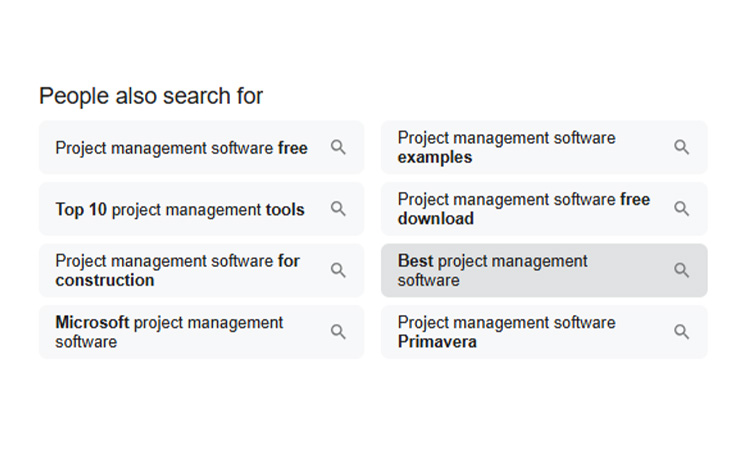
You can search on Google like this-
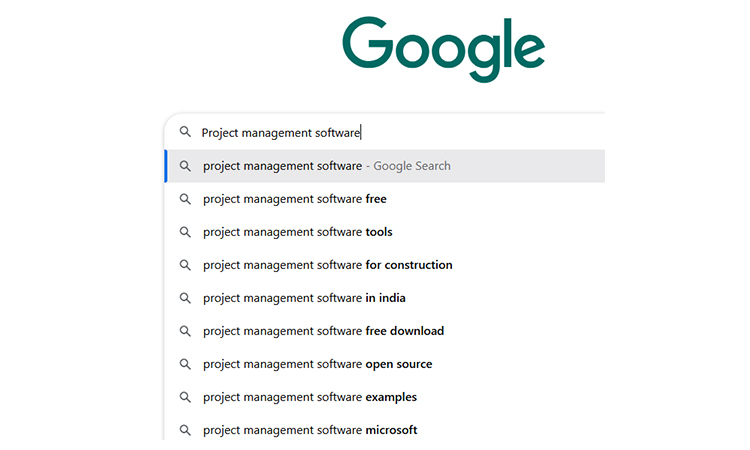
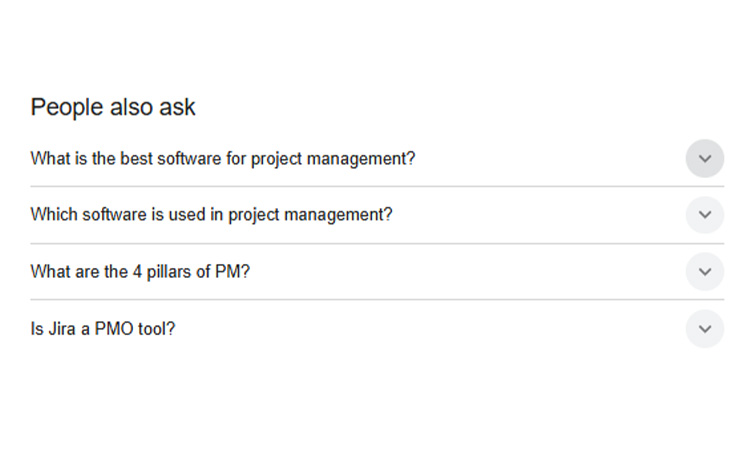
Then check the “People Also Ask” section. So that you can find out what the actual audience is looking for.
Step 2: Analyze Competitors
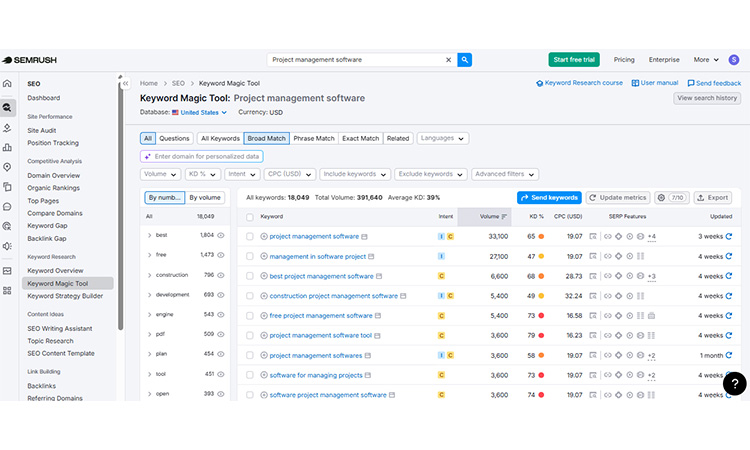
The best keyword research tools are Ahrefs, Semrush, and Google Keyword Planner. Here are simple steps to find keywords on Semrush:
Sign in to Semrush. And go to “Keyword Magic Tool.” Put main keywords in the search bar, and Semrush will provide a list of keywords-
- How to choose relevant keywords for a software development website?
| Metric | Definition | How to Choose the Best |
| Keyword Volume | Number of monthly searches for a keyword | Choose moderate volume keywords with clear intent. Avoid only high-volume keywords with low conversion intent. |
| Keyword Difficulty (KD) | How hard is it to rank for a keyword | Start with low to medium KD (10–40). Higher KD requires strong authority and backlinks. |
| CPC (Cost Per Click) | Actual cost advertisers pay per click | High CPC indicates strong commercial intent. Prioritize these for lead generation. |
| Search Intent | The purpose behind a search query | Choose keywords with commercial and transactional intent for better conversions. |
| SERP Features | Special results like snippets, FAQs, and ads | Target keywords with featured snippets and FAQs for SEO visibility. |
| Relevance | Match between the keyword and your service | Select keywords directly related to your software services and solutions. |
| Trend (Growth) | Keyword popularity over time | Choose growing keywords to capture future traffic opportunities. |
- What Are the Different Types of Search Intent in SaaS SEO for Software Companies?
For software companies, search intent = traffic quality + revenue growth.
Search intent is the reason behind a user’s search query. It explains what the user actually wants to find on Google. Its not just about keywords, but about the user’s goal, problem, or action.
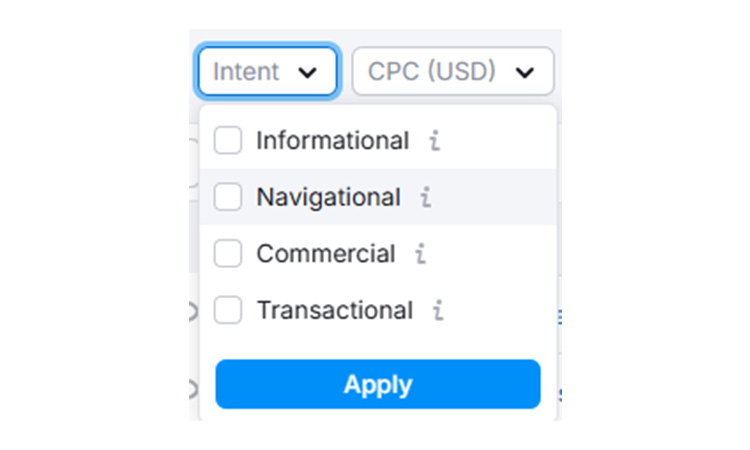
Every search falls into a specific intent type:
- Informational intent – user wants to learn something
- Commercial intent – user compares tools or services
- Transactional intent – user is ready to buy or take action
- Navigational intent – user searches for a specific brand or website
Step 3: Expand with Long-Tail Keywords
Long-tail keywords (3+ words) have lower search volume but much higher conversion rates.
- Broad: “Accounting software.”
- Long-Tail: “Small business accounting software with VAT integration.”
Step 4: Assess Search Intent
Before committing to a keyword, search for it yourself. Does Google show:
- Guides/Blogs? (Informational Intent – TOFU)
- Listicles/Comparisons? (Commercial Intent – MOFU)
- Pricing/Product Pages? (Transactional Intent – BOFU)
What is the Best SEO Strategy for Software Companies?
The effective SEO strategy for software companies is to combine keyword research, technical SEO, content marketing, and conversion optimization. Focus on search intent, create problem-solving content, and build authority with backlinks. This helps attract high-intent users and convert them into qualified leads on Google. In this segment, you will discover all proven seo strategies to improve your software development website:
- How to Optimize On-Page SEO for Software Companies?
Optimize on-page SEO for software companies by using target keywords in title tags, meta descriptions, and headers. Structure content clearly, match search intent, and add internal links to relevant pages. Improve readability, page speed, and user experience to rank higher on Google and increase conversions.
Most Important on-page Optimization Steps (Quick Checklist)
- Use target keyword in title, URL, and first paragraph
- Match content with search intent (informational or transactional)
- Optimize headings with semantic keywords
- Write clear, helpful, and user-focused content
- Add internal and external links to important pages
- Add image alt text as well as manage its size and quality
- Improve readability with short sentences and paragraphs
- Ensure mobile-friendly and fast-loading pages
- Meta Title Tags (with Target Keyword)
The meta title is the clickable headline shown in search results.
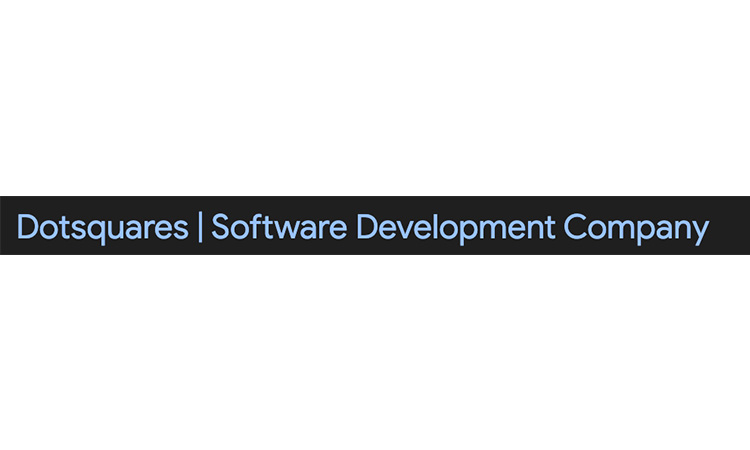
Best Example: Custom Software Development Company | Scalable Enterprise Solutions
Best Practices:
- Place primary keyword at the beginning
- Keep length between 50–60 characters
- Add power words like “Best”, “Guide”, “2026”
- Make it clear and benefit-driven
- Meta Descriptions
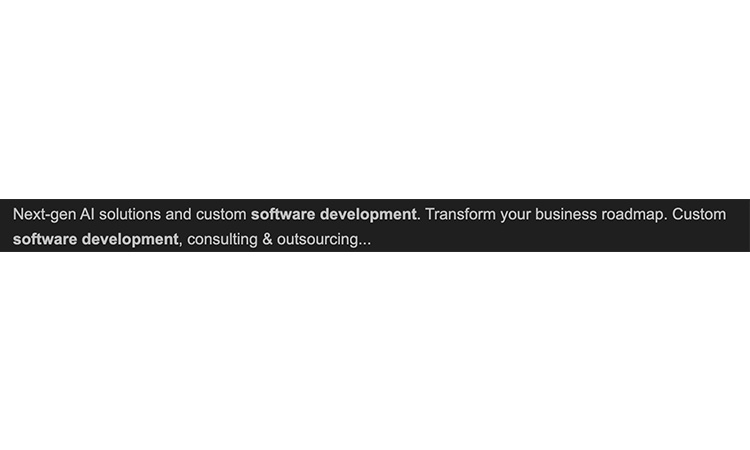
A summary of the page is shown below the title in search results. For software development company websites, the meta description acts as your organic ad copy. It doesn’t directly impact seo rankings, but it drastically improves your Click-Through Rate (CTR).
Best Example: Learn how SEO for software companies drives traffic and generates qualified leads with proven strategies.
Best Practices:
- Keep it within 150–160 characters
- Include target keyword naturally
- Add a clear benefit or CTA
- Write for clicks, not just keywords
- Header Tags (H1, H2, H3)
Headers structure your content and help search engines understand topics.
Best Example: H1: SEO for Software Companies; H2: How to Generate SaaS Leads; H3: Keyword Research Strategy
Best Practices:
- Use only one H1 per page
- Include keywords in H2 and H3 naturally
- Keep headings clear and descriptive
- Follow logical hierarchy (H1 → H2 → H3)
- Internal Linking Between Pages
Linking one page of your website to another relevant page.
Best Example: Link a blog on SaaS SEO strategy to a page on SEO services for software companies.
Best Practices:
- Use keyword-rich anchor text
- Link to high-converting pages (services, landing pages)
- Connect related blog posts (topic clusters)
- Avoid over-linking; keep it natural
- How Does Content Marketing Drive SaaS SEO Growth?
Content marketing is the strategic creation and distribution of valuable, relevant, and consistent assets, such as blogs, white papers, and videos, designed to attract and retain a clearly defined audience. For a software development company, it is not just about selling code; it is about solving technical problems for your clients before they ever hire you. Research indicates that companies with active blogs see 434% more indexed pages than those without, directly impacting their visibility in search engine results.
- Guide: Building Topical Authority through Content Marketing
To dominate search engine results, you must move away from random posting and adopt a Hub-and-Spoke (Pillar-Cluster) model.
| Strategy Component | Action for Software Companies |
| Pillar Page | Create a 3,000+ word “Ultimate Guide to [Core Service]” (e.g., Custom CRM Development). |
| Cluster Content | Write 10–15 smaller articles answering specific questions related to the pillar. |
| Internal Linking | Link every cluster article back to the pillar page to pass “link juice.” |
| Technical Health | Ensure high site speed so users don’t bounce before reading your expertise. |
- Best Topics for Targeted Audiences for the Software Development Industry
Choosing the right topic for the right “persona” ensures your seo tools show a positive ROI:
- For CTOs & Tech Leads (The Decision Makers)
- Topics: Legacy system modernization, microservices vs. monolith architecture, and “How to choose a software development company.”
- Goal: Build trust through technical depth and proof of concept.
- For Product Managers (The Problem Solvers)
- Topics: Agile sprint optimization, MVP development checklists, and UI/UX trends.
- Goal: Demonstrate that you understand their daily workflow and pain points.
- For Founders & CEOs (The Visionaries)
- Topics: The ROI of custom software, AI integration in business, and software outsourcing costs.
- Goal: Focus on business growth, cost-saving, and long-term scalability.
- Expert Tips for Software SEO
- Monitor Growth: Use Google Analytics to track which content pieces actually lead to “Request a Quote” conversions, not just traffic.
- Maintain Performance: Content with heavy images can slow down site speed; optimize all media to keep your seo rankings high.
- Use Data: Software companies have access to unique data, publishing “State of the Industry” reports to become a primary source for others.
- How to Optimize Off-Page SEO for Software Companies?
For software development companies, off-page SEO is about more than just backlinks. It is about digital reputation and trust. Because software services are high-cost and high-intent, Google prioritizes signals that prove your company is a recognized authority in the tech space.
- Digital PR & Original Data Reports
Journalists and tech bloggers are always looking for data. By publishing a “State of [Tech Stack] 2026” or “AI Adoption in Manufacturing” report, you become a citable source.
- Step: Survey your clients or analyze anonymized industry data.
- Goal: Earn high-authority editorial links from news sites and niche tech journals.
- Participation in Developer Communities
Engaging on platforms like Stack Overflow, GitHub, and Reddit doesn’t provide direct “dofollow” links, but it drives “social signals” and referral traffic that Google uses to verify your brand’s legitimacy.
- Strategic Guest Posting (The “Expert” Approach)
Backlinks are links from other websites pointing to your site. They act as trust signals for Google. High-quality backlinks improve rankings, authority, and organic traffic. For SEO for software companies, backlinks are a core part of a strong SEO strategy. You must contribute high-level technical insights to reputable platforms like HackerNoon, DZone, or TechCrunch.
- High-quality backlinks come from:
- Relevant IT and technology websites
- High-authority domains (real traffic, not spam)
- Contextual placements inside content
- Editorial mentions (not paid or spam links)
You should focus on quality over quantity for long-term results.
- Best Ways to Get Backlinks (Proven Methods)
- Digital PR & Media Mentions
Get featured on:
- Tech blogs
- SaaS publications
- Startup news sites
- SaaS Directories & Listings: Submit your product to:
- SaaS directories
- Software listing platforms
- Broken Link Building: It works well for IT and technology companies.
- Find broken links on tech blogs
- Replace them with your content
- Partnerships & Integrations
- Collaborate with other SaaS tools
- Get listed on partner pages
- HARO / Expert Quotes
- Share expert opinions on journalist platforms
- Get featured in high-authority articles
→ Most Important Backlink Strategy (Must Follow)
- Focus on relevance over domain metrics
- Build links from real IT and technology websites
- Use a content + outreach combined strategy
- Avoid spammy or low-quality backlinks
- Stay consistent for long-term SEO success
- How Does Technical SEO Impact Software Development Company Websites?
Technical SEO for software companies forms the backbone. Search engine bots need clean, fast, and well-structured sites to crawl and index content. Without a solid technical foundation, even the best content fails to reach the right audience. Tech companies that ignore technical SEO lose online visibility to better-optimized competitors.
Below, you will find every major technical SEO element, its definition, and clear steps to help your software company grow more qualified traffic.
- Mobile Optimization
Mobile-friendliness means your website works correctly on smartphones and tablets. Search engine algorithms now rank mobile-first, so a poor mobile experience hurts domain authority. Software development company websites often target decision-makers who browse on mobile devices.
Steps to Optimize:
- Use Google’s Mobile-Friendly Test to audit your site today.
- Switch to a responsive design framework like Bootstrap or Tailwind CSS.
- Set font sizes above 16px and keep buttons at least 44px tall.
- Remove Flash elements and replace them with HTML5 alternatives.
- Test every landing page on Android and iOS browsers regularly.
- Page Speed Optimization (Core Web Vitals)
Core Web Vitals measure loading speed, visual stability, and interactivity on your website. Google uses these metrics as direct ranking signals for technology companies. Poor scores push your SaaS pages down in search results and reduce more qualified traffic.
Steps to Optimize:
- Run a PageSpeed Insights audit to identify your biggest bottlenecks.
- Compress all images with tools like Squoosh or ShortPixel.
- Minify CSS, JavaScript, and HTML files across the entire site.
- Enable browser caching and use a content delivery network (CDN).
- Reduce server response time to below 200ms for all key pages.
- Track keyword rankings and page speed together to measure SEO impact.
- SSL Certificate (HTTPS)
An SSL certificate encrypts data between your server and the user’s browser. Google treats HTTPS as a ranking signal, and users trust secure sites more. SaaS and software company websites handle sensitive user data, so HTTPS is non-negotiable for credibility.
Steps to Optimize:
- Purchase or enable a free SSL certificate through Let’s Encrypt.
- Force HTTPS redirects for every page on your domain.
- Update all internal links to use HTTPS URLs consistently.
- Check your SSL expiry date and set up auto-renewal alerts.
- XML Sitemap Submission
An XML sitemap tells search engine bots which pages exist on your website. Software development company websites often have large product, feature, and blog sections. A proper sitemap helps search engines discover and index all valuable pages faster.
Steps to Optimize:
- Generate a sitemap with tools like Yoast SEO, Screaming Frog, or Sitebulb.
- Submit your sitemap directly in Google Search Console.
- Include only canonical, indexable URLs in the sitemap file.
- Update the sitemap automatically every time you publish new content.
- Robots.txt Optimization
The robots.txt file tells search engine bots which pages to crawl or skip. Incorrect robots.txt settings can accidentally block critical pages from search indexing. Many tech companies block staging environments but forget to update the file after launch.
Steps to Optimize:
- Audit your robots.txt file at your domain.com/robots.txt today.
- Block admin panels, login pages, and duplicate parameter URLs.
- Allow full crawl access to all core product and service pages.
- Test your rules inside Google Search Console’s robots.txt tester.
- Fixing Crawl Errors
Crawl errors occur when search engine bots cannot reach a page on your site. Unresolved crawl errors waste your crawl budget and reduce your overall online visibility. Software company websites with large documentation sections are especially vulnerable to these issues.
Steps to Optimize:
- Open Google Search Console and review the Coverage report weekly.
- Fix all server errors (5xx) by checking your hosting and server logs.
- Resolve soft 404 errors by either creating the page or removing the URL.
- Submit fixes for verification directly inside Search Console after each repair.
- Structured Data / Schema Markup
Schema markup adds extra context to your pages so search engines understand your content better. Rich results from schema markup increase click-through rates for software companies significantly. SaaS websites use schema to display ratings, pricing, and FAQs directly in search results.
Steps to Optimize:
- Add Organization, Software Application, and FAQ schema to key pages.
- Use Google’s Rich Results Test to validate every schema block.
- Implement schema through JSON-LD format for cleaner code management.
- Monitor rich result performance directly inside Google Search Console.
- Canonical Tags
A canonical tag tells search engines which version of a page is preferred. Software development company websites often generate duplicate URLs through filters, session IDs, or pagination. Without canonical tags, search engines split page authority across multiple duplicate URLs.
Steps to Optimize:
- Add a self-referencing canonical tag to every page on your site.
- Set canonicals across HTTPS vs HTTP and www vs non-www versions.
- Audit canonical tags with Screaming Frog during your monthly SEO review.
- Ensure your CMS does not override canonical tags with incorrect defaults.
- Avoiding Duplicate Content
Duplicate content refers to identical or near-identical content on multiple URLs. Search engines struggle to determine which version of duplicate content deserves to rank. Technology companies with large feature comparison pages often fall into duplicate content traps.
Steps to Optimize:
- Use Copyscape or Siteliner to detect internal duplicate content issues.
- Consolidate thin or duplicate pages into single, comprehensive resource pages.
- Set up parameter handling rules inside Google Search Console.
- Differentiate each product or service page with industry specific keywords and unique copy.
- Proper 301 Redirects and Handling 404s
A 301 redirect permanently moves traffic from an old URL to a new destination. Software companies that rebrand or restructure their sites need clean redirects to preserve SEO services value. Broken 404 pages destroy user experience and waste crawl budget on dead links.
Steps to Optimize:
- Map all old URLs to new destinations before any site migration.
- Implement 301 redirects at the server level, not through JavaScript.
- Create a custom 404 page with navigation links back to core sections.
- Audit redirect chains monthly and keep hops below two per redirect.
- Lazy Loading for Images and Videos
Lazy loading defers the load of off-screen images and videos until users scroll to them. This technique directly improves Core Web Vitals scores for software development company websites. Feature-heavy SaaS pages with multiple product screenshots benefit enormously from lazy loading.
Steps to Optimize:
- Add the loading=”lazy” attribute to all image and iframe elements.
- Use Intersection Observer API for custom lazy load on video embeds.
- Test lazy load behavior across Chrome, Firefox, and Safari after implementation.
- Verify that above-the-fold images do not use lazy loading to protect LCP scores.
- Clean Site Architecture and Breadcrumb Navigation
Site architecture refers to how you organize and link pages across your website. Search engine bots follow internal links to discover content, so flat site architecture matters. Breadcrumb navigation helps both users and search engines understand where a page sits within your site.
Steps to Optimize:
- Keep all core pages within three clicks from the homepage maximum.
- Create clear category structures for products, features, and resource sections.
- Add BreadcrumbList schema markup to all breadcrumb navigation elements.
- Audit internal links quarterly to remove orphan pages from your site structure.
How to Optimize Local SEO for Software Companies
Local SEO helps software companies attract nearby clients, partners, and talent. Many tech firms overlook local search, yet it drives highly targeted and more qualified traffic. A focused local SEO strategy increases trust and online visibility, and separates your business from competitors in the same city.
- Claim and Optimize Your Google Business Profile
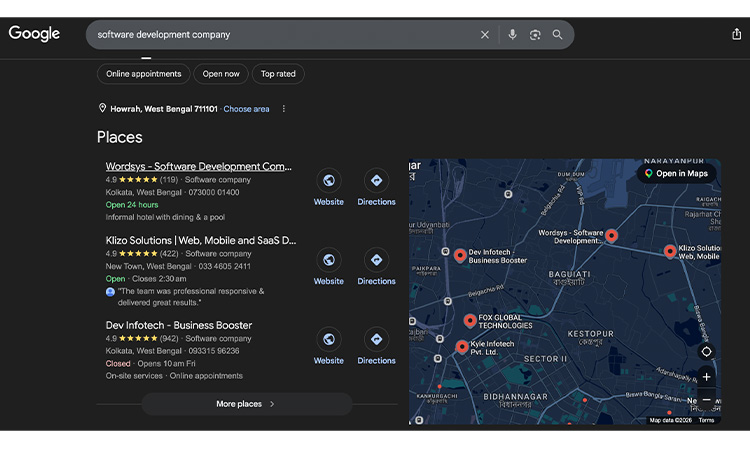
Your Google Business Profile serves as your most powerful local SEO asset. Search engines pull business details directly from this listing for local search results.
Steps to Optimize:
- Claim your profile at business.google.com and verify your address.
- Select the most accurate primary category, such as “Software Company.”
- Add your business hours, phone number, and website URL completely.
- Upload high-quality photos of your office, team, and product screenshots.
- Post weekly updates about new features, case studies, or company news.
- Build Consistent NAP Citations
NAP stands for Name, Address, and Phone number. Search engine algorithms check NAP consistency across every directory where your business appears.
Steps to Optimize:
- Audit existing citations with tools like BrightLocal or Moz Local.
- List your software company on directories like Clutch, G2, and Yelp.
- Keep your NAP format identical across every platform without exceptions.
- Remove or correct any outdated listings from old office locations immediately.
- Target Location-Based Keywords
Industry-specific keywords combined with city or region names drive local search intent directly. Software development company websites need dedicated location pages to capture this traffic.
Steps to Optimize:
- Research terms like “software development company in [city]” using Ahrefs or SEMrush.
- Create separate landing pages for each city or region your company serves.
- Add location keywords naturally into page titles, headers, and meta descriptions.
- Avoid keyword stuffing and focus on content that answers real user questions.
- Collect and Manage Client Reviews
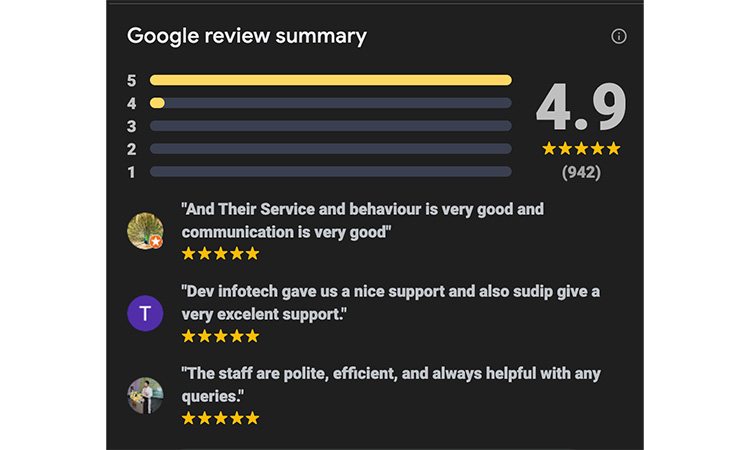
Reviews build domain authority signals and directly influence local search rankings. Technology companies with strong review profiles attract more qualified traffic from local searches.
Steps to Optimize:
- Ask satisfied clients to leave reviews on Google, Clutch, and G2 after project completion.
- Respond to every review, both positive and negative, within 48 hours.
- Include a direct review link in your post-project email follow-up sequence.
- Monitor new reviews weekly and flag any spam or inaccurate submissions.
- Create Locally Relevant Content
Search engines reward software companies that produce content relevant to their local market. Locally focused blog posts and case studies strengthen your connection to regional search intent.
Steps to Optimize:
- Write case studies that highlight local clients and specific regional challenges you solved.
- Publish blog posts about local tech events, startup ecosystems, or city-specific industry trends.
- Mention local landmarks, business districts, or community organizations where relevant.
- Add an FAQ section to location pages that addresses local buyer questions directly.
- Build Local Backlinks
High-quality backlinks from local sources signal geographic relevance to search engine algorithms. Software companies benefit greatly from partnerships with local organizations and media outlets.
Steps to Optimize:
- Partner with local universities, co-working spaces, or business associations for link opportunities.
- Submit press releases to regional tech blogs and local news outlets about company milestones.
- Sponsor local tech meetups or events and request a backlink from event organizers.
- Join your local Chamber of Commerce and earn a citation link from their directory.
What Are the Best SEO Tools for Software Companies? (Full Strategy-Based Table)
SEO tools help software companies improve rankings, fix technical issues, and generate leads. Top tools like Ahrefs and Semrush are widely used for keyword research, backlinks, and competitive analysis (ProPicked). Meanwhile, tools like Screaming Frog’s SEO Spider focus on deep technical audits and site crawling (Stan Ventures).
- Below is a complete SEO tools table by strategy (On-page, Off-page, Technical SEO etc.)
| SEO Strategy | Tool Name | Definition | Best Use Case |
| 1. On-Page SEO | Surfer SEO | AI-driven content optimization tool | Optimize blog content using keyword density and NLP terms |
| Clearscope | Content grading and keyword relevance tool | Improve content quality and ranking potential | |
| Yoast SEO | On-page SEO plugin for websites | Optimize meta tags, readability, and structure | |
| Frase | AI tool for content briefs and answers | Create SEO-friendly content based on search intent | |
| SE Ranking | All-in-one SEO tool with on-page audit | Analyze content optimization issues |
| SEO Strategy | Tool Name | Definition | Best Use Case |
| 2. Technical SEO | Screaming Frog SEO Spider | Website crawler that audits technical SEO issues | Find broken links, duplicate content, crawl errors |
| Google Search Console | Free tool from Google | Monitor indexing, performance, and errors | |
| Google PageSpeed Insights | Website speed testing tool | Improve Core Web Vitals and loading speed | |
| GTmetrix | Performance and speed analysis tool | Identify speed issues and UX problems | |
| JetOctopus | Log analyzer and crawler tool | Analyze crawl budget and bot behavior |
| SEO Strategy | Tool Name | Definition | Best Use Case |
| 3. Off-Page SEO (Backlinks) | Ahrefs | Backlink analysis and SEO platform | Analyze backlinks and competitor strategies |
| SEMrush | All-in-one SEO and marketing tool | Link building, competitor research, and keyword tracking | |
| Moz Pro | SEO tool with domain authority metrics | Track domain authority and link profile | |
| Majestic SEO | Link intelligence platform | Analyze link quality and trust flow | |
| BuzzSumo | Content and outreach tool | Find link-worthy content and influencers |
| SEO Strategy | Tool Name | Definition | Best Use Case |
| 4. Keyword Research & Strategy | Ahrefs | Keyword research and competitor tool | Find high-intent keywords |
| SEMrush | Keyword and market research platform | Analyze search volume, CPC, and trends | |
| Ubersuggest | Beginner-friendly keyword tool | Find keyword ideas and SEO opportunities | |
| KeywordTool.io | Long-tail keyword generator | Discover search queries across platforms |
| SEO Strategy | Tool Name | Definition | Best Use Case |
| 5. Analytics & Tracking | Google Analytics | Tracks user behavior and traffic | Measure conversions and user journeys |
| Google Search Console | Search performance tracking tool | Monitor rankings and indexing | |
| Microsoft Clarity | Heatmaps and session recordings | Improve UX and conversions |
- Most Important SEO Tools (Quick Stack for Software Companies)
If you want a powerful SEO stack, use:
- Keyword + competitor research → Ahrefs
- All-in-one SEO → Semrush
- Technical SEO → Screaming Frog SEO Spider
- Performance tracking → Google Search Console
- Content optimization → Surfer SEO
KPIs for Growth: Measuring SEO Success in Software Development Companies
Measuring SEO success for software development companies requires tracking metrics that align with a long B2B sales cycle. Success isn’t just traffic; it is conversion quality.
- Conversions & Leads: Use Google Analytics to track High-Intent actions, such as Request for Quote (RFQ) submissions or whitepaper downloads.
- Keyword Rankings: Monitor your seo rankings for money keywords (e.g., custom software services) and technical long-tail queries.
- Topical Authority: You can utilize seo tools to track how many of your pages appear in search engine results for a specific pillar, like Cloud Migration.
- Technical Health: Maintain a “Healthy” score in Search Console, focusing on site speed and Core Web Vitals to ensure low bounce rates.
- Backlink Profile: Track the growth of high-DR (Domain Rating) links from reputable tech publications.
Ultimately, the goal is ROI. If your search rankings lead to qualified discovery calls, your SEO strategy is winning.
What are the Latest SEO Trends for Software Companies in 2026?
In 2026, the landscape for software development companies has shifted from “Search Engine Optimization” to “Generative Engine Optimization” (GEO). The focus is no longer just on ranking #1 on a page, but on becoming the “cited source” in AI-generated answers.
- The Rise of AI Search Engines (SGE, Gemini, ChatGPT)
AI Overviews (AIO) are replacing traditional blue links. For software development company websites, visibility now depends on being summarized by models like Google Gemini and ChatGPT.
- The Trend: Search is moving toward “Answer Engines.” Users ask complex questions like, “Compare the scalability of Node.js vs Go for a fintech app,” and expect a synthesized answer.
- How to Adapt: Use Schema markup (Organization, Product, and FAQ) to help AI “read” your site structure. Write in a modular, factual style that is easy for LLMs to extract.
- Solving for Zero-Click Searches
In 2026, over 60% of searches result in no click to a website because the answer is provided directly on the SERP (Search Engine Results Page).
- The Trend: If a user searches for “software development costs 2026,” Google displays a table or summary immediately.
- How to Adapt: Don’t fight the zero-click; own it. Optimize for Featured Snippets (Position Zero). Even if they don’t click, your brand name appears as the authoritative source, building “share of model” (how often AI mentions you).
- Trust Engineering: The New E-E-A-T
Google’s E-E-A-T (Experience, Expertise, Authoritativeness, Trustworthiness) is now evaluated at the entity level. It’s not just about the article; it’s about the company behind it.
- The Trend: AI search engines prioritize content with “Proof of Experience.” Generic AI-written blogs are ignored in favor of case studies, original research, and expert-led opinions.
- How to Adapt: Author Profiles: Link your developers’ LinkedIn and GitHub profiles to their articles.
- Original Data: Publish your own industry benchmarks (e.g., “Our Analysis of 500 Cloud Migrations”). Original data is the #1 way to get cited by AI.
- Entity-Based SEO: Beyond Keywords
Search engines now understand “Entities” (concepts/things) rather than just strings of text.
- The Trend: Google connects your brand to specific entities like Custom Software, Agile Methodology, or Dubai Tech Sector.
- How to Adapt: Build a Knowledge Graph around your brand. Ensure your software development company is mentioned on high-authority sites like Clutch, Crunchbase, and Wikipedia-style tech wikis. This solidifies your brand as a known entity in the eyes of the algorithm.
FAQs
Ans. The best strategy combines keyword research, technical SEO, content marketing, and link building. Focus on search intent, create helpful content, and optimize conversion paths to generate qualified leads.
Ans. You can use tools like Ahrefs or SEMrush to find long-tail keywords with low difficulty. Target specific problems and niche queries to rank faster.
Ans. Blog posts, comparison pages, case studies, and product-led content work best to improve SEO for a software company’s website. These formats address user intent at different funnel stages and help convert traffic into leads.
Ans. Use clear CTAs, fast-loading pages, and a user-friendly design. Offer free trials, demos, or lead magnets. Align content with user intent to increase conversion rates.
Ans. Backlinks are critical for building authority and improving rankings on Google. High-quality links from trusted websites signal credibility and improve domain strength.
Ans. SEO can reduce reliance on paid advertising but not fully replace it. It provides long-term traffic and high search rankings, while ads deliver quick results. A combined strategy works best for growth.
Ans. Track rankings, traffic, and conversions using tools like Google Analytics and Google Search Console. Focus on lead generation, not just traffic.
Ans. Common mistakes include ignoring search intent, targeting the wrong keywords, a weak content strategy, and poor technical SEO. These issues reduce rankings and conversions.
Conclusion
Right now, your potential customers are searching on Google. They are looking for solutions you already offer. If your website is not ranking, you are losing those leads to competitors every single day.
SEO is not optional anymore. It is the most sustainable way to generate high-quality SaaS leads. When you align content with search intent, optimize pages, and build authority, your website starts working for you 24/7. No ad spend. No constant chasing. Just consistent, qualified traffic and conversions.
Don’t Wait—Your Competitors Are Already Ranking
Every day you delay, competitors capture your traffic and potential customers.The longer you wait, the harder it becomes to:
- Rank for high-intent keywords
- Attract ready-to-buy users
- Convert traffic into demos and leads
Take action now. Get your SEO strategy right today.
Start optimizing your software website now, or keep losing leads to competitors.

