





In this digital era, where Google algorithms update frequently, being a forensic firm owner and just creating a website or social media page are not enough. So if your brand is not at the top of the first page of the search engine, then how will you attract law firms, insurance companies, and corporate legal clients? The solution is quite simple: ” seo for forensic firms.” The right direction of search engine optimization strategies for forensic firms helps your brand to be at the top of search engine results pages (SERP).
Financial misconduct, internal fraud, ransomware attacks, and litigation support — in moments of urgency, most law firms, compliance teams, and enterprise decision-makers are increasingly delegated to forensic specialists. So with the help of the correct website, content optimizing, and on-page, off-page, and local SEO audits, your brand will flourish online and target organic traffic. Let’s dig deeper and find out in a step-by-step SEO audit strategy.
What is SEO for Forensic Firms?
SEO for forensic firms is a specific SEO approach to improve trust, authority, and high online visibility for forensic firms in legal, corporate, cybersecurity, compliance, and investigation sectors. A 2022 academic research paper titled Public “Awareness and Attitudes Towards SEO” found that 59.2% of respondents believed SEO has a strong impact on rankings.Traditional SEO focuses on keyword ranking and website traffic but in a forensic firm SEO’s strategy, the main goal is to attract decision-makers who need trusted investigative expertise during high-stakes situations such as:
- corporate fraud investigations
- cyber incidents
- litigation support
- financial misconduct cases
- digital evidence analysis
- compliance investigations
It is not just about getting more people on the website. The objective is to establish a niche forensic firm as an authority that legal firms, corporate clients, and compliance teams can rely on for investigating sensitive matters.
SEO for Forensic Firms combines:
- legal-intent keyword targeting
- authority-driven content marketing
- E-E-A-T optimization
- investigation-focused case studies
- technical trust signals
- reputation management
- local and enterprise SEO strategies
Let’s dig deeper and understand with a simple example. When your target audience searches for “forensic accounting for litigation” or “corporate fraud investigation firm” then from an SEO perspective, Google tends to focus on those websites that focus on proven experience (such as- 10 year expertise in [mention your niche area]), technical expertise, industry certifications, authoritative content, and strong trust signals. And if you correctly maintain these factors, then your brand will become an expert authority and acquire the first page spot. To maintain these elements, you need the right SEO approaches.
How SEO Helps Forensic Firms Generate Legal and Corporate Leads
The Association of Certified Fraud Examiners (ACFE) says internal fraud investigation teams grew by nearly 50% between 2019 and 2024. It is a sign of increasing corporate demand for fraud investigations, forensic accounting, cybersecurity investigations, and compliance support. SEO helps your website appear at the right time when your target audience searches for it.
- Importance of a forensic SEO audit
- Topical Relevance — If you rank for keywords like “digital forensics expert witness” or “corporate fraud investigation,” your firm can appear front and center with high-intent legal buyers.
- Improve Authenticity & Reliability — Moreover, the foundational Google PageRank improves authority. And it’s important when law firms and corporations are vetting forensic experts.
- 24/7 Lead Generation— A well SEO-optimized website generates incoming queries without having to continuously spend on PPC ads.
- The Niche Markets Reach— Different clients of the legal and corporate sectors search for very specific services; SEO helps to capture those exact high-value queries.
- Higher Results — Improved qualified leads, increased return on investment, and a stronger brand identity.
Top SEO Strategies Forensic Firms Use to Attract High-Value Clients
You should make SEO strategies in a planned way to dominate Google’s search results. The target of seo for forensic firms service is to attract authentic corporate and legal clients. Here, we discuss all the important SEO strategies with steps and tools for SEO success. Let’s begin:
- On-Page SEO for Forensic Firms
Most of the latest research makes on-page SEO the foundation of seo for forensic firms. It is the upfront strategy to improve website performance. The on-page SEO work is incredible when you research relevant keywords and optimize the meta title, meta descriptions, image optimization, and internal and outbound linking correctly. In this segment, you will learn all the strategies with steps and useful tools.
- How to research keywords for SEO for forensic firms?
Keywords are the search terms that your target audience uses. You can understand the search intent through keywords. This is the foundation of SEO strategy. For newer websites, the best opportunities are often: Low SEO difficulty + medium volume + strong intent keywords. The best keyword research tools are:
- Semrush
- Ubersuggest
- Mangools
- Google Keyword Planner
- Ahrefs
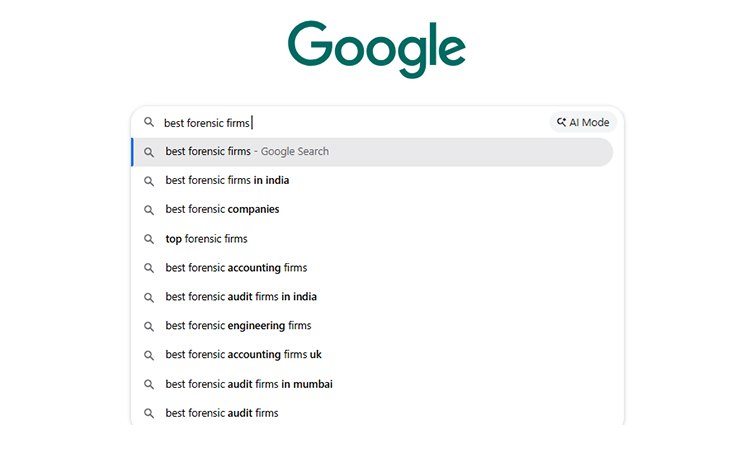
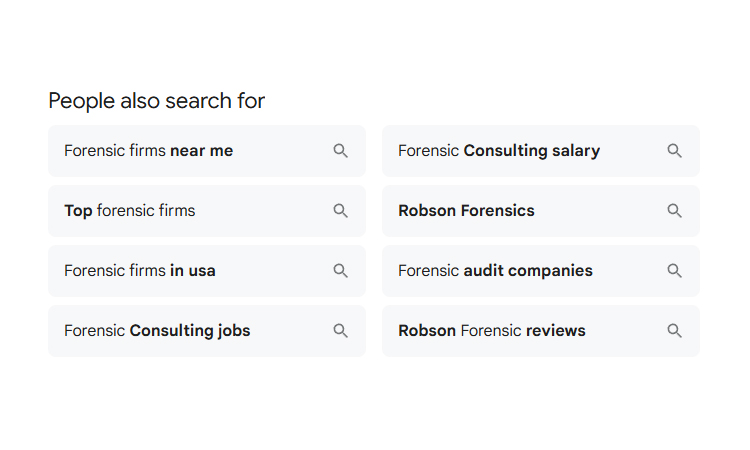
However, we can start with brainstorming. Like Google, autocomplete can be your trusted partner in terms of keyword research. Type the main keyword like “best forensic firms” and let Google show you what most people search for, like this—
Then we will move forward to taking help from keyword research tools like Ubersuggest.
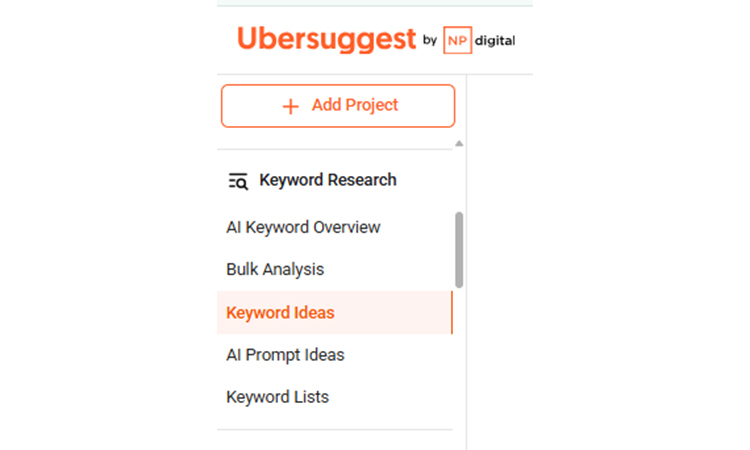
Step 1- Sign in to the Ubersuggest keyword research tool. And put in the main keyword.
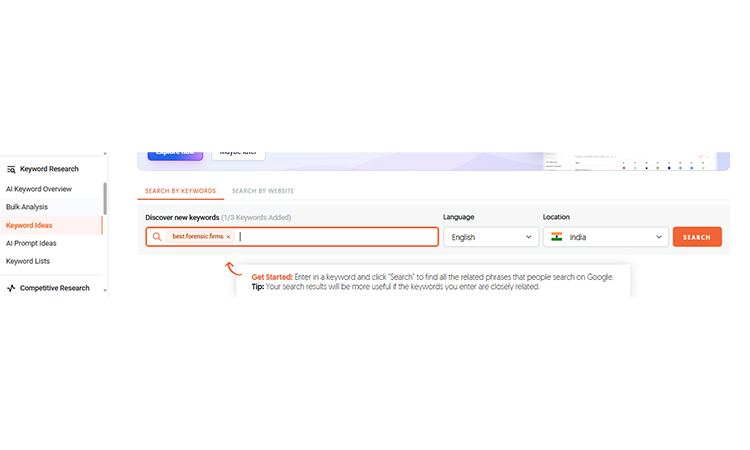
Step 2- Analyze Keyword Metrics
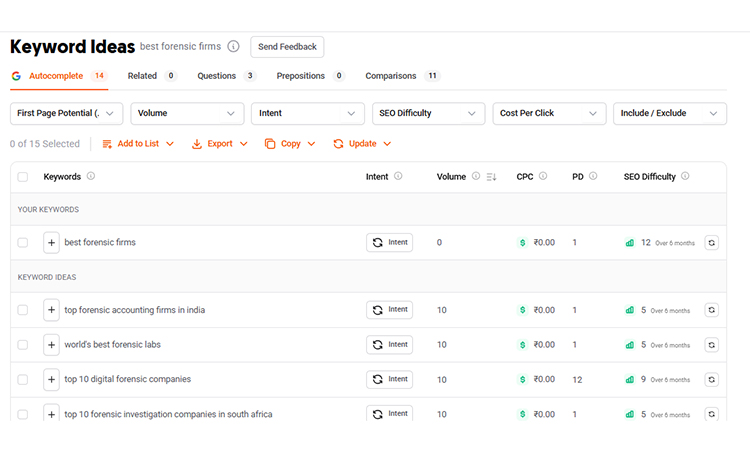
| SEO Metric | Definition | Best Tips to Choose Keywords |
| Intent | Search intent tells you why a user is searching for a keyword. It can be informational, commercial, navigational or transactional. | Choose keywords based on your business goal. For blog traffic, go for informational intent. Use commercial and transactional intent keywords for leads or sales. |
| Volume | Search volume is the estimated number of monthly searches for a keyword on search engines such as Google. | Don’t just go after high-volume keywords. It’s usually easier to rank for niche keywords with a medium volume. |
| CPC (Cost Per Click) | CPC is the amount paid by advertisers to Google Ads for one click on a keyword. Higher CPCs usually reflect a higher commercial value. | High CPC keywords often indicate strong buying intent. Use them for service pages, landing pages, and lead-generation content. |
| PD (Paid Difficulty) | Paid difficulty shows how competitive a keyword is in paid advertising campaigns. | Paid ads can get expensive if PD is very high. Use SEO and long-tail keywords to play better ball. |
| SEO Difficulty | SEO difficulty estimates the difficulty to rank organically for a keyword based on competition and the authority of ranking pages. | For new websites, start with low- to medium-difficulty keywords. Rank for the highly competitive terms after establishing authority. |
After finding relevant keywords, make a list on an Excel sheet. It helps you to keep track of all keywords in one place.
Best Tips for placing keywords to improve search rankings
- Naturally incorporate the main keyword in your page title and H1 heading.
- In the initial 100 words, you should include your main and secondary keywords.
- Use keywords descriptively in subheadings (H2 & H3) wherever possible.
- Incorporate keywords naturally into both the URL and meta description.
- Instead of stuffing in keywords all over the content, add related semantic keywords too.
- Focus on both image alt text and internal links on the most relevant variations of these keywords.
- Meta Title Tags
It is a clickable headline shown in the search engine results pages. It gives an idea about what the page is about.
- How to optimize the meta title?
- The ideal meta title length is 50-60 characters.
- Add the main keyword to the meta title.
- Best Tools: Yoast SEO, Semrush, Moz Pro
- Meta Description
A meta description is a summary of the webpage. It is positioned under a meta tag.
- How to optimize the meta description?
- The meta description should be in 150–160 characters.
- Add the primary keyword naturally.
- Include a clear call-to-action (“call now” or “book appointment now”).
- Moreover, you can add credibility signals, like how many clients you have handled, with numbers.
- Best Tools: Screaming Frog, Ahrefs, Google Search Console
- Header Tags (H1, H2, H3)
Heading tags in HTML organize page content in a hierarchical way, which makes it easier for both legal clients and search engines to find what you’re talking about.
- Steps:
- One H1 per page — your core service statement
- H2s for major service categories
- H3s for supporting details or sub-services
- Best Tools: Surfer SEO, Clearscope, Semrush Content Audit
- Internal Linking Between Pages
You can connect your website’s pages with internal links (hyperlinks with associated anchor texts). This leads business visitors deeper into your services, and your traffic can move from one webpage to another page.
- Steps:
- Link related service pages together
- Use descriptive anchor text
- Create a logical client journey from blog → service → contact
Let’s understand with an example—if you have a blog post “How Metadata Reveals Fraud in Corporate Documents” that internally links to your Expert Witness Services page and Corporate Investigation Consultation page. It can keep legal readers engaged with your content and also attract them to your service page.
- Best Tools: Screaming Frog, Ahrefs Site Audit, LinkWhisper
- Image Optimization (Alt Text, Size)
The image should load faster. So the process of making your image size shorter, but not compromising the quality, and adding alt text is known as image optimization. Alt text (alternative text) is a brief written description added to an image in HTML. This helps search engines know what the image is about.
- Steps:
- Write descriptive alt text with natural language.
- Compress images under 100KB.
- Use professional, relevant image filenames.
- Best Tools: TinyPNG, ShortPixel, Google PageSpeed Insights
- URL Structure (Clean, Readable, Keyword-Rich)
A Uniform Resource Locator is the main web address of your webpage.
- Steps:
- URL structure consists of lowercase letters with hyphens.
- Do not use stop words (and, the, of).
- The URLs should be clear, to the point of service, short, and descriptive.
- Best Tools: Yoast SEO, Rank Math, Google Search Console
- Outbound Links to Relevant Sources
Your website should have links to trustworthy outside sources. It includes legal databases, government agencies, or industry groups that show that your forensic firm is a legitimate one for business and legal clients.
- Steps:
- Link to authoritative legal/forensic references
- Open outbound links in a new tab
- Avoid linking to competitors
- Credible Sources to Link:
| Source | Purpose |
| FBI Cyber Division | Validate cybercrime investigation claims |
| ACFE (Association of Certified Fraud Examiners) | Support corporate fraud content |
| U.S. Courts.gov | Reference legal evidence standards |
| NIST Digital Forensics | Technical credibility for corporate readers |
- Best Tools: Ahrefs, Moz Link Explorer, Google Search Console
- Content Marketing Strategies That Attract Corporate Clients
Content optimization is the most significant part of a seo for forensic firms audit. Now Google prioritizes content that maintains E-E-A-T factors. It means “E” stands for experience and expertise, “A” stands for authority, and “T” stands for trust. So if you correctly implement these four factors, it can be a game-changer for your new website content. One more thing, always check the new Google algorithm update.
According to the research, the right content optimization and marketing give 3x more leads than traditional outbound marketing while costing 62% less. The website should have original insights like case studies and expert opinions. This will improve credibility and trust for your legal support. You can add how you help your corporate clients in the form of case studies with relevant numbers and facts.
- Best Tips for Content Marketing
- Cover All the Bases
Understanding the search intent of your target audience is most important. You should know who you’re crafting content for. You should match each stage in the buyer journey: awareness, consideration, and decision. This way, you can serve user intent and touch on their pain points of products and services they are looking for. You can simply write your main keyword or service name, like “forensic investigation services for attorneys,” on Google, and you can see various search topics like that.
- Add Case Studies
Case studies are the most trustworthy element of your website. You should give real insights with information on how you help your clients with real strategies and statistics. For example, you may write detailed posts like “How Digital seo for Forensic firms Investigations Helped a Corporation Recover $2M in Fraud Evidence.”
- Create Educational Whitepapers
Educational whitepapers are in-depth, well-researched publications that educate on the topics of forensic services, industry hazards, fraud investigation techniques, cybersecurity concerns, or compliance solutions. Forensic businesses may use whitepapers to demonstrate knowledge, develop trust, and position themselves as thought leaders within the field.
They also provide professional education to law firms, business customers, and insurance companies on sophisticated forensic themes. If well designed, white papers may help SEO, provide qualified prospects, and boost B2B marketing by pulling decision makers who are looking for competent forensic investigation services on the web.
- LinkedIn Thought Leadership
You should post weekly insights on forensic investigations, metadata analysis, and cyber fraud trends. However, the corporate clients and attorneys actively look on LinkedIn for reputable experts.
- FAQ & Legal Resource Pages
Frequently Asked Questions are crucial for featured snippet rankings. It can improve your search engine visibility. So add more FAQs on your website regarding your service. It’s like you’re giving answers to the most asked questions of your target clients.
- Expert Tip- Audit Your Existing Content to improve seo for Forensic firms
- You can start by finding the content gap between your competitors. Search for new trends on search engines. Do not just delete your existing blogs or web page content. Try to update frequently with new data and facts.
- You should update the content when you see your keyword move from page 1 to page 2–3. And your traffic decreased on Google Analytics.
- Always monitor competitors’ blogs or content style. See which keywords they rank for that you don’t. You can use Semrush’s Keyword Gap to find competitor keywords. Then make a list of those keywords and put them in an Excel sheet. That helps to maintain all relevant keywords, data, and information together in one place.
- Off-Page SEO: Building Authority & Reputation
An off-page seo for forensic firms audit is to maintain search engine visibility from outside to our website. This SEO process involves the external factors, such as building links, finding broken links, and creating engagement through forum discussion on Quora and community posts on Facebook, YouTube, and other social channels, as well as guest blogging and influencer mentions. In this segment, you will learn in depth all these strategies with the right steps and tools.
- Complete Off-Page Strategy Summary-Quick Guide
| Strategy | Primary Benefit | Best Tool | Timeline |
| Backlink Building | Domain authority & trust | Ahrefs | 3–6 months |
| Broken Link Building | Free high-quality links | Screaming Frog | 1–3 months |
| Forum Engagement | Brand visibility & traffic | Quora / Reddit | Ongoing |
| Social Media Signals | Audience reach & shares | Hootsuite | Ongoing |
| Guest Blogging | Authority & referral traffic | HARO / Pitchbox | 2–4 months |
| Influencer Mentions | Targeted audience reach | Sparktoro | 2–5 months |
| Press Releases | Media coverage & backlinks | PR Newswire | Immediate |
- Backlink Building from Trusted Websites
To acquire external backlinks from authoritative websites linking back to your forensic firm—this signals power for search engines and decision-makers in the legal environment.
- Steps:
- List high-domain legal, compliance, and industry sites
- You should present your brand as the most essential, trusted expert.
- Write forensic research that is worthy of links.
- Develop connections with bar associations and legal directories.
- Target Sources for Forensic Firms:
| Source Type | Example Sites |
| Legal Directories | Martindale-Hubbell, Avvo, FindLaw |
| Compliance Bodies | ACFE, ASIS International |
| Government Resources | FBI.gov, Courts.gov, NIST.gov |
| University Law Reviews | Harvard Law Review, Stanford Law |
| Insurance Associations | RIMS, Insurance Journal |
- Best Tools: Ahrefs, Moz Link Explorer, Semrush Backlink Analytics
- Broken Link Building
This is an off-page forensic SEO technique where you find broken (dead) links on authoritative legal and corporate websites and try to link your forensic content as a replacement to get real backlinks.
- Steps:
- You should discover broken link tools for law/forensic resources.
- Copy that matches your replacement content on the site.
- Well-written approach e-mail with a polite and helpful tone, prepared to reach out to the webmaster.
- Provide a seamless replacement resource for your page.
- Best Tools: Ahrefs Broken Link Checker, Screaming Frog, Check My Links (Chrome Extension)
- Forum / Quora / Reddit Engagement
Forum, Quora, and Reddit interactions include answering questions, offering expert views, and engaging in fraud investigation, cybersecurity, digital forensics, and legal compliance conversations. Forensic companies gain authority, brand exposure, website traffic, and prospective legal or corporate customers who want expert forensic solutions online.
- Steps:
- First, you should identify relevant forums and threads where attorneys ask about most cases (like questions)
- You should provide a clear, informative answer. This is not in a selling or advertising way.
- Include your firm’s link only when genuinely relevant
- You should be a consistent presence over weeks and months.
- Platform Strategy:
| Platform | Best Use | Example Thread |
| Quora | Answer legal/forensic questions | “How is digital evidence collected for corporate fraud cases?” |
| Engage in r/law, r/cybersecurity | “What should companies look for in a forensic investigator?” | |
| Legal Forums | JDSupra, LexisNexis Community | Evidence admissibility discussions |
| LinkedIn Groups | Corporate counsel communities | Fraud investigation best practices |
- Best Tools: Quora Spaces, Reddit Search, Google Alerts for relevant questions
- Social Media Signals and Shares
The total interaction—likes, shares, comments, and reposts—your seo for forensic firms earned across social platforms will boost online visibility to legal and corporate audiences.
- Steps:
- You should be stable in your postings on LinkedIn, Twitter/X and Facebook.
- Covering insights from cases, industry news, and recent forensic updates.
- Ask clients and partners to share your content.
- Utilize relevant hashtags to connect with attorneys.
- Content Ideas for Forensic Firms:
| Post Type | Example |
| Educational Post | “5 ways metadata exposes document tampering in corporate disputes” |
| Industry News | “New federal ruling on admissibility of digital evidence” |
| Case Insight | “How email forensics uncovered a $500K procurement fraud” |
| Expert Tip | “What every GC should know before hiring a forensic investigator” |
| Milestone | “Proud to have supported 200+ corporate litigation matters” |
- Best Tools: Buffer, Hootsuite, LinkedIn Analytics, Sprout Social
- Guest Blogging
Guest blogging is writing expert articles published on third-party legal, corporate, or technology websites. It improves the trust and authenticity of your forensic firm.
- Steps:
- Find Legal Publications and Corporate Blogs that Allow Contributors
- Pitch very specific and valuable forensic topics
- Add a natural bio link back to your firm’s services page
- Capitalize on guest posts through your own channels
- High-Value Guest Blog Targets:
| Publication | Audience |
| Above the Law | Attorneys & Legal Professionals |
| Corporate Counsel Magazine | In-House Legal Teams |
| JDSupra | Law Firms & Corporate Lawyers |
| Legaltech News | Legal Technology Decision-Makers |
| ACFE Fraud Magazine | Fraud Examiners & Corporate Investigators |
- Best Tools: Hunter.io (email outreach), BuzzSumo, HARO (Help a Reporter Out), Pitchbox
- Influencer Mentions
Then you can collaborate with legal, compliance, and corporate investigation influencers to improve your online visibility.
- Steps:
- Search for legal podcasters, compliance thought leaders, and LegalTech influencers.
- Then you may offer expert interviews, data, or insights that they can highlight.
- Collaborate to produce content such as panel discussions or webinars.
- Give them exclusive forensic case data.
- Target Influencer Categories:
| Influencer Type | Example Platforms |
| Legal Podcasters | Lawyer2Lawyer, The Legal Talk Network |
| Compliance Thought Leaders | LinkedIn, ACFE Events |
| LegalTech Journalists | Legaltech News, Law.com |
| Former FBI/DOJ Investigators | LinkedIn, Conference Circuits |
| Corporate Governance Experts | Forbes Contributor Network |
- Press Releases
News releases are official announcements shared with legal publications, media websites, and industry platforms about your forensic firm’s achievements, new services, major cases, partnerships, or business growth. They help increase brand visibility, build credibility, and attract legal firms, corporate clients, and potential business opportunities through online media coverage.
- Steps:
- You can announce something newsworthy (new service, big case win, certification, or expansion).
- Release through press release wire services.
- Focus on legal and business trade media specifically.
- Optimize the headline with relevant keywords.
- Newsworthy Topics for Forensic Firms:
| Announcement Type | Example |
| New Service Launch | “Firm Launches AI-Powered Contract Fraud Detection Division” |
| Expert Certification | “Lead Investigator Earns CFE and EnCE Dual Certification” |
| Case Milestone | “Forensic Team Supports 100th Corporate Litigation Matter” |
| Strategic Partnership | “Firm Partners with Regional Bar Association as Preferred Expert Witness Provider” |
| Office Expansion | “Forensic Investigation Firm Opens New York Corporate Investigations Office” |
- Best Tools: PR Newswire, Business Wire, GlobeNewswire, EIN Presswire
- Local SEO Strategies for Forensic Firms Attracting Legal & Corporate Clients
Local seo for forensic firms will help you to attract local clients, and you can pop up in local search results. It’s like one of your potential corporate clients types “best forensic accounting firm near me,” and if you optimize your Google Business Profile (GBP) and add your business name to local directories, it will help you to pop up on local search results.
The research says there’s an almost 900% increase in “near me” or “close by” searches, and almost 46% of Google searches have local intent. Here are the top local SEO for forensic firms with the right steps to attract more legal and corporate firms locally:
Strategy 1: Google Business Profile Optimization
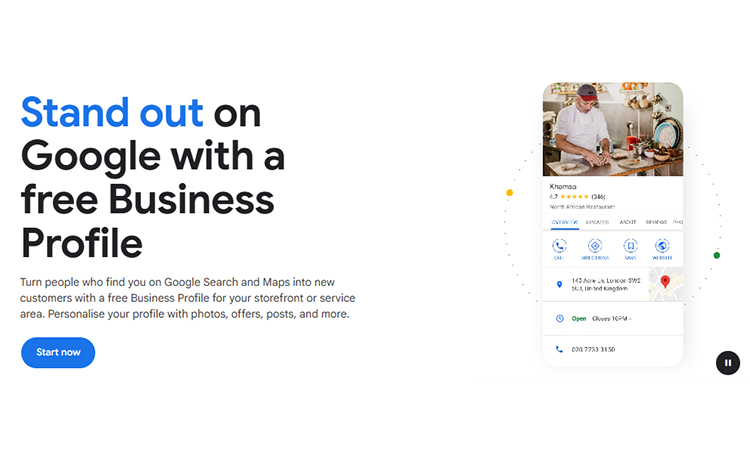
- First, go to https://business.google.com/en-all/business-profile/
- Then sign up with your professional email ID. And click on “Start now.”
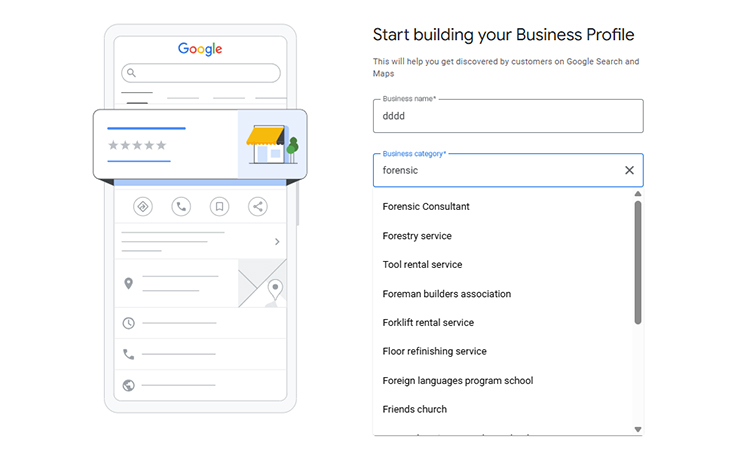
- Write your forensic firm’s name and choose the business category, which is the kind of forensic service you provide.
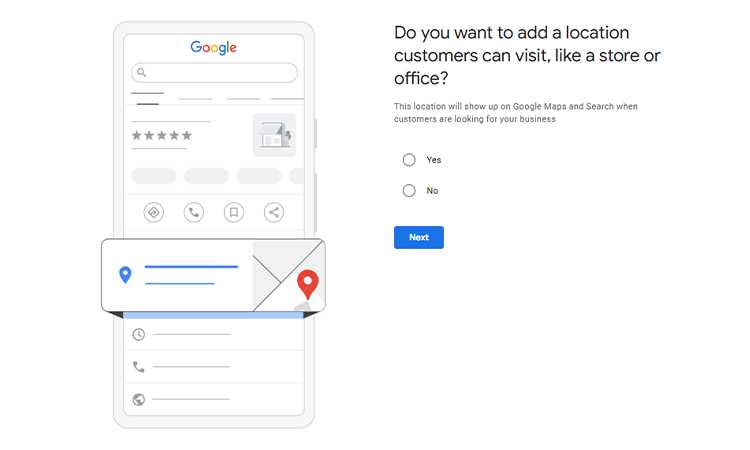
- If you have a physical office, then select “Yes” and add your location correctly.
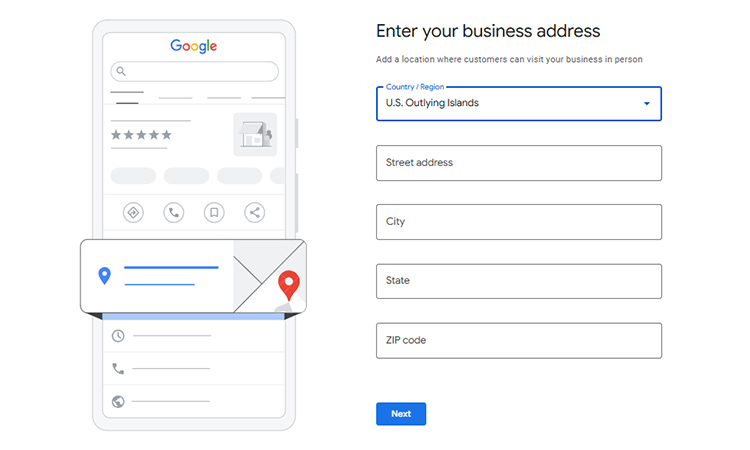
- Add the address in all the details.
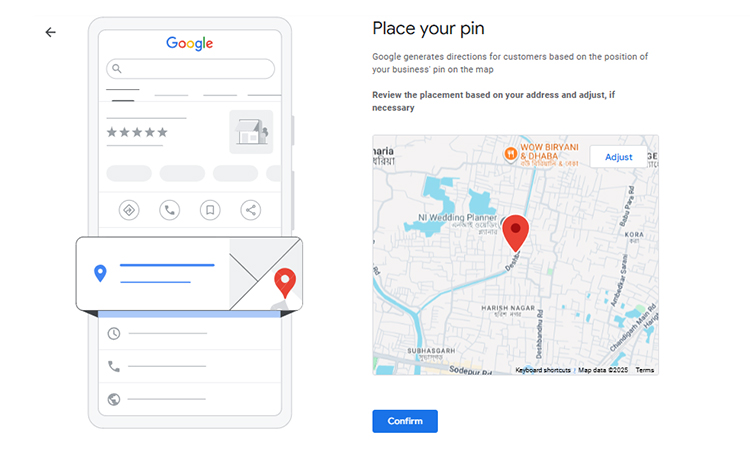
- Point the map to the exact location so that your clients can find you without any confusion.
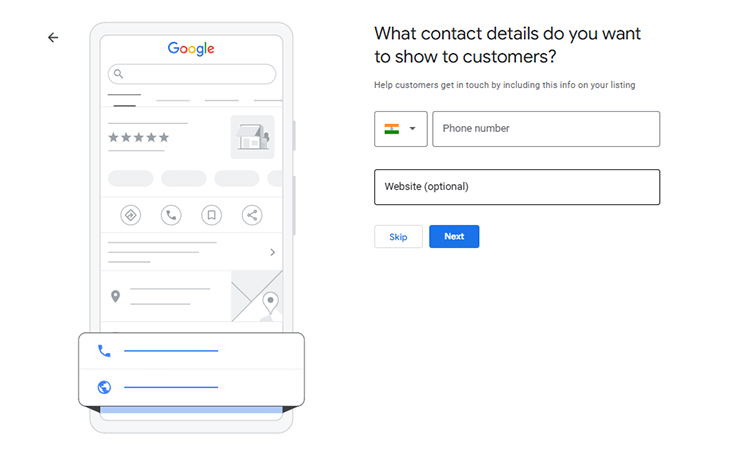
- Then put your official calling number. This will encourage your potential clients to contact you.
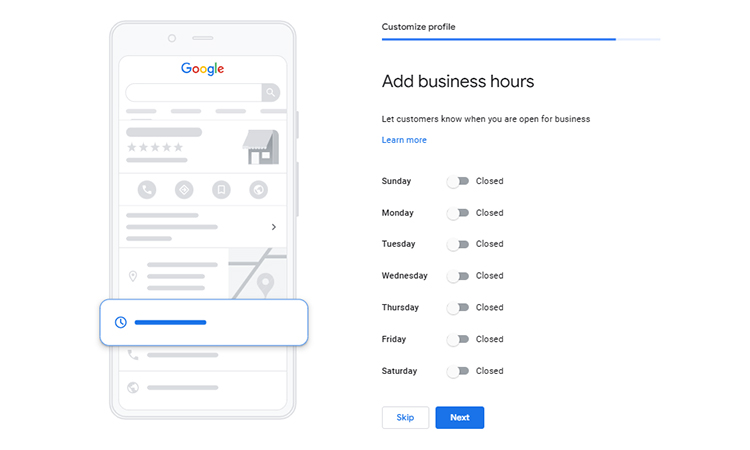
- Add your opening hours to improve the authenticity of your forensic service.
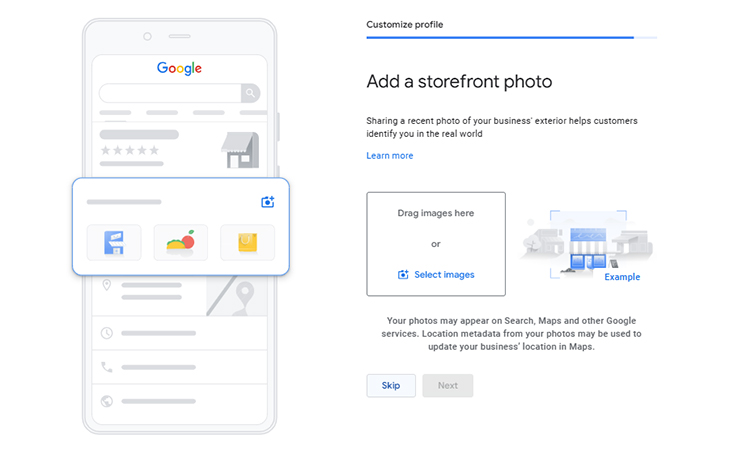
- Also, try to add live, high-quality pictures of your office, happy clients, and those related to your services.
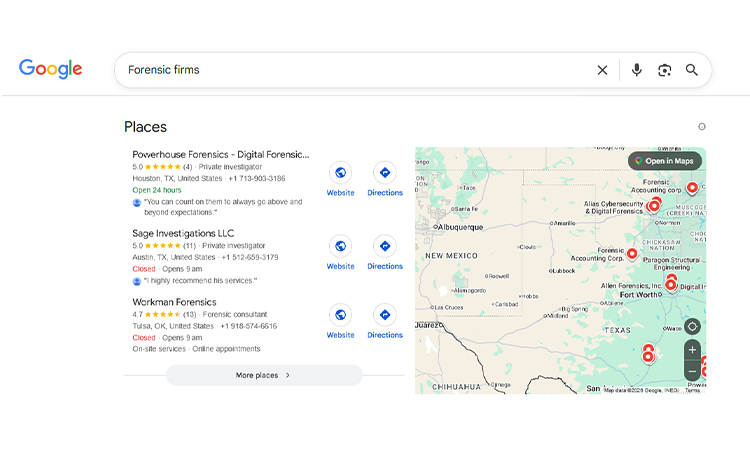
After Google verifies your company (usually within 5 business days) your company will appear like this-
However, the optimization should be correct. Use keywords in the description, and put all details correctly. You can get help from these tools, Google Business Profile Manager, BrightLocal, Whitespark to optimize GBP.
Strategy 2: Local Keyword Targeting
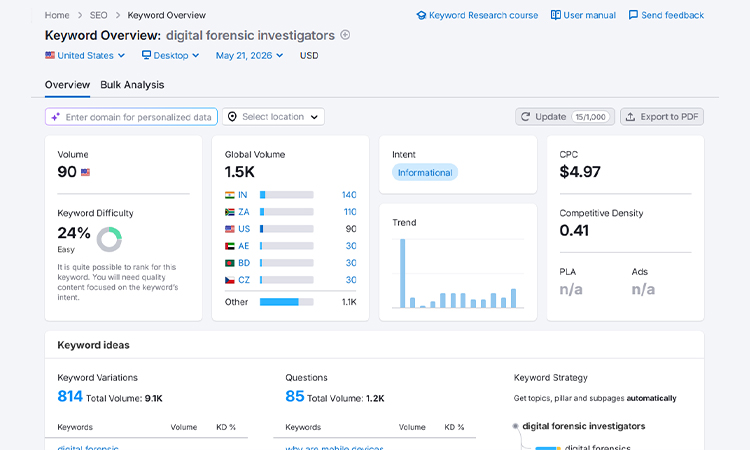
You can optimize your forensic firm’s pages around location-specific search terms. Always think like your clients and put yourself in their shoes—a foundational part of any basic SEO audit.
- Steps:
- First, conduct a data assessment of local search volumes using keyword tools
- Target keywords like “digital forensic investigators Chicago” or “corporate fraud investigation firm London”.
- You should include local keywords naturally in page titles, headers, and meta descriptions etc.
- Create custom service landing pages by city/region.
- Tools: Google Keyword Planner, Ahrefs, Semrush, BrightLocal
Strategy 3: NAP Consistency Across Directories
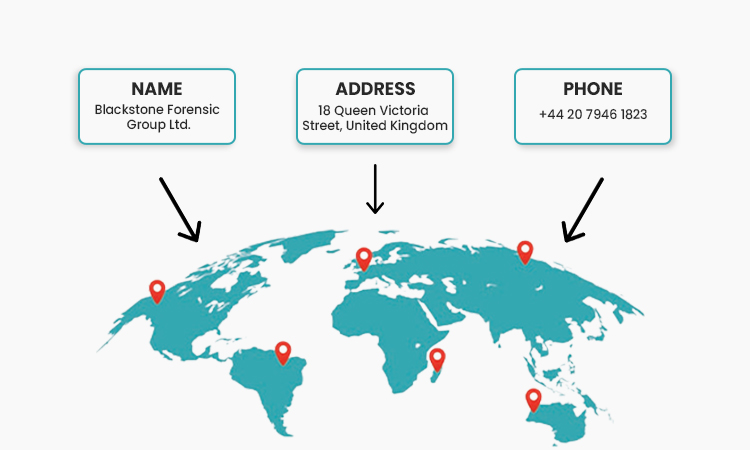
Google sees NAP as one of the most important and mysterious for forensic firms trust factors. It tells your corporate clients that you are, who you say you are and that you’re not a sketchy business. This is because NAP needs to be the same in all online directories.
- Steps:
- Audit all current directory listings immediately.
- Correct any inconsistent NAP information found.
- Submit uniform listings to legal and business directories.
- Quarterly review listings as part of your forensic process.
- Priority Directories for Forensic Firms:
| Directory | Audience |
| Martindale-Hubbell | Attorneys & Law Firms |
| Avvo | Legal Professionals |
| Better Business Bureau | Corporate Clients |
| Yelp for Business | General Corporate Search |
| Justia | Legal Industry |
- Tools: BrightLocal, Moz Local, Yext
Strategy 4: Local Link Building
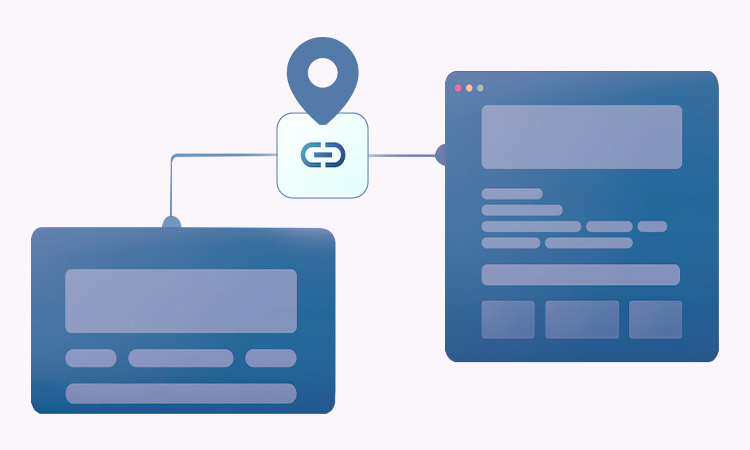
You can get backlinks from local authoritative sites to improve local link building. It enhances your forensic firm’s ranking in local search consoles.
- Steps:
- Get involved in local bar association directories. Sponsor legal events to promote your brand name locally.
- Partner with regional chambers of commerce for member listings.
- Provide forensic knowledge to local legal documents.
- Write opinion pieces for regional business publications
- Tools: Ahrefs, Moz Link Explorer, Whitespark Citation Finder
Strategy 5: Location-Specific Schema Markup
Structured data code that confirms the exact location information of your forensic firm to search engines. So that Google can display your firm in local forensic SEO results.
- Steps:
- Set up the LocalBusiness schema on the homepage and contact page.
- Include address, phone, service area, and operating hours.
- Add GeoCoordinates markup for precise location targeting.
- Verify using Google’s Rich Results Test after implementation.
- Tools: Schema.org, Rank Math, Google Rich Results Test
Strategy 6: Get Reviews From Your Clients
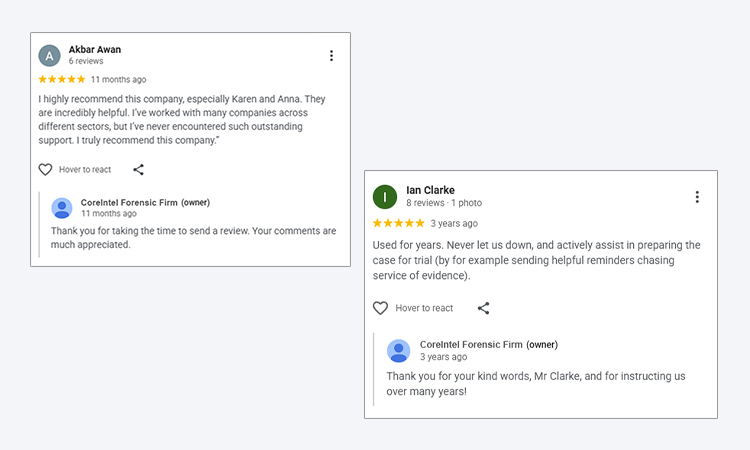
Reviews are the most important factor, which shows your reliability and authenticity.
- Steps:
- Always ask your happy clients to drop a review.
- Then you should respond professionally to every review within 48 hours.
- Monitor review sentiment monthly through search console data assessment
- Address negative reviews calmly and constructively
- Tools: BrightLocal, Podium, Google Business Profile
- Technical SEO for Forensic Firms: Building Security & Professional Trust
At the Technical SEO section, technical issues that may affect the website’s performance and SEO success will be fixed. Here, we discussed the top technical SEO strategies that are used by most professional seo for forensic firms experts to enhance your search engine visibility:
- Mobile-Friendliness
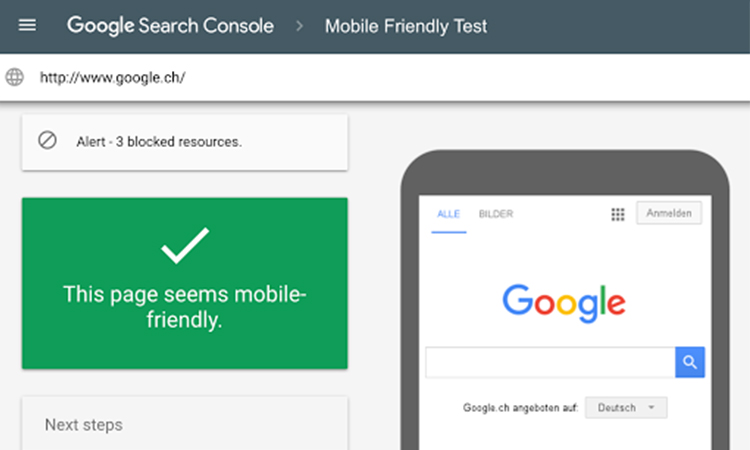
According to the Semrush report, almost 60% of searches occur on mobile devices in the U.S. So the website should be mobile-optimized.
- Steps:
- Use Google’s Mobile-Friendly Test tool.
- Use a responsive design across all pages.
- Tap-friendly buttons and text so the user can browse easily.
- Best Tools: Google Search Console, GTmetrix, BrowserStack
- Page Speed Optimization (Core Web Vitals)
Website performance is evaluated by Google’s Core Web Vitals: loading speed, interactivity, and visual reliability. It directly impacts search rankings and conversion rates.
- Steps:
- Compress images and minify CSS/JavaScript
- Turn on browser caching and CDN delivery
- Target LCP under 2.5 seconds, CLS under 0.1, INP under 200 milliseconds
- Best Tools: Google PageSpeed Insights, GTmetrix, Cloudflare
- SSL Certificate (HTTPS)
Google sees HTTPS (HyperText Transfer Protocol Secure) as a ranking signal. SSL stands for Secure Sockets Layer. It is a security technology that encrypts data transferred between a website and a browser and a user. SSL helps protect sensitive information such as passwords, payment details, contact form submissions, and confidential business data. It is a must-have for a forensic firm’s website to protect its clients’ private information.
- Steps:
- Get an SSL certificate from your hosting provider
- Force HTTPS across all pages via 301 redirects
- Verify no mixed content warnings exist
- Best Tools: SSL Labs, Cloudflare, cPanel AutoSSL
- XML Sitemap Submission
A structured file containing a list of all the pages corresponding to your forensic firm’s website, which allows search engine crawlers to find and index them faster.
- Steps:
- The sitemap should contain all service and blog pages & other pages.
- Submit directly using Google Search Console
- Each time a new page gets published, the sitemap is automatically updated by WordPress plugins.
- Top Tools: Google Search Console, Yoast SEO, Screaming Frog
- Robots.txt Optimization
A file that tells search engine crawlers which pages should be indexed or ignored—you don’t want Google results showing internal web pages from your forensic firm site on a duplicate basis (or worse, confidential info).
- Steps:
- Block admin, login, and thank-you pages.
- Ensure critical service pages are not blocked.
- Text validation should be regularly performed to avoid unintended consequences.
- Best Tools: Google Search Console, Robots.txt Tester, Screaming Frog
- Fixing Crawl Errors
The fundamental element in every seo for forensic firms audit is to find and fix technical problems that block search engines from reading your pages correctly.
- Steps:
- A full crawl audit is performed to find all the errors
- These include the 404s and server errors, mostly
- Check crawl stats weekly in Search Console
- Key Tools: Google Search Console, Ahrefs Site Audit, Screaming Frog
- Structured Data / Schema Markup for Forensic Firms
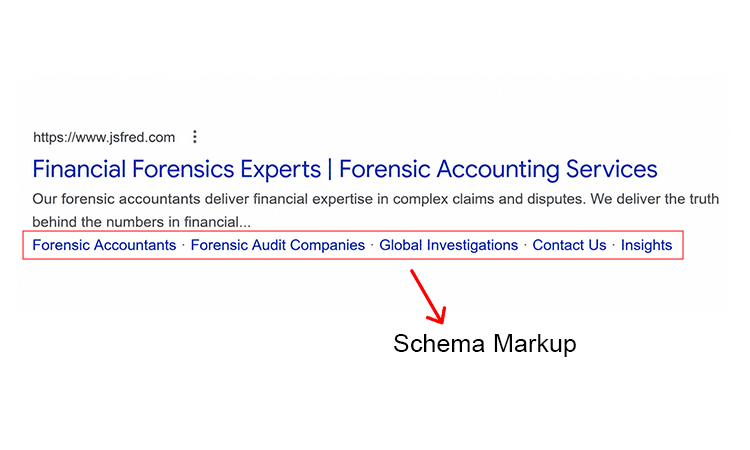
Structured data (schema markup) is code that is added to the website to help search engines develop a better understanding of the content that exists on web pages. Schema markup for forensic firms improves search prominence and trust indicators. It indicates to Google your services related to digital forensics and litigation support services, fraud investigations, and cybersecurity consulting.
- Schema Examples For Forensic Firms
- Organization Schema for company information
- Local Business Schema for office locations
- Professional Service Schema for forensic services
- Article Schema for blogs and case studies
- Client Testimonials/Reviews (schema datatype)
Such schemas can help bolster rich search results and amplify E-E-A-T signals.
Some popular schema markup implementation and testing tools are:
- Google Rich Results Test
- Schema.org
- Merkle Schema Markup Generator
- Google Search Console
- Canonical Tags
HTML tags that tell Google which version of a page should be rated as the main one, so there is no dual content penalty. So that forensic firms do not lose rankings in search results.
- Steps:
- Put Canonical tags on every paginated and filtered page
- Self-referencing canonical for every unique page
- Auditing high-utility links is your main quality control step
- Best Tools to Optimize: Screaming Frog, Ahrefs, Yoast SEO
- Avoiding Duplicate Content
It is an important rule that two pages on your seo for forensic firms website do not have the same content. If you create duplicate content, a search engine’s algorithm will not know which page to rank higher or lower.
- Steps:
- Check all service pages for duplicate content
- Merge thin or duplicate content instantly
- Canonicalization of duplicates with 301 redirects
- Ideal Tools: Semrush Site Audit, Siteliner, Copyscape
- Proper 301 & 302 Redirects and Effective 404 Error Handling for Forensic Company Websites
- 301 Redirect: A 301 redirect is a permanent redirect. It tells Google that a page has permanently moved to a new URL. It also passes most SEO value to the new page.
- Best use:
- Old service pages moved to new URLs
- Website redesigns
- HTTPS migration
- 302 Redirect: A 302 redirect is temporary. Google keeps the original page indexed.
- Best use:
- Temporary campaigns
- Testing new pages
- Short-term maintenance
- Handling 404 Errors: A 404 error appears when a page is missing. Too many broken pages hurt SEO and user trust.
- Optimization Tips
- Redirect deleted pages to relevant pages
- Avoid redirect chains
- Fix broken internal links
- Create a custom 404 page with contact details and service links
- Monitor errors in Google Search Console
- Redirect Path Chrome Extension — Quickly checks 301, 302, and 404 status codes in the browser.
- Valuable Tools to Try: Screaming Frog, Ahrefs, and Rank Math
- Lazy Loading for Images/Videos
Lazy loading images and videos until a user scrolls to them can skyrocket performance on forensic firm pages loaded with case graphics or explainer videos.
- Steps:
- Adding loading=”lazy” to all the images
- Add lazy loading to embedded video
- After you implement, test the speed enhancements
- Best Tools: Google PageSpeed Insights, WP Rocket, Cloudflare
- Clean Site design & Breadcrumb Navigation
A well-structured site should break down in a simpler way so that clients can easily navigate it. Breadcrumb navigation helps users get around on a website by telling them where they are in the site’s hierarchy. It makes things easier for users; search engines can crawl, and there are more internal links.
- Steps:
- structure homepage → services → type of investigation
- Breadcrumbs follow all pages within the page
- Make sure no page is more than 3 clicks away from the homepage.
- Best Tools: Screaming Frog, Google Search Console, Slickplan
SEO Success Metrics: A Forensic Firm Perspective
The seo for forensic firms success should be measured. Without a report, you cannot conclude whether this SEO strategy works or not. So, try to focus on the following factors to measure forensic SEO firms performance:
- Organic Traffic Growth — View monthly search visitors from all channels with Google Analytics. It shows which page or position your content and keyword ranks.
- Lead Conversion Rate — Key for marketing ROI, it measures the ratio of all organic visitors to corporate clients who fill out consultation forms.
- Growth of Backlink Profile — Check every new authority link (from legal directories and bar associations) acquired each month through Google Search Console.
- Bounce Rate & Engagement — Explore the time corporate visitors spend on service pages through Google Analytics → Longer sessions mean more content authority.
- Core Web Vitals Scores — Check your monthly page speed & UX metrics from Google Search Console, UberSuggest, and Page Speed Insights. The good scores directly improve SEO rankings and improve reliability.
Conclusion
So, at the end of our discussion of seo for forensic firms, we can easily conclude that SEO is a must-have for forensic firms to attract legal and corporate clients. SEO gives you a more sustainable result than PPC (pay-per-click) ads. The correct keyword, content optimization, and perfectly written case studies improve trust factors and enhance online visibility. Though you can strategize an SEO audit and strategy, professional seo for forensic firms experts can provide better results.
Think practically; you need to focus on your clients and solve their problems. So the SEO service agencies can help your company’s website rank higher in search results and give it strong exposure on other social media as well. Attorneys are searching for forensic experts right now. Is your firm visible? Let’s fix that with a professional SEO service. Book your free SEO consultation now.
Frequently Asked Questions (FAQs)
Ans. When you see sudden drops in organic traffic, keywords disappearing from search results, Google manual action notifications, unexplained conversion rate drops, and huge ranking losses after a Google algorithm update, these are urgent warning signs for you. Then it requires immediate forensic SEO firms investigation and data assessment.
Ans. The standard time for SEO to show results for forensic firms is 3-4 months.
Ans. The most common issues for losing ranking are not focusing on Google algorithm updates, toxic backlink profiles, duplicate content, crawl errors, manual actions, and poor Core Web Vitals scores.
Ans. Litigation lawyers can find seo for forensic firms by publishing expert witness qualification pages, detailed chain-of-custody content, and case methodology guides. These are all based on keywords that lawyers use to quickly find credible forensic investigation support for ongoing litigation cases.
Ans. Before a consultation, corporate legal teams look at detailed case studies with measurable outcomes, credentials from certified investigators, documentation on admissible evidence methodology, and client testimonials from named attorneys.
Ans. A properly optimized forensic firm website usually gets its first inquiries from lawyers and businesses within 60 to 90 days. It is possible with the help of local SEO and Google Business Profile visibility. As content authority, backlink profile strength, and search engine visibility increase, the website starts getting organic leads within six months.

