





SEO for CBD companies is the most significant digital marketing strategy to get organic traffic. However, CBD brands often face restrictions on paid ads across major online platforms. Since paid advertisements are unavailable for CBD products, SEO can be the best choice for the CBD industry. Search engine optimization improves search engine rankings for your cannabis company’s website. You create a professional website, but if you do not optimize content and add relevant keywords, then how will your website show up on search engine results pages?
The only sustainable solution is a dedicated CBD SEO strategy. And in these CBD SEO tactics, we need to implement three important SEO strategies: on-page, off-page, and technical SEO. In this comprehensive guide, we will discuss all the important strategies with steps and tools.
What is SEO for CBD companies?
CBD SEO is the process of optimizing your cannabis business’s website to attract organic traffic through valuable content, keyword optimization, and on-page, off-page, and technical SEO strategies. Most of the usual places to advertise, like Facebook Ads, Instagram Ads, and Google Ads, don’t allow cannabis and hemp-derived products. Search Engine Optimization (SEO) is often the most important thing a CBD brand can do to grow.
Let’s understand deeper through a simple example: You may imagine a customer searching for “natural anxiety relief”. Through a prominent SEO strategy, your CBD brand’s educational blog post appears first. They read your guide, trust your third-party lab results, and click to purchase your broad-spectrum oil. You’ve successfully converted a searcher into a customer without spending a cent on restricted ads.
Why Do CBD Companies Need SEO?
According to Fortune Business Insights, the global cannabidiol (CBD) market size stood at USD 16.52 billion in 2025 and is projected to reach USD 24.61 billion in 2026 and USD 382.04 billion in 2034, registering a CAGR of 40.89% during the forecast period 2026-2034. In 2025, North America held a market share of 47.63% for cannabidiol. Furthermore, the U.S. market for cannabidiol is projected to witness significant growth, reaching an estimated value of USD 78.74 billion by 2032. So, in this competitive CBD industry, only traditional marketing or word-of-mouth promotion is not enough to get a huge number of clients. And also, paid ads do not always work well. So we need to focus on correctly implementing SEO for CBD companies.
- Top 4 Importance of Implementing SEO for CBD Companies
- Avoids Ad Bans: Google, Facebook, and Instagram heavily restrict CBD advertising and only allow certain compliant products in limited markets.
- Captures High-Intent Buyers: It targets users already looking for phrases like “buy organic CBD oil”, which translates to much higher sales conversion rates.
- Improves authenticity and reliability: High rankings and educational content establish compliance, authority, and safety E-E-A-T (Experience, Expertise, Authoritativeness, and Trustworthiness) in a highly skeptical marketplace. Google and other search engines pay close attention to CBD websites with content optimised for this niche. Health and wellness sites are labelled as YMYL (Your Money or Your Life) by Google because the content can have an effect on a person’s health.
- Provides long-term ROI: Paid ads work until your budget runs out, but SEO traffic is sustainable.
SEO for CBD Companies: 6 Best Practices to Boost Website Traffic and Sales
Here, we discuss the top useful strategies you can implement to increase organic traffic for your CBD website through SEO:
- Keyword Research for CBD Businesses to Improve SEO
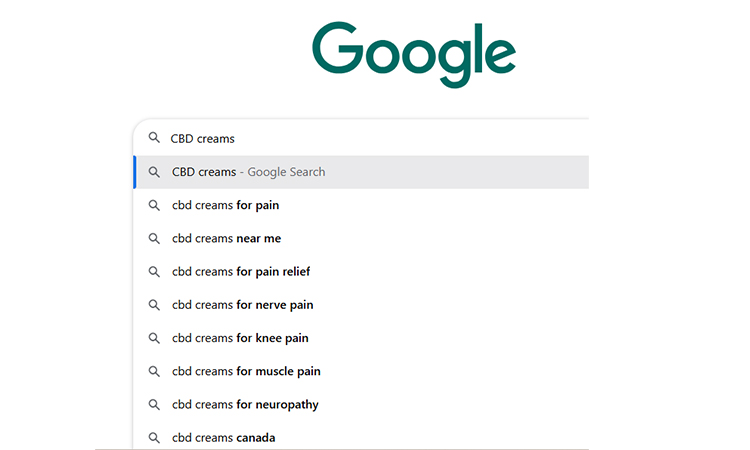
Keywords are the search terms your potential customers use to search for your products. You should find the most used terms and incorporate them in your website content. You need to understand the search intent. You can use Google Keyword Planner, Semrush, Ubersuggest, and Answer The Public. Also, you can type the main keyword on Google like this and get various other suggestions of keywords your target audience is actually using—
Furthermore, you can go to Semrush and type the main keyword in the search bar and let Semrush give you a list of keywords.
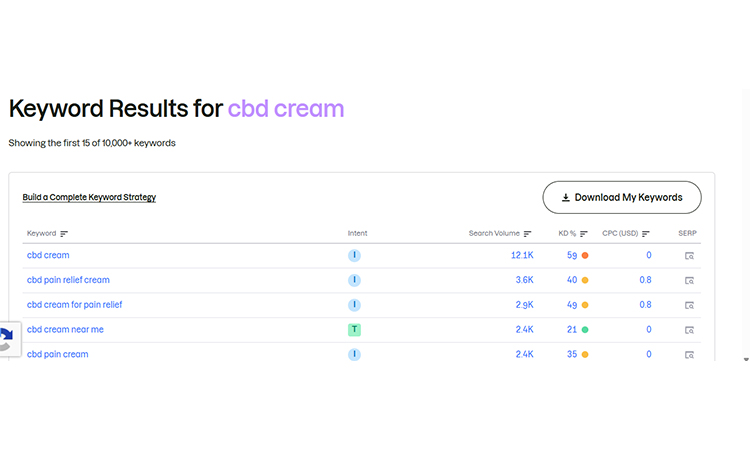
Expert tips for choosing the right keywords to grow your online CBD business with SEO
| Metric/Term | Definition | Tips to Choose for CBD |
| Search Volume | How many times a certain keyword is searched for on average every month. | Try not to just go after big numbers. For niche CBD products, searches with a moderate volume of 100 to 1,000 often convert better. |
| Keyword Difficulty (KD) | A number (usually between 0 and 100) that tells you how hard it is to get on page one compared to other sites. | Begin with easy keywords (KD less than 30) to build authority quickly before moving on to more difficult keywords. |
| Search Intent | The fundamental reason a user typed that query into a search engine. | Focus on “transactional” intent (i.e., buy broad-spectrum CBD) to sell and “informational” intent to educate the skeptical buyer. |
| CPC (Cost Per Click) | The average price advertisers pay for a single click in paid search campaigns. | If you want to find commercially valuable search terms, using high-CPC keywords can help. This is because advertisers are willing to pay more for clicks that could lead to sales. However, CPC alone does not guarantee SEO success, relevance, rankings, or conversions . |
| SERP (Search Engine Result Page) | The actual page Google displays to a user after they submit a search query. | Analyse the live SERP. If top results are all massive medical sites, it might be too hard to compete for that phrase. |
- Target Long-Tail Keywords: Avoid fighting for massive, broad terms. Instead, focus on hyper-specific phrases to match potential customers searching for exact solutions.
- Dominate Local Search: If you manage a physical CBD store, target location-based keywords to drive consistent foot traffic directly to your brick-and-mortar shopfront.
- Master User Intent: Balance transactional terms with educational ones to capture high-value organic search traffic at every step of the consumer buying journey.
- On-page SEO for CBD companies
On-page SEO for CBD businesses means boosting the quality of the content, where keywords are placed, title tags, meta descriptions, headings, images; and internal links on each page of the website. It makes the experience better for users and helps search engines understand what you’re writing. On-page SEO that works raises organic visibility, brings in qualified traffic, and makes users more engaged. It also helps with rankings for important CBD-related search terms.
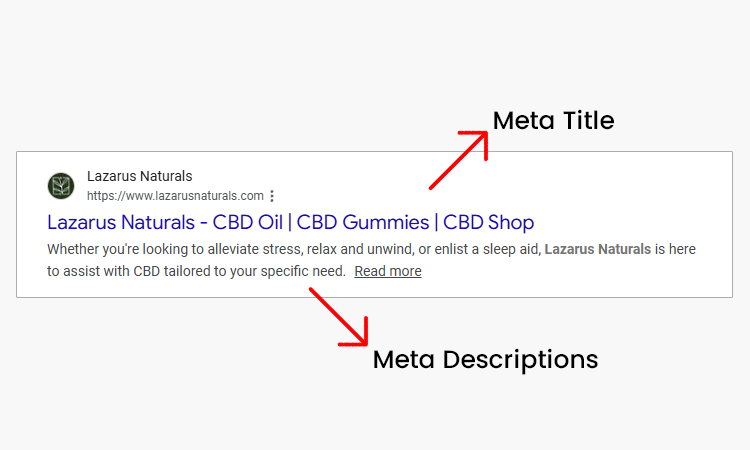
- Meta Title Tags – This is the first clickable headline in Google search results. The ideal title tags should be under 60 characters with your targeted keywords front-loaded. Example: “Buy Full-Spectrum CBD Oil | [Brand Name]”.
- Meta Descriptions – They are short summaries of a webpage that appear in search engine results beneath the page title. Write engaging meta descriptions under 155 characters containing your primary keyword and a clear call to action. Strong meta descriptions can increase click-through rates, which is a direct effect on organic traffic growth for cannabis SEO.
- Header Tags (H1, H2, H3)- One H1 per page with your primary keyword, H2s for main sections and H3s for subtopics. For SEO for CBD companies, a product page H1 might read: “Organic CBD Gummies for Sleep & Anxiety”.
- Internal Linking – Link blog content to product pages and related articles with descriptive anchor text. It distributes authority across your site and helps to build a loyal customer base by naturally leading users to purchase pages.
- Image Optimisation—Compress all images with TinyPNG or ShortPixel. Write descriptive alt text with targeted keywords—e.g., alt=”500mg full-spectrum CBD oil tincture”—to rank in Google Image Search and improve accessibility.
- URL Structure – Keep URLs short, readable, and keyword-rich: yourdomain. com/cbd-oil-for-anxiety beats yourdomain.com/product?id=4821 every time.
- FAQ Sections for Voice Search – Add FAQ schema to answer conversational queries like “What is the best CBD dosage for sleep?” It can help to capture featured snippets and voice search traffic.
- Outbound Links – Link to authoritative sources like PubMed research and FDA CBD guidelines to improve your page’s E-E-A-T signals.
- Become an expert in Content Strategy in the CBD Companies
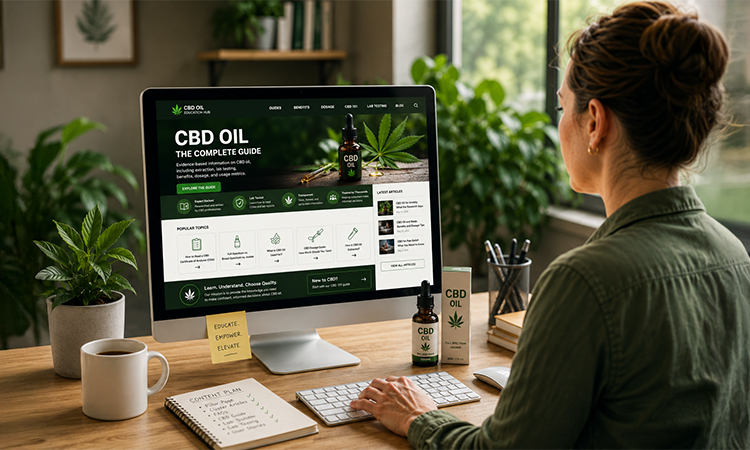
You can succeed in your cannabis business online, which requires planned SEO tactics. The primary solution is a dedicated content marketing system that safely drives organic traffic.
- Create a Topical “Hub and Spoke” Model
Instead of publishing random articles, your development team should design a structured educational hub.
- The Hub (Pillar Page): Try to write a definitive, comprehensive guide covering everything about CBD oil (extraction, tracking, and usage metrics).
- The Spokes (Cluster Articles): Link this master guide to smaller, highly specific question-based articles such as “How to Read a CBD Certificate of Analysis (COA)” or “What is the difference between full-spectrum and isolate?” Each cluster article should link to the pillar page, and the pillar page should link to all supporting content. This hub and spoke model helps with crawlability, increases topical relevance, and tells users and search engines that you are an expert in the subject.
- Prioritize Strict Content Quality and E-E-A-T
Google looks at your site using YMYL (Your Money or Your Life) rules because CBD has to do with health. You can’t skimp on high-quality content. There should be clear links to third-party lab results in every article, and no false medical claims should be made. Each article should be reviewed by a certified healthcare professional.
- Off-Page SEO for CBD companies
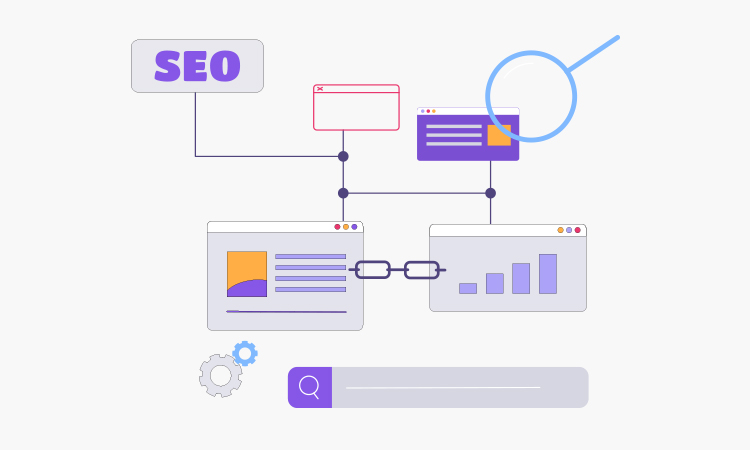
Off-page SEO for CBD companies refers to all SEO practices performed outside your website to improve its robust online presence, authority, and rankings. This includes link building, digital PR, brand mentions, guest posting, influencer outreach, social media promotion, and local citations. CBD is a competitive and regulated industry, so off-page SEO enhances reputation and organic search.
- Backlink Building from Trusted Reputable Sites – CBD SEO experts earn links from high-authority wellness, health, and lifestyle websites. Target DR 50+ domains using Ahrefs — one quality backlink outweighs 100 spammy ones for CBD keyword rankings. A 2025 SEO survey found that 73.2% of SEO professionals believe backlinks affect rankings and visibility in AI-powered search results.
Best Platforms for Backlink Building for CBD Companies
- Leafly — Leading cannabis directory; getting listed builds instant niche authority
- Medium — Publish CBD educational articles with contextual backlinks
- Reddit (r/CBD) — Community engagement drives natural referral traffic
- WeedMaps — Essential CBD business directory listing
- Quora — Answer CBD questions with relevant site links
- YouTube — Video descriptions with backlinks boost domain diversity
- Broken Link Building- Moreover, you can find broken links on cannabis and wellness blogs using Screaming Frog, then pitch your relevant CBD content as a replacement. It’s free, white-hat, and highly effective for building a loyal customer base of referring domains.
- Forum, Quora & Reddit Engagement- Then you can answer CBD-related questions genuinely on r/CBD, Quora, and niche forums. Add your site link only where contextually relevant — Google reads these signals as real community authority.
- Social Media Signals & Shares– High share counts on social media platforms like Facebook, Instagram, and Pinterest drive indirect SEO for CBD companies’ value. Every share expands content reach and generates natural backlink opportunities.
- Guest Blogging– You can publish expert CBD articles on reputable health and wellness blogs with a DoFollow backlink to your site. This is a cornerstone of any effective SEO strategy for CBD brands.
- Influencer Mentions- Moreover, you can partner with micro-influencers (10K–100K followers) in wellness niches. An unsponsored mention or blog feature earns a powerful, natural backlink that Google trusts far more than paid placements.
- Press Releases – Then you may try to distribute newsworthy CBD brand updates via PR Newswire or EIN. Presswire to earn authoritative media pickups, branded mentions, and high-DA backlinks that accelerate targeted keyword authority.
- Local SEO for CBD Companies
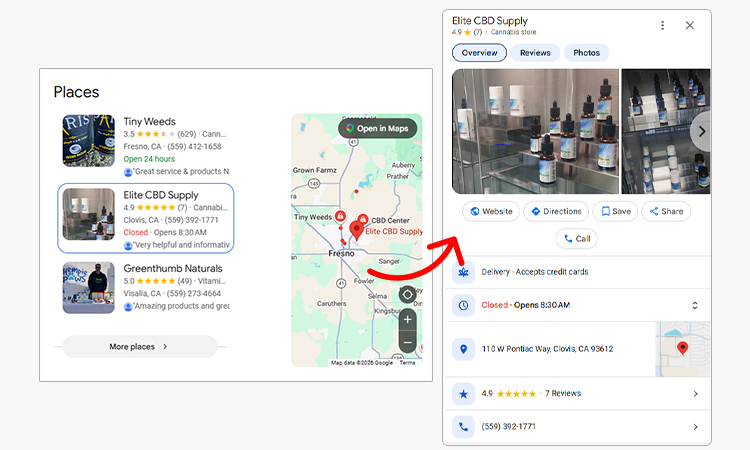
Local SEO helps CBD brands improve their visibility in location-based searches and attract nearby customers. As competition in the cannabis industry grows, implementing effective local SEO strategies is essential for increasing foot traffic, generating leads, and building brand awareness. For businesses focusing on SEO for CBD companies, local optimization can drive highly targeted traffic from users actively searching for CBD products and services in their area.
- Optimize your Google Business Profile – You can fill out your Google Business Profile with correct categories, hours, information about your business, and photos. Get customers to write reviews to boost trust and visibility in your area.
- Focus on Local Keywords – Use city, region and neighbourhood-specific keywords throughout your website content. For example, phrases like “CBD store in Miami” or “CBD products in Denver” help search engines connect your business with local searches.
- Build Local Citations – List your business on reputable directories such as Yelp, Bing Places, and industry-specific cannabis directories. Business listings on those platforms are very important to capture a wider range of clients. Consistent Name, Address, and Phone Number (NAP) information strengthens local rankings.
- Develop Location-Specific Content- Write blogs, guides, and landing pages that are relevant to local audiences. This will help you attract local customers.
- Get local backlinks- You can work with local groups, news websites, and trade magazines to get relevant backlinks that improve your authority and local search performance.
- Technical SEO for CBD Companies
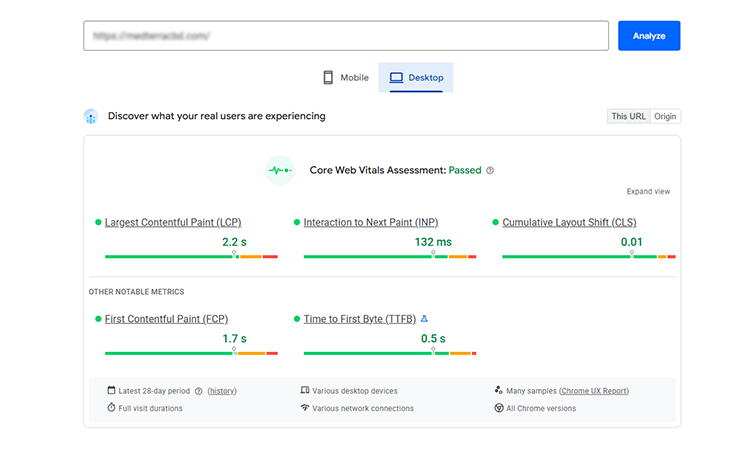
Technical SEO for CBD Companies is the process of optimizing a website’s technical foundation, including site speed, crawlability, indexing, mobile-friendliness, security, and structured data, to improve search rankings and user experience.
- Page Speed Optimization (Core Web Vitals) – Core Web Vitals measure how fast, responsive, and stable your website feels to users. So utilize tools like Google PageSpeed Insights and GTmetrix to identify performance issues. Compress images, minify CSS and JavaScript files, enable browser caching, and optimize server response times to improve key metrics such as Largest Contentful Paint (LCP), Interaction to Next Paint (INP), and Cumulative Layout Shift (CLS).
- Largest Contentful Paint (LCP) helps to measure how quickly the largest visible content element (such as an image or heading) loads, indicating page loading performance.
- Interaction to Next Paint (INP): It evaluates how quickly a webpage responds to user interactions (clicks, taps, keyboard input). This indicates interactivity and responsiveness.
- Cumulative Layout Shift (CLS): This indicates visual stability by detecting unexpected page element movement during loading.
Better Core Web Vitals can enhance user experience and support SEO performance.
- SSL Certificate (HTTPS)- An SSL certificate encrypts data between your visitor and your server, and Google uses it as a ranking signal. Install one through your hosting provider (most offer free SSL via Let’s Encrypt) and force HTTPS sitewide by updating your .htaccess file or use a plugin like Really Simple SSL on WordPress.
- XML Sitemap Submission— It is the process of submitting your website’s XML sitemap to search engines like Google and Bing. An XML sitemap lists all important pages on your site, helping search engines discover, crawl, and index content. You can generate it automatically using Yoast SEO, Rank Math, or Screaming Frog, then submit it directly inside Google Search Console under the Sitemaps section.
- Robots.txt Optimization- The robots.txt file instructs search engine crawlers which pages to crawl or ignore — access yours at yourdomain.com/robots.txt, block low-value pages like cart, checkout, and admin URLs.
- Fixing Crawl Errors-Crawl errors occur when Google tries to access a page on your site but fails, wasting your crawl budget and hurting rankings. You can run a full site audit in Screaming Frog or Ahrefs Site Audit to surface all broken URLs, then fix or redirect them promptly and monitor status weekly inside Google Search Console under the Indexing report.
- Structured Data / Schema Markup- Schema markup is code added to your pages that helps Google to understand your content and display rich results like star ratings, prices, and FAQs in search. So you can take help from Google’s Structured Data Markup Helper or Rank Math’s schema builder to add Product, Review, and FAQ schema to your CBD product and blog pages, then validate with Google’s Rich Results Test.
- Canonical Tags- A canonical tag tells Google which version of a page is the “master” version, preventing it from splitting ranking power across duplicate or similar URLs — add <link rel=”canonical” href=”your-preferred-url”/> in the <head> of every page, and use Yoast SEO or Rank Math to manage canonicals at scale without touching code.
- Avoiding Duplicate Content— Duplicate content confuses Google about which page to rank and dilutes your authority. Therefore, try to audit your site with Siteliner or Copyscape to detect internal and external duplication, then resolve it by consolidating thin pages, rewriting duplicate product descriptions, and applying canonical tags or 301 redirects where needed.
- Proper 301, 302 Redirects and Handling 404s – A 301 redirect permanently sends users and search engines from one URL to another and passes most of the original page’s SEO value. A 302 redirect is a temporary redirect used when a page is expected to return or move back in the future. Google can pass ranking signals through 302 redirects, but a 301 remains the preferred option for permanent URL changes. A 404 error indicates that a page cannot be found. Use tools like the Redirection plugin (WordPress) or server-level redirects to manage URL changes, and redirect valuable broken pages to the most relevant live page when appropriate to preserve user experience and link equity.
- Lazy Loading for Images & Videos- Lazy loading delays the loading of images and videos until a user scrolls near them, dramatically improving page speed and Core Web Vitals scores. You can enable it by adding loading=”lazy” to your <img> tags, or use plugins like WP Rocket or Smush on WordPress and verify it’s working correctly via Chrome DevTools Network tab.
- Clean Site Architecture & Breadcrumb Navigation– Site architecture refers to how your pages are organized and linked together, and breadcrumbs show users and Google the hierarchical path to any page. Therefore, you can structure your CBD site so every page is reachable within 3 clicks from the homepage, implement breadcrumb navigation using Rank Math or Yoast, and mark it up with BreadcrumbList schema so Google displays the trail directly in search results.
How to Analyze SEO Performance for CBD Companies?
| Key Performance Indicator (KPI) | Definition | Why It Matters for CBD Companies | Best Tools to Measure |
| Organic Sessions / Traffic | The number of unique visitors who find your website via unpaid search results (like Google or Bing). | It is very important to consider that your content marketing and keywords are successfully driving non-paid users to your site. | Google Analytics 4 (GA4), Fathom |
| Keyword Rankings & SERP Positions | The specific ranking placement (e.g., Position #1 vs. Position #25) of your pages for targeted terms. | Tracks whether your pages are moving up toward the high-click “Page 1” zone for high-intent search terms. | Semrush, Ahrefs, SE Ranking |
| Organic Conversion Rate / Revenue | The percentage of organic visitors who complete a purchase or submit a Request for Quote (RFQ). | High traffic means nothing if it doesn’t sell. This links your SEO efforts directly to real business revenue. | Google Analytics 4 (GA4), Triple Whale, Saras Analytics |
| Share of Voice (AI & Search Mentions) | The frequency at which your brand is cited or recommended by traditional search and generative AI engines. | Essential for tracking your visibility in modern AI-driven search models (like Gemini, Perplexity, and ChatGPT). | Scrunch AI, Profound , OtterlyAI, Brand24 |
| Local Map Pack Rankings | The visibility of your physical retail location in local geographical map searches (e.g., “CBD store near me”). | Directly correlates with physical shopfront walk-ins and local foot traffic. | BrightLocal, Local Falcon |
| Click-Through Rate (CTR) | The percentage of users who click on your website link after seeing it appear in the search results. | Shows if your Title Tags and Meta Descriptions are compelling enough to win clicks over competitors. | Google Search Console (GSC) |
| Core Web Vitals & Bounce Rate | Technical site health metrics measuring page loading speeds, visual stability, and user drop-off rates. | Slow e-commerce sites cause users to leave instantly. Good technical scores keep users shopping longer. | Google PageSpeed Insights, Hotjar, Microsoft Clarity |
Latest Seo Trends to Implement to Improve Seo for CBD Companies
The latest algorithm shifts focus heavily on AI integration and authentic credibility. These cutting-edge updates will help your CBD brand to be optimized for the modern search engines:
- Optimize for Generative Engine Optimization (GEO)
In the face of Google’s AI Overviews and engines like Perplexity or ChatGPT Search ruling the discovery game, focus on getting cited. You should develop informative, factual educational content hubs that demystify chemical absorption metrics and extraction types without making illegal medical claims.
- Devalue Thin Content (Google’s 2026 Spam & Core Updates)
Google’s ranking systems prioritize helpful, reliable, people-first content. You should avoid pumping out generic articles about “CBD benefits.” Instead, inject a unique, expert perspective. Moreover, add a licensed medical practitioner to review your content, and explicitly link your e-commerce product pages to verified, structured third-party lab certifications (COAs) to demonstrate bulletproof transparency.
Conclusion
As competition in the CBD market continues to grow, businesses that invest in SEO for CBD companies gain a significant advantage. Mastering keyword research and creating E-E-A-T-driven content improves technical performance and earns quality backlinks; SEO establishes long-term visibility and trust.
Are you ready to dominate search results? Partner with a trusted SEO agency today to unlock sustainable organic growth, higher rankings, qualified leads, and long-term revenue, without relying on paid advertising.
Frequently Asked Questions
Ans. Most CBD businesses start seeing noticeable SEO improvements within three to six months. Results depend on competition, website authority, content quality, and keyword targeting.
Ans. Yes, A CBD SEO agency understands industry regulations, keyword opportunities, and ranking factors. Their expertise can improve visibility, traffic, and conversions more efficiently.
Ans. CBD SEO requires strict compliance, strong E-E-A-T signals, and accurate health-related content. Businesses must avoid misleading claims while building authority through trusted sources.
Ans. CBD SEO costs $1,000–$10,000+ per month, depending on website size, competition, target market, and campaign goals. CBD startups spend $1,000–$3,000 per month on SEO, content creation, link building, and technical optimization, while established brands spend $5,000–$10,000.
Ans. You can start with commercial keywords such as “CBD oil,” “CBD gummies,” and location-based terms. Then target informational topics like CBD dosage, COAs, and extraction methods to capture users throughout the buying journey.

