





Biotech companies often invest extensively in both research and innovation. But they struggle to make their scientific breakthroughs visible to healthcare organizations, researchers, investors, pharmaceutical companies, and others. And this is where SEO for biotech companies comes as a solution.
SEO acts to bridge the gap by enhancing visibility where your audience searches for reliable information actively. Gartner reveals that nearly 61% of B2B buyers seek a rep-free buying experience and often rely on digital channels to search solutions before they interact with sales teams.
The stat reflects the necessity for an impeccable organic presence of biotech businesses to build trust during the buyer journey. And to do this, they require the best SEO strategies, which not only strengthen online visibility but also build website credibility and generate quality leads. In this post, we will discuss top SEO strategies for biotech companies, which deliver the most promising outcomes.
What is SEO for Biotech Companies?
SEO for biotech companies is a process to increase search engine visibility of scientific expertise and make it easily discoverable among the target audience. Being a part of digital marketing, its process consists of numerous activities like on-page, backlink creation, resolving technical issues of websites, etc.
These indeed have a significant role in improving the ranking of websites in search engines. Search engine optimization for a biotech company is completely different from consumer SEO since it needs to cater to some specific audiences at once.
Why is SEO Beneficial for Biotech Companies?
Biotech companies need search engine optimization to make their research easily get noticed. SEO works effectively to connect real expertise with people who search for solutions actively. Let’s explore some other crucial benefits of SEO for biotech companies:
- Increase Organic Visibility
When it comes to biotech searches, these are often specific yet technical. It covers mainly assays, mechanisms, compounds, etc. When your biotech company’s website ranks for these relevant search terms, it ensures the appearance of your business when audiences search for the same.
- Build Credibility
In a competitive industry like biotech, even a single, small, or inaccurate claim can break trust. Posting accurate and high-quality content builds higher credibility before prospects approach your team. When your website ranks for technical keywords, it also improves trust by showing search engines recognize your biotech company as a trusted source.
- Generate Quality Leads
People often look for biotech-specific terms that are generally highly qualified. Someone searching for the keyword “recombinant protein expression yield optimization’ already has an in-depth understanding of their actual needs. This brings the possibility of starting a business conversation than those clicking a generic advertisement.
- Attract Strategic Partners and Investors
Due diligence is something that often starts with an online search. Whether it’s licensing partners, investors, or potential collaborators, they always find out the organization’s scientific presence before their first meeting. Many important factors like credible research, organic visibility, clear technical content, and consistent industry authority play a vital role in building trust before the presentation of a pitch deck.
- Support Long-Term Sales Cycles
As far as biotech buying decisions are concerned, they often take months or sometimes even years. It also requires the involvement of many people as well. SEO content works better in this by helping during the entire process by building trust, answering questions, and also keeping your online business visible even after the first visit.
Top SEO Strategies That Really Work for Biotech Companies
Only specialized SEO strategies will help you improve the online visibility of your biotech company. We will take a look at some of those strategies that deliver the desired outcomes. Let’s explore them one-by-one:
- Keyword Research Based on Scientific Search Intent
Keyword research is the first step and the foundation of search engine optimization — SEO for biotech companies is not an exception. You need to focus on getting details about phrases and keywords your target audience searches for.
Your target audience may look for any specific product, whether it’s an antibody or something else. It helps you improve your product pages for the same. They may also be seeking information on diseases or applications. You can use the same topic to write blog posts.
Once you explore search queries used by your target customers, you will be able to align your content with these queries. It helps you answer important questions asked most commonly by your customers. It also highlights how your products solve actual issues.
Being a life science company, you are responsible for balancing industry-specific terminology with search-friendly language to increase visibility.
- Important Types of Keywords:
While searching for important keywords, you need to focus mainly on two important categories that are as follows:
- Short-Tail Keywords: It’s basically a general or even a single term
- Long-Tail Keywords: They are specific terms consisting of 3 or more terms.
Of course, both keyword categories have their own relevance. But targeting long-tail keywords helps you maximize your reach to specific audiences while increasing the chance of conversion rates.
The major advantage of these keywords is they have less competition, which makes it convenient for new websites to rank, especially when compared to vast terms such as antibodies, PCR, or others. Though these keywords are tough to rank, they bring qualified traffic in larger volume.
- Top Keyword Research Tools
To find the list of keywords for your biotech company, you can rely on the following popular tools:
- Google Trends
- Google Keyword Planner
- Ahrefs
- SEMrush
Using Google Trends will help you find the latest and trending keywords that will definitely help you rank your website.
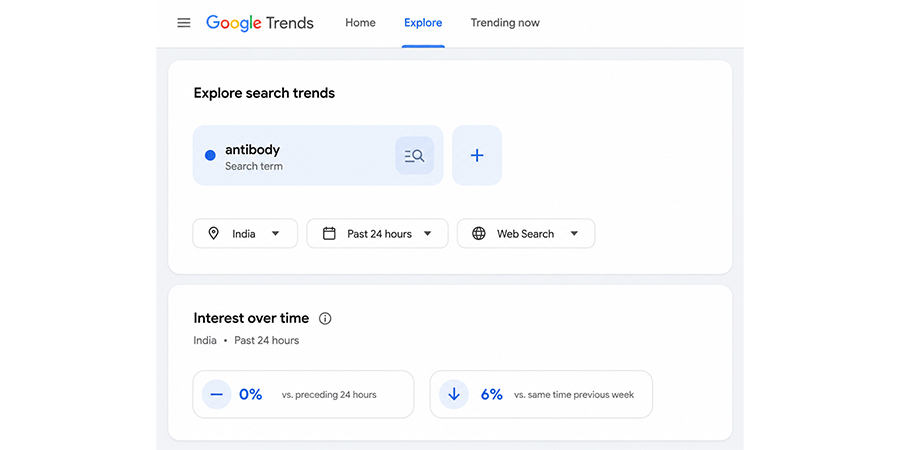
In this tool, we inserted the search term ‘antibody,’ and the result is as follows:
- Importance of Understanding Scientific Search Intent
Apart from the type of keywords, you also need to be familiar with search intent. It helps you craft content that truly matches users’ search queries, leading to higher engagement. The following are some of the important types of scientific search intent:
- Informational: It reflects the user’s desire to learn related to diseases, scientific topics, etc. For instance, ‘Causes and Signs of Diabetes”.
- Commercial: It signifies users’ research for any technology, products, or solution before they make a final purchasing decision. For instance, they go through comparison (PCR vs qPCR, or any detailed buying guide.
- Transactional: It shows users are ready to take an action, such as requesting quotes, connecting with suppliers, or purchasing products. The best example of queries like ‘buy protein supplements’ etc.
- Navigational: It reflects users’ search for a specific product or company. For instance, a search query related to the product name of a specific biotech company.


- On-Page SEO
When it comes to on-page SEO, it refers mainly to optimization of content and the overall structure of your website. The major purpose is to make your website search-engine friendly and thus maximizes the possibility to improve its ranking. On-page optimization involves of performing various activities that are as follows:
- Title Tags and Meta Description
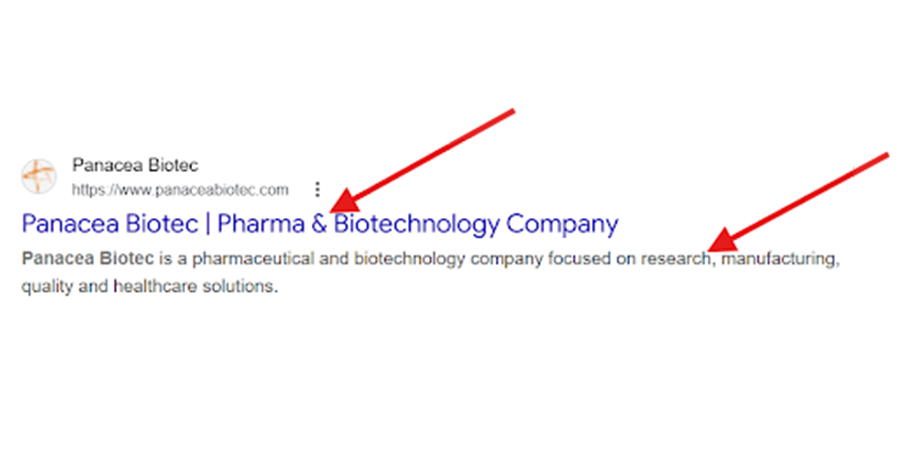
Title tags and meta description are highly important as they appear directly in search engine result pages (SERPs). They are the most crucial factor that determines whether users will click on your website or not. So, you should never leave any stone unturned to make your title tags and meta description compelling.
While writing title tags and meta description, you need to consider the following important things:
- The title tags should not be more than 60 characters long and must include your target keyword.
- Meta descriptions should not be more than 160 characters and also offer a complete brief overview of your website’s content.
- Image Alt Text
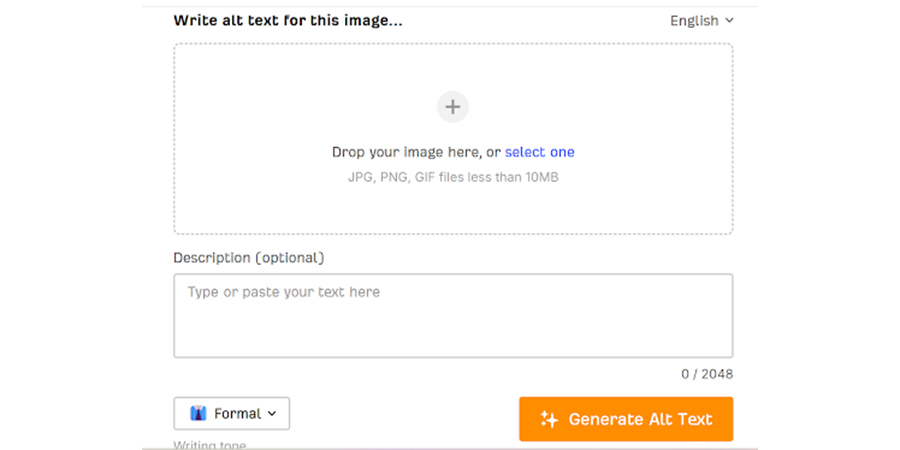
Image alt text is basically the text that is visible in place of an image if it doesn’t appear for any reason. Besides, it’s also used by search engines for indexing your images and also to understand your website content. Make sure your image alt text is descriptive and also include your targeted keywords.
You can leverage the Ahrefs tool to generate image alt text.
- Header Tags
Header tags are mainly used for structuring your website’s content and also reflect the hierarchy of information on every page. They allow search engines to understand your website content and also to rank your website for relevant keywords. You can use header tags in the following ways:
- H1: Main title
- H2: Subheadings
- H3: Subheadings
- User Experience
As far as user experience (UX) is concerned, it’s a highly important factor in search engine optimization. If your website is not easy to use, users will avoid spending long engaging with it.
You need to ensure your website is easy to navigate and also that your content is easy to read. It’s also important to ensure your website is mobile-friendly since people nowadays use mobile phones and tablets most frequently.
- Create Scientifically Accurate Content for Biotech Companies
The fact can’t be denied that science is a complicated subject, and content for any biotech website is also as well. Most startup biotech company clients are indeed in stealth mode, where they don’t share much information. So, now the question is, how to do SEO for biotech companies if you don’t have any content.
Your content plan should be focused on where you exist now and also where you wish to be in the future. It’s also a great idea to have an iterative approach to your content strategy that lets you make monthly decisions and analyze data from content.
Another important thing you can do is to make the content of your biotech website SEO-optimized, well-founded, and highly accessible. Search engines can analyze your authority and expertise on the mentioned topic, which makes your website the actual source for related queries. This mainly includes:
- Offering content that appeals to vast audiences with different expertise levels.
- Avoiding technical jargon
- Avoid unnecessary abbreviations as they complicate complex topics.
- Maintain a highly engaging writing style that compels readers to explore.
Apart from blog articles, you can publish some other forms of content, including posters, whitepapers, FAQs, etc. These indeed complement your content strategy better. Whether it’s quality infographics, citations, and strategically placed CTAs, etc., make the content apt and perfect.
- Create Backlinks to Improve Authority
When it comes to backlinks, these are other important factors that play a vital role in improving search engine rankings. These are basically digital world references that reflect the credibility and thus relevance of websites.
So, if you wish to create high-quality backlinks for your biotech website, you need to consider the following crucial tips:
- Craft shareable content including infographics
- Publish guest articles on other biotech websites.
- Collaborate effectively with academic institutions or even industry media.
- Post in peer-reviewed scientific journals.
- Pro Tips: Always try to earn backlinks for your website only from a genuine and highly reputed website. This improves your SEO visibility and thus your brand authority.
- Technical SEO
Technical SEO enables search engines to crawl properly and thus index your website hassle-free. The following are some important areas to focus on:
- Duplicate Content: You should always avoid content that competes for rankings as well.
- 404 Errors: You can resolve broken links or even use 301 redirects
- Robots.txt and Sitemap: It ensures search engines access your website properly.
- Canonical Tag: It tells search engines which versions of a page you need to focus on
- Core Web Vitals: It helps you determine the real-world user experience of your website.
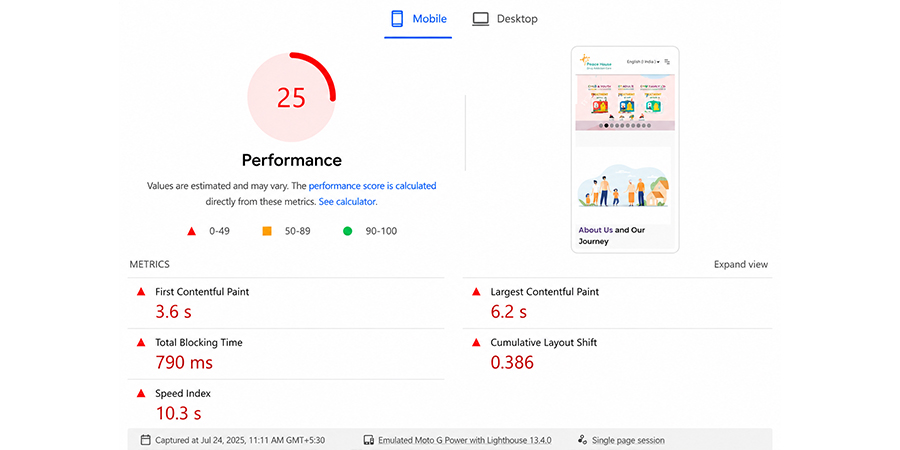
Google PageSpeed Insights allows you to discover those areas where you can improve your website speed. For instance, if you have two blogs focused on the same topic, like IHC troubleshooting, that causes duplicate content errors to be flagged up.
You need to always review the content and then create one detailed blog. Besides, you also need to break the same into different series of helpful troubleshooting blogs. Each blog covers common issues that are as follows:
- False-positive signals
- No staining
- High background
- Wrong or negative signals
Non-specific staining canonical tags are something that tends to be useful for life science space websites since some product categories have certain individual pages for products of multiple sizes.
- Website Speed
According to Google, websites should have a LCP (Largest Contentful Paint) of 2.5 seconds to deliver an outstanding user experience. If your website takes a lot of time to load, people will not stay too long and abandon it eventually to lose the targeted traffic. It’s also one of the important ranking factors. A technical SEO audit uncovers mainly site speed issues along with crawlability and indexation issues before they grow.
There are several important things you can do to increase your website speed, including using a content delivery network (CDN), optimizing your images, minifying your code, etc. You can leverage tools like PageSpeed Insights to check the loading speed of your website.
- Build Topical Authority
When it comes to building topical authority, it’s not possible without the E-E-A-T framework. It allows Google’s human reviewers to check content quality. Though this framework doesn’t help directly in Google ranking, it’s useful when it comes to guiding writers while creating product content. It encourages them to craft useful content for the target audience.
If you write new content, you need to follow the below important framework:
- Expertise: It reflects knowledge in your niche
- Experience: It offers first-hand insights and also case studies
- Authoritativeness: You need to earn credibility with the help of citations and backlinks.
- Trustworthiness: It reflects your website security and also transparent content.
Whether it’s peer-reviewed content, industry certifications, or regulatory compliance, these types of content work effectively for SEO for biotech companies. Also include the expertise of the author related to the topic.
- Measure and Improve SEO Performance
Needless to mention, SEO for biotech companies is a continuous process that requires ongoing monitoring and thorough optimization, which is essential to maintain and boost performance.
When you analyze SEO metrics for your life science companies continuously, it helps you to understand how your audience interacts. You will be able to discover those keywords that bring higher web traffic. It also helps you know how your website ranks compared to your competitors.
With this data-based approach, you will be able to make well-informed decisions to improve your online visibility and thus can achieve your business objectives. You can perform various activities such as optimizing for new keywords, updating content regularly, or adapting to algorithm changes better, etc., to maintain and improve your search rankings.
So, how to analyze SEO performance? Well, you can do it by using the following important tools:
- Google Analytics: It offers clear insights into user behavior, website traffic, conversion rates, etc.
- Google Search Console: It offers important data on site visibility and also search performance.
- SE Ranking, SEMrush, and Ahrefs: These tools offer comprehensive SEO analytics, including backlink analysis, keyword rankings, competitive research, etc.
Common SEO Mistakes Biotech Companies Should Avoid
You can get the unmatched benefits of SEO for biotech companies only when you do it properly. Even a single mistake prevents you from appearing in search results pages. Let’s go through each mistake one-by-one and along with their respective solution:
- Ignore Search Intent
A large number of biotech websites target mainly those keywords based on search volume, even without getting details of user intent. It causes a higher bounce rate.
- Solution: You need to review pages that already rank for target keywords before you write content. If you find the top results are protocols, comparisons, or guides, you need to follow the same format while making your content more accurate and valuable.
- Publish Only Research Papers
Peer-reviewed publications contribute a lot to building scientific credibility, but they also rank well in search outcomes or also lure potential customers. They are written for researchers instead of online searchers and are hidden behind paywalls or also presented in hard-to-understand language.
- Solution: You can use published research from the foundation and also turn important findings into simple content.
- Avoid E-E-A-T
When you publish content without a named author, it minimizes reliability for both technical readers and search engines. In the biotech industry, credibility matters a lot and also makes it tough for AI systems to cite the organization as a trusted source.
- Solution: You can publish content written by a genuine scientist, whether it’s their published research, credentials, or support every claim with references to any reliable scientific studies.
- Overuse Scientific Jargon
When you write exclusively for PhD-level readers, it makes it too complex for journalists, investors, and stakeholders to understand your content. Search engines often favor content that answers questions for a vast audience, not only specialized experts.
- Solution: You can utilize language that matches the audience of every page. All you need to do is keep your research protocols and methods pages fully technical for scientists.
- No Internal Linking
Biotech websites don’t link pages to each other, whether it’s resource libraries, separate blogs, or product pages. Search engines find it really tough to understand the actual page relationships without internal linking. This makes it tough for authority to pass from a great-performing page to the latest ones.
- Solution: Make sure you craft a clear content structure through linking mechanism pages to related protocols and any relevant product pages.
Hire a Professional SEO Company to Get Desired Results
SEO for biotech companies needs both search engine optimization expertise and scientific knowledge. The majority of in-house marketing teams often lack both skills. On the other hand, a large number of general SEO companies often struggle to explain even complex science with accuracy and also optimize it better for search engines.
A top-rated SEO company works effectively in minimizing the gap by turning their overall scientific expertise into organic growth even without sacrificing accuracy. So, when you partner with the right SEO services provider, you can get their assistance in the following things:
- Keyword strategy
- Craft content matching both search intent and scientific accuracy
- Structured author credentials
- Citations that develop E-E-A-T
- Technical SEO
- Link building
FAQs
Ans. SEO costs for biotech companies range from $1500 to $3000 or beyond on a monthly basis. It also depends on many factors like content requirements, competition, website complexity, goals, etc.
Ans. Well, SEO for biotech companies generally takes 6 to 9 months to deliver significant results. It depends on many factors such as website authority, competition, technical optimization, content quality, and more.
Ans. Biotech companies face numerous SEO challenges. These include complex keywords, technical content, limited audience understanding, strict compliance requirements, long sales, etc.
Ans. SEO for biotech companies is completely different from others, as it requires content to be scientifically accurate and to match regulatory requirements while still ranking. It requires crafting authoritative content that both researchers and search engines rely on.
Ans. Scientific content that generates the most organic traffic includes industry reports, research-backed articles, educational guides, experts insights, case studies, etc. These are the most popular formats that answer even complex questions and improve search visibility better.
Conclusion
SEO for biotech companies is one of the proven methods for these companies to increase the search engine presence of their valuable research, expertise, data, etc. As mentioned above, doing search engine optimization in the right way and with a proper strategy requires a lot of research work and a foolproof plan. And this is something you can expect only from a reliable SEO company that has adequate expertise in this niche.

