






Creating SEO content is much more than just choosing keywords and crafting headings. It requires a clear direction to ensure the content is based on search intent while preventing repeated revisions. According to the research, 58% of B2B marketers consider their content strategy just moderately effective and require better planning. SEO content brief serves as an effective solution for the same.
It minimizes the overall gap by converting audience insights and also keyword research into a perfect writing instruction. When you craft a fully focused and relevant content, it aligns better with your audience needs and core SEO objectives. In this post, we will discuss important strategies for creating content briefs to improve topical coverage and support search performance.
What are SEO Content Briefs?
An SEO content brief is a document that is created by a content strategist or manager basically explaining the major business objectives and also goals of crafting every piece of content. The document includes important instructions and details like keywords, search intent, desired word count, competitive analysis, etc.
It helps writers to craft performance-driven articles, blog posts, white papers, and more. A content brief helps your both freelance and in-house writers to know your expectations and incorporate the same in every piece of content they deliver. It increases your chances to receive quality content.
Importance of SEO Content Briefs
The major importance of SEO content briefs is that it ensures every article gets a clear direction to ensure a better outcome, while offering many other advantages. We have discussed below some other reasons of its importance:
- Improve Topical Coverage
Search engines often give preferences to those pages that include a topic with a complete detail. With a content brief, you will be able to determine the related keywords, subtopics, common questions, etc., which a complete article needs to address.
The content brief also ensures no important things are missed, rather than depending on a guesswork or memory of writers. With the time, it creates a complete topical authority and thus indicates to search engines that your website is a trustworthy source on the subject.
- Improve Content Performance
An SEO content brief effectively boosts content performance by aligning every key piece of content with search intent and the target audience’s actual needs. It includes the FAQs readers want answered, primary keywords, and the information competitors cover.
These important details are useful for writers to create perfect content that fills information gaps, addresses user queries, and more. Besides, the content brief also focuses on internal linking opportunities, content structure, desired conversion action, and more.
- Align Content with Search Intent
A content brief involves documenting the search intent of every target keyword and thus reflects what already ranks, whether its angles, formats, or depth. This ensures writers are always focused on what search actually wants rather than what brands wish to say.
For instance, when users look for a software solution, it means they prefer a comparison guide. In this scenario, the content brief instructs writers to create content by including pricing details, feature comparisons, etc. Doing this helps writers create content that can easily match user expectations.
- Improve Search Engine Ranking
Ranking of any web page depends on several factors such as quality, relevance, and on-page optimization. A SEO content brief emphasizes on building all these in from the scratch by determining both primary and secondary keywords. It also includes title, header structure, meta description guidance, internal linking opportunities, etc.
Content brief ensures these elements are in place before you proceed to write. It ensures the final article can match the search engine expectations and also gain high position in SERPs.
- Increase Collaboration Between Writers and SEO Team
Both writers and SEO specialists often work with multiple priorities. Writers often emphasize on clarity and storytelling whereas SEO teams mainly focus on keywords and content structure. A content brief often becomes a shared reference point between them.
Expectations often set upfront, and feedback cycles shorten. And both sides understand clearly what success is actually meant for. The result often leads to smooth workflows, a few misunderstandings, and a consistent content output.
SEO Content Brief vs Regular Content Brief: Key Differences
Whether it’s SEO content brief or regular content brief, they both serve different objectives. A regular content mainly focuses on the message whereas SEO content briefly emphasizes on messages and also how perfectly it can be discovered. Let’s have a complete difference between them:
| Aspect | Regular Content Brief | SEO Content Brief |
| Primary Goal | Message communication or support a campaign | Content brief serves its core purpose of ranking in search and generates organic traffic. |
| Research Basis | Audience preferences and brand objectives | It includes factors like search intent, keyword data, SERP analysis |
| Keywords | Keywords are not specified | In this, every keyword (primary, secondary, and related) is defined properly. |
| Structure | Its structure is based on creative direction and is fully flexible. | It includes mainly header structure guided by what ranks actually. |
| Competitor Insights | Regular content briefs don’t include any competitor insights. | Necessary with a complete analysis of top-ranking pages. |
| Technical Elements | The regular content brief doesn’t include any detailed technical elements. | It includes title tag, meta description, internal links, and URLs. |
| Success Metrics | It includes shares, engagement, and brand awareness. | It mainly includes organic traffic, rankings, click-through rate, etc. |
| Content Lifespan | Mainly time-bounded | It’s updated over time. |
What to Include in SEO Content Briefs
A content brief works only when it gives writers everything they need in one place. Missing details lead to guesswork, which leads to revisions. Here are different elements every strong SEO content brief should include:
- Primary Keyword
Also popular as target keywords, the primary keyword reflects the core topic of your content. These are the important search terms you often include in your content brief to help your writers know the important terms to use in heading, subheadings, meta description, body content, etc.
- Secondary Keywords
Secondary keywords are those that are related terms of the main topic. They are also termed as a variation of the core topic and help page rank for a vast set of searches and thus add context for search engines. You can list them properly and tell writers to implement them in the article properly.
- Search Intent
Search intent mainly explains why users search for primary keywords, whether they want to learn, buy, or compare. You can also mention what actually the current and top results appear, including listicles, how-to-guides, product pages, etc. Doing this lets writers stay focused completely on answering real questions from searchers rather than just mentioning keywords.
- Editorial Direction
Editorial direction actually explains the angle properly along with the important message of the piece. It describes what the unique point of view should be mainly. What should readers know or do once completing the reading process? It should also include the main points to cover, arguments, topics to avoid, etc. It helps in keeping content original and purpose-driven.
- Expected Word Count
Expected word count offers a flexible range according to depth and length of the top-ranking pages. For instance, it can include 1,500 to 2,000 words. So, you should make it clear that completeness is something that matters the most rather than just achieving the exact number. It prevents writers from cutting the main points.
- Target Audience
It’s crucial to determine who you write your content for in terms of their experience level, role, challenges, and objectives. A blog for beginners often requires different language and also depth compared to one for senior marketers. Once writers are familiar with the target audience, you need to select the best examples, tone, and level of detail.
- Brand Voice
Brand voice mainly shares a complete guidance in terms of tone and style. It defines whether the brand is professional, friendly, authoritative or witty. It’s crucial to mention the actual preferences on jargon, sentence length, formatting, and point of view. When you link to a style guide or also a simple article makes this convenient to follow.
- Internal Links
You need to provide a complete list of all those pages on your website you wish your writers to link to with the use of the suggested anchor text. Internal links are beneficial to spread authority across your website, guide readers to the related content, help search engines to know how your pages connect actually.
- External Links
External links are basically recommendations for studies, statistics, definitions, etc., including government sites, industry reports, respected publications, etc. They are vital to build trust and support your claims. Apart from this, you should also note any types of websites to avoid, including direct competitors or also even low-quality sources.
- Competitor Links
You need to include the top five ranking pages even for the targeted keywords. These are mainly for research rather than for copying. You can also include short notes on what works better and also where it actually falls short. It helps writers actually cover the same and in a better way, including original data, fresh examples, clearer explanations, etc.
- Headings
You can offer a suggested outline by including multiple headings like H1, H2, and H3. It’s important to include relevant subtopics and questions discovered in search results, including “People Also Ask” queries. You can give your writer a space to refine the complete structure while keeping the important sections. Make sure your headings are clear, descriptive, and feel natural.
- Technical Details
Technical details are mainly on-page elements that support search engine optimization (SEO). Some of these elements are as follows:
- Title Tags: It should be within 60 characters, with the main or primary keyword.
- Meta Description: It should be between 150 to 160 characters.
- Image Requirements: It includes file names, alt text, and format.
- URL Slug: It should be short and keyword-friendly.
- Schema or Formatting Needs: It includes tables, FAQs, lists, etc.
- Call to Action (CTA)
It guides users on what they should do next after reading the entire content. They can take actions, including download a guide, subscribe, read a related article, request a demo, etc. You need to be specific about the placement, wording, and link. A bold CTA converts traffic into results and also ensures content supports a business objective.
Vital Strategies to Create More Focused and Search-Friendly Content
Crafting search-friendly content often requires a complete strategy that connects the audience based on search intent, audience needs, business goals, etc. We have discussed some of these strategies that your SEO content brief must include:
- Define Your Content Objective and Target Audience
Before you create any content, define its purpose and identify the target audience. Besides, you also need to explain what the content is meant to achieve and who it will help. With these details, writers not only craft content that covers the topic but also address the core audience’s needs and attract potential customers.
So, you can set a specific objective for every piece of content. We can take an example — a blog post may aim to attract relevant organic traffic, educate beginners, generate qualified leads, help readers to compare software solutions, etc. The main goal should also be to determine the depth, examples, structures, and CTAs of the content.
The next important thing you can do is to describe your target audience whom you target with your content. To do it properly, you need to keep various factors in mind, including challenges, knowledge level, search behavior, interests, etc.
A guide based on keyword research for beginners needs to explain basic concepts clearly. On the other hand, an article for experienced SEO professionals focuses on data analysis and advanced techniques.
For instance, if a software development agency seeks to attract startup founders looking for custom software development services, its brief should focus development timelines, project costs, vendor selection criteria, technology choices, and more.
- Conduct Detailed Keyword Research
Keyword research keeps a great relevance to identify the search terms users most frequently use to find important information, services, products, etc. But, when you search keywords based on only search volume, it often causes content that attracts irrelevant visitors to answer user’s queries.
So, how to do keyword research?
Well, you can start the entire process by discovering a primary keyword that matches the topics and thus your business objectives. Once you find them, you can then proceed to find secondary keywords, question-based queries, related phrases, etc., with the use of tools like Google Search Console, Google Keyword Planner, Semrush, Ahrefs, etc.
We will use the Keyword Magic Tool (by Semrush) and take keywords like “Healthy Dieting Tips”. We put this keyword in the tool and the result appears as follows:
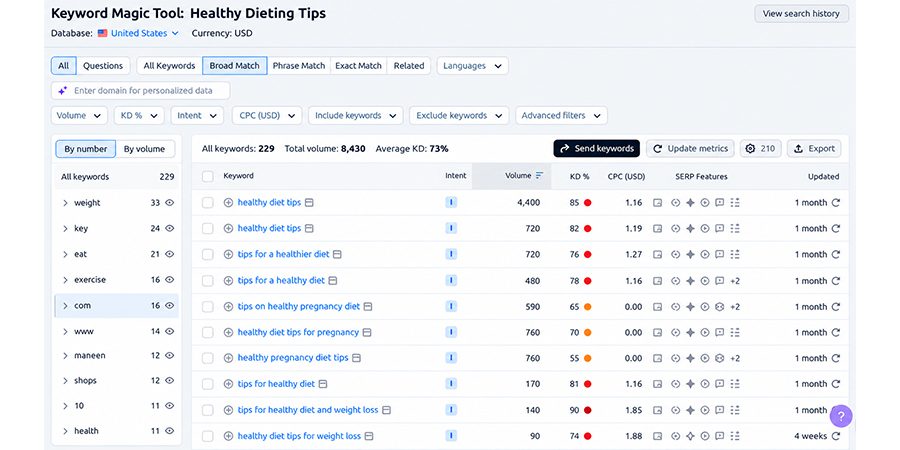
You can now click on the keyword to gather more details regarding the same. It helps you get more details related to search volume and ranking difficulty.
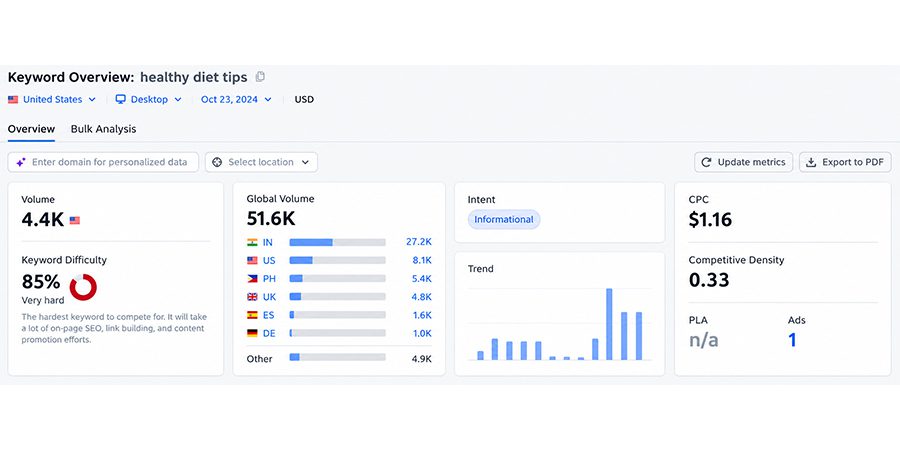
You may be desiring to select your primary keywords that have a higher search volume and ranking difficulty. And it certainly creates more challenges for you. Therefore, you need to search for keywords until you discover the right one with the least difficulty phrases.
Once you have chosen your primary keyword or phrases, you can then add the same to your SEO content brief and produce top-quality content accordingly.
- Analyze Competitor Content and SERPs
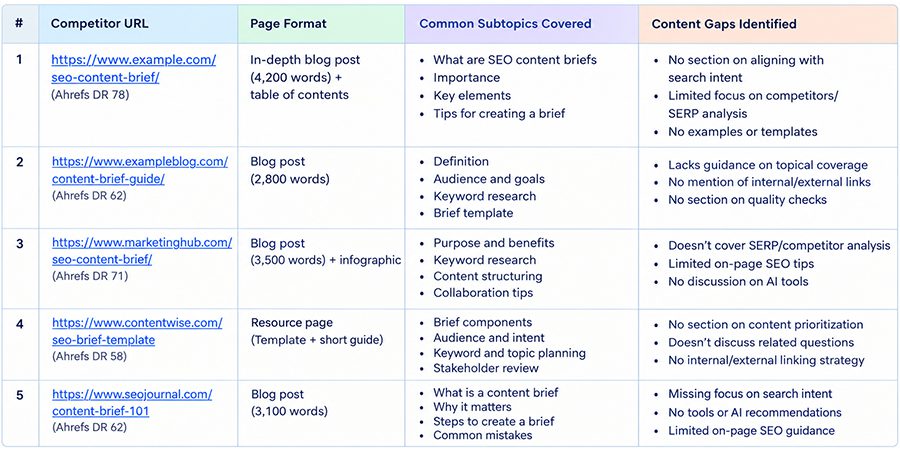
A thorough competitor analysis lets your content teams understand what their existing pages include and also discover opportunities to craft more useful resources. Meanwhile, your objective should not be competing with their articles or just recreate their complete heading structure even without determining their actual importance.
How to Start the Process of Analyzing Competitor Content?
Well, you can do it in the following important steps:
- Analyzing various relevant pages ranking for the target query.
- Go through content formats, headings, supporting statistics, examples, answers, internal links, etc., to some common questions.
- Check whether the results mainly feature comparison pages, tutorials, product pages, and some other formats.
- Check for information gaps that your content can easily match. There’s a possibility that your competitors might describe a concept even without providing implementation steps, relevant examples, etc. You can take these gaps as an opportunity to include original insights and practical guidance.
Before you start writing your content, you should first make a document of all your important findings by including recurring subtopics, competitor URLs, ideas for differentiation, content gaps, etc. You can consider a competitor source as an important insight instead of an article to rewrite.
- Develop a Focused Outline with Content Priorities
With a clear outline, you can easily organize important information logically and then maintain a complete focus throughout the content. In absence of this, content often becomes repetitive and important questions become unanswered and thus secondary topics can easily distract the major objective.
You should always craft a fully proposed heading structure according to keyword research, search intent, audience needs, competitor analysis, and more. For instance, you can follow the below heading orders:
- H1: For the main page title
- H2: For major sections
- H3: For supporting points where needed
You should focus on those sections based on their importance to any reader. Any necessary information appears before any optional example, supplementary explanations, related topics, and more. Every important heading needs to serve a unique purpose and thus contribute to the main objective of an article.
- Add Topical Coverage and Related Questions
Comprehensive content matches various crucial aspects of a topic even without drifting into any unrelated information. An impeccable SEO content brief easily discovers the related concepts, subtopics, and various audience questions writers require to cover.
You can start the process by analyzing the related search queries by going through the following important things:
- People Also Ask
- Customer Support Questions
- Sales Conversations
- Relevant Community Discussions.
These important sources can reveal the issues and some major concerns easily, which matter to your audience the most. All you need to do is to group many related questions under the right headings rather than creating a dedicated section for every query. This prevents repetition and thus produces a complete logical reading experience.
A brief targeting SEO content brief may include the following important questions:
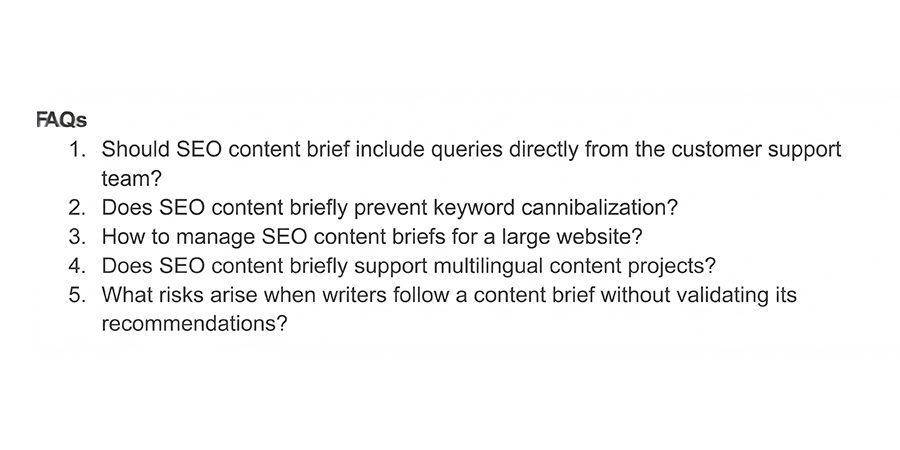
You need to focus on those questions that support your primary search intent. One thing you need to take into account is that every related question deserves an important place in the article, specifically when it needs a separate page or also addresses different audience requirements.
You need to find out those topics that need original examples, expert explanations, supporting evidence, etc. It enables writers to deliver some important and meaningful information instead of just repeating what competing pages say actually.
- Focus on Internal Links and External Sources

As far as internal links are concerned, they are meant to spread authority and thus help search engines to understand the site structure. So, it’s a great option to plan them properly and in the brief, with descriptive anchor text and target URLs.
For internal linking, you can list many relevant pages on your website, suggested anchor text, their destination URLs, etc. You can select pages that expand naturally on a topic or also support the next step of readers.
When it comes to external sources, you need to spot authoritative references that support technical explanations, factual claims, statistics, and more. It also depends on the subject, which may include original research, official documentation, established industry studies, and more.
You need to just ask your writers to not verify those sources that support any claims that are being made. A statistic is meant to be accompanied through its original source and also important context instead of copied from an article that cites even no evidence.
- Set Practical On-Page SEO
On-page SEO instructions are useful for writers to create content that readers and search engines can easily understand. Meanwhile, the brief should focus completely on certain important requirements instead of any unnecessary long checklist of any optimization rules.
You should always specify the following important things:
- Title tag
- H1 heading
- URL slug
- Meta description
- Image requirements
- Relevant internal links
All you need to do is to check the primary keyword and then explain where it may fit perfectly, including title, introduction, or a proper heading.
You need to provide complete guidance on descriptive subheadings, readable paragraphs, and useful formatting, image alt text, etc. In case the content requires structured data, a specific publishing format, technical validation, then check who can implement it.
It’s advisable to avoid rigid keyword density targets. When you repeat a keyword a number of times, it doesn’t guarantee improved rankings. It makes your content awkward.
- Leverage AI to Improve Research
Ahrefs reveals that 93% of marketers leverage AI for content, which is indeed up from 87% of the year even before. You can leverage it to save time even without replacing your judgement, summarizing competitor pages, clustering keywords, drafting meta descriptions, suggesting subtopics, generating outline options, and more.
You can leverage AI tools to let SEO teams organize information, speed up research, group related keywords, generate initial outlines, identify questions, etc., which deserve investigations further. When used properly, they make SEO content brief more effective without replacing editorial judgement.
For instance, an SEO expert can give a list of all researched keywords and then insert them into an AI tool to group the same into the related themes. After this, they can review the clusters completely, analyze search intent, and then decide topics that belong to even the same article.
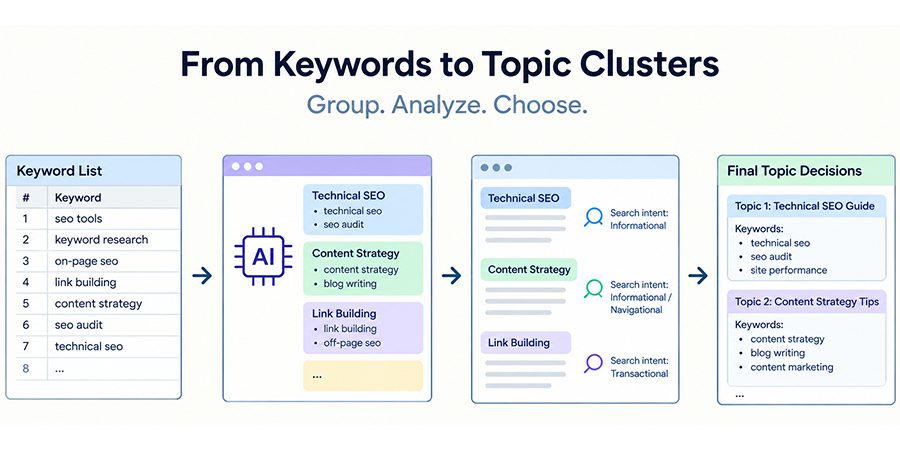
Apart from this, AI can also make an effective comparison to competitor outlines, discover potentially missing subtopics, summarize long source documents, and more. Meanwhile, you should not consider AI-generated suggestions as verified facts.
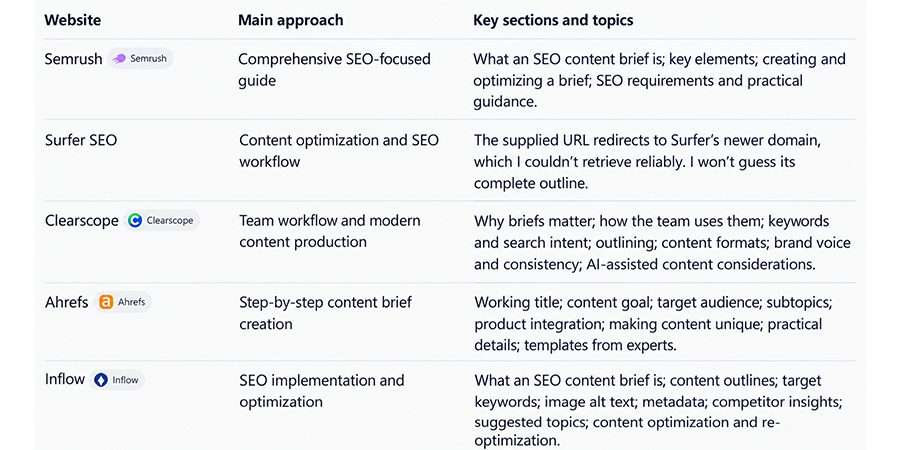
You need to check statistics against original sources, review technical claims with qualified subject-matter experts, and validate keyword recommendations with SEO tools.
- Focus on Quality Checks
Once writers create the content successfully, your next step should be to review the content thoroughly. You need to check the prepared content against your provided SEO content brief to verify whether it matches as per guideline.
Besides, you need to also check whether the stats used in the article are latest or not. And then check its source as well. You need to confirm whether the intent is answered early, review headings, test links, read the piece loudly for clarity and also for brand voice.
After checking everything, you can run plagiarism checkers to check for duplicacy. Once you find content that is original, you can then proceed to publish the same. There are indeed many tools available for this purpose.
Some Common SEO Content Brief Mistakes to Avoid
An effective SEO content brief requires proper direction and planning. But, even an experienced team can make mistakes that impact the quality of content and briefs. We have discussed some of the common mistakes along with their solutions:
- Using Plagiarized or Unoriginal Content
Some content briefs instruct writers to just copy phrasing, structure, or important points of those pages that rank. The end result is basically a near duplicate of what already exists, which offers no value to your readers and thus also maximizes the plagiarism concerns.
Solution: You can use competitor pages for research rather than templates. Always take note of the gaps they leave and also a completely unique angle, including examples, original data, expert onion, etc. Your writers should run a complete plagiarism check before final submission to the article.
- Setting Arbitrary Word Count
When you target only to match the fixed word count by crook or by hook even without considering search intent, topic, or reader expectations, you have actually created content that has no value. A longer content doesn’t necessarily perform well in search results.
Solution: You should allow the search intent and topic depth to decide the actual length. Besides, you can review your top-ranking pages to visualize how much a deal is required and then offer a complete flexible range. Besides, you should also focus on completeness and clarity instead of hitting just a number.
- Focusing on Keywords Without Search Intent
A SEO content brief that includes all those keywords but often ignores why user search produces content that mentions actually the right terms. But, it often fails to answer some real questions. In this, both engagement and rankings suffer.
Solution: You can determine the real intent for every targeted keyword, be it informational, transactional, or commercial. It’s good to analyze the search outcomes to check the formats and also angles that match it properly and then guide writers to answer the searcher’s questions and then place keywords in a natural way.
- Getting Conflicting Instructions
One section often asks for a casual tone whereas others demand formal language. On the other hand, the SEO team seeks keyword-heavy headings while the brand team seeks creative ones. Writers are often kept on guess, which piles up the revision process.
Solution: You need to ask your editorial, SEO and brand stakeholders to go through the brief before it’s submitted finally to the writer. You can set one point of contact for questions and then keep a single and a fully updated version of the document to ensure instructions are fully consistent.
- Overlooking Subject-Matter Expertise
When you assign a topic to your writer who doesn’t have enough expertise in this subject or ignore available experts, it often causes a shallow and generic content. It also finds difficulty to earn trust and reliability.
Solution: You should assign writers to topics they are fully aware of and include expert input in brief, including internal data, interview notes, recommended sources, etc.
FAQs
Ans: Yes, SEO content briefs include important queries directly from the customer support team. These queries mainly reveal product-related challenges, real customer concerns, information gaps, and more. They also help writers in crafting relevant content that matches both user needs and search intent.
Ans: Yes, an SEO content brief prevents keyword cannibalization through assigning search intent, unique primary keywords, topics to every page. It ensures content targets distinct queries and thus minimizes overlap between competing URLs.
Ans: You can manage content briefs for a large site by using centralized documentation, standardized templates, and clear workflows. You need to assign briefs according to topic clusters while prioritizing pages through business objectives and update guidelines to maintain accuracy and consistency regularly.
Ans: Yes, SEO content briefs support multilingual content projects through defining search intent, target keywords, audience preferences, localization requirements for every language. They also help to maintain consistency while adapting content to cultural differences and regional search behavior.
Ans: Well, following any unvalidated content brief often causes irrelevant keywords, inaccurate information, misleading recommendations, poor search intent alignment, etc. These issues minimize the overall content quality, undermine audience reliability, and thus harm SEO performance.
Conclusion
SEO content brief brings a clear roadmap when it comes to creating relevant, focused, and search-friendly content. It allows businesses to improve their content production and thus support their complete SEO objectives, through aligning keyword research with search intent and enhancing content production as well.
Meanwhile, creating effective content is something that requires a proven strategy and expertise. Approaching a reliable SEO company helps businesses in creating data-based content briefs, minimize content gaps, enhance organic visibility, and build a great foundation for long-term search performance.

