





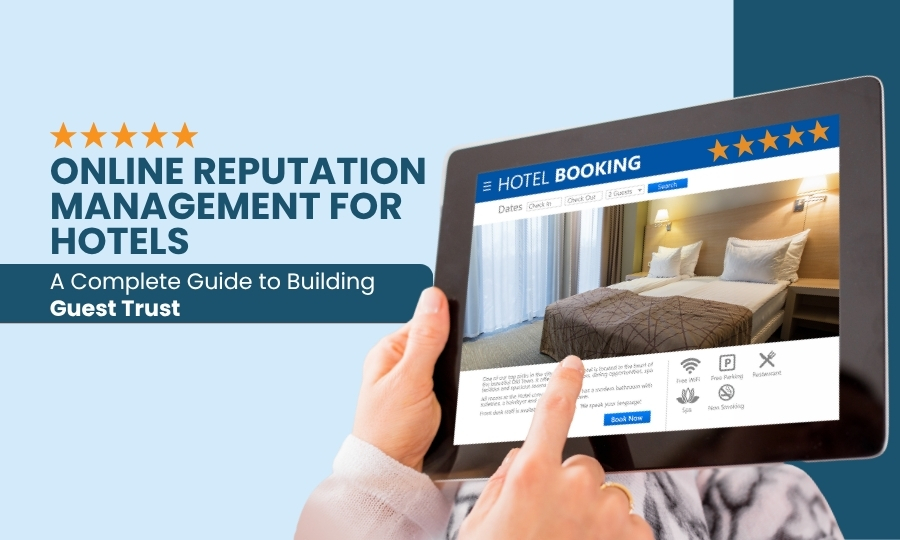
In today’s highly competitive digital scenario, modern travellers are more likely to check a hotel’s digital presence before they even step into that hotel’s lobby. The available options online for hotels are quite a few, so the competition is real! How your hotel appears across the online platforms where your target audience is mostly active and is looking for a hotel that matches their budget, required facilities, and location is crucial to its digital reputation. Managing your hotel’s online reputation is the only way to grab your potential guests’ attention. Thus, online reputation management for hotels has emerged as a non-negotiable strategy to turn casual browsers into confirmed bookings.
According to a 2024 HNR Hotel News article, 97% of hotel guests tend to check online reviews when booking a stay at a hotel. A positive online presence with a glowing review profile and impressive online image can help hotel businesses maintain consistency in driving new clients and achieve desired revenue and sales.
Here in this blog, we will explore how hotel businesses can build and manage a robust online reputation by following a strategic approach. Let’s get started!
What is Online Reputation Management for Hotels?
It refers to a strategic process of building, influencing, managing, monitoring, and shaping how a hotel property or business is perceived across the web. Hotel authorities must provide a premium experience for their guests, track their online reviews, and maintain a consistent brand voice across various online channels to drive more bookings and boost their overall revenue.
In previous times, a hotel’s reputation used to rely mainly on word-of-mouth and personal recommendations. But today, a modern traveller’s first impression of a hotel is usually formed based on the hotel’s digital storefronts, like its Google presence and visibility on industry-specific platforms like TripAdvisor and Booking.com. This makes a hotel’s online reputation a critical driver of its overall business success.
Why Online Reputation Management Matters for Hotels: 6 Key Reasons
Reputation management for hotels is crucial for a hotel business, as it helps establish authority online and build trust among potential customers.
In today’s digital landscape, hotel businesses must prioritise investing in online reputation management to build a strong online presence and stay ahead of competitors.
- Positively Impacts Booking Decisions
A majority of travellers are more likely to book a hotel with a higher rating when choosing between two otherwise similar properties. In a competitive market, and especially during off-peak seasons, every single booking counts to generate revenue. As most travellers are more likely to search for a hotel online before booking their stay, it’s crucial to establish a strong hotel reputation online.
Effective online reputation management ensures your hotel is positioned as an authority in its niche market, encouraging potential guests to book their stay at your hotel.
- Builds Guests’ Trust
Strategic online reputation management requires hotel businesses to respond to online reviews, no matter whether they are positive or negative. When you respond to your customer reviews and comments, it helps you showcase your transparency, accountability, and commitment to delivering the best possible guest experience.
You can achieve your guests’ trust by ensuring the highest level of guest satisfaction when they see how much you value their opinions. Prompt and personalised review responses turn your casual visitors into loyal and returning guests for your hotel business.
- Drives Revenue and Sales
Online reputation management for hotels helps businesses and property owners establish a strong online reputation with a glowing review profile that will create high demand. So the hotel owners can increase their Average Daily Rates without hurting occupancy.
When your potential guests see that your hotel is in demand for the best stay in the town or a specific location, and your existing guests are satisfied with their experience, they will be more likely to choose your property over your market competitors. All these positively contribute to exceptional sales and revenue generation for your hotel business.
- Influences Local Search Visibility
Major search engines like Google prefer to rank businesses with a great review profile, with recent and authentic customer feedback.
ORM strategies ensure you drive a healthy flow of reviews from your satisfied guests. This specific factor helps your hotel property rank higher in Google’s ‘Local Pack’ and also on Google Maps. So, your potential guests easily find your property when looking for the best hotel in their preferred location.
- Helps Maintain Brand Image
Online reputation management for hotels helps business owners to navigate how their property is perceived across the internet. ORM for hotels requires you to address negative feedback and guest complaints constructively.
It allows you to resolve operational issues and prevent isolated complaints from damaging your hotel’s digital image. You can maintain a consistent online image for your hotel across major digital platforms so that your target audience perceives your hotel business in the same way, no matter where they come across your profile.
- Increases Search Engine and OTA Visibility
OTA platform algorithms and metasearch engines favour hotel properties with high online ratings and great review engagement to rank them higher in their search results. A great reputation comes with higher visibility on search engine results pages, higher impressions, greater profitability, and better click-through rates.
The more visible your hotel is across the search engines and OTA platforms, the more potential guests will be likely to feel interested in your hotel offerings and book their stay at your hotel. Hotel businesses can seek professional hotel reputation management services to maximise these benefits.
4 Key Factors That Influence Online Reputation Management for Hotels
Do you know what can mostly influence your hotel’s online reputation?
If not, we will discuss this in this section. A hotel’s reputation can be influenced by multiple factors. You need to achieve those factors to build a great digital image and authority. When comparing identical options when it comes to hotels, your potential guests will assess these factors to decide whether to choose your hotel or not.
Here are four key factors that majorly influence a hotel business’s online reputation:
- Online Guest Reviews
The first thing that majorly influences a hotel’s online reputation is the guest reviews it receives across online platforms. The detailed textual reviews your hotel receives from your satisfied guests provide your prospects with unfiltered insight into various factors, such as your hotel’s room comfort, staff friendliness, cleanliness, and hospitality.
Your review profile provides the best possible information to your potential guests so that they can make an informed decision by choosing your hotel for their stay. A glowing review profile with a noticeable volume of recent, detailed, and genuine guest feedback can majorly impact a hotel’s online reputation.
- Ratings across Online Review Platforms
The star ratings range from a score of 1-star to 5 stars on channels like Google Maps, Google Business Profile, and industry-specific review sites like TripAdvisor and Booking.com. A great volume of higher ratings on these platforms acts as instant visual trust signals.
These ratings can drastically improve your hotel’s search visibility across these platforms, while search engines prefer to rank hotels with higher ratings in their results. It allows you to command premium pricing for booking your hotel rooms, boosting your sales and revenue.
- Social Media Mentions
The more people mention your hotel on social media, the greater opportunities you will get to make your hotel reach wider and highly targeted audiences. Thus, you must promote user-generated content, influencer tags, and guest posts on social media platforms like Instagram and TikTok. Monitoring social media mentions is crucial to reputation management for hotels.
Thus, you must encourage your guests to use branded hashtags and share positive experiences by tagging your hotel on social media channels. By leveraging these social media mentions, you can foster a social media community and drive direct engagement.
- Website and Online Booking Experience
Your hotel’s website is more likely to be the first point of contact when a traveller comes across your hotel’s online presence. It’s the first touchpoint between your property and the guest. If your hotel booking process through the website is too slow or quite complex, it may erode the trust that your hotel has built through great reviews.
You must ensure that your hotel’s website is mobile-friendly and that the pages load quickly. Additionally, your website must offer a seamless and transparent experience for visitors to find their suitable room by calculating rates and finally completing a reservation.
4 Major Online Platforms Hotels Must Prioritise to Manage Their Digital Image
From Google Business Profiles to popular hotel review sites, you must prioritise certain platforms for online reputation management for hotels. As part of your active and multi-channel strategy, you must consider building an exceptional presence on major review hubs, hotel booking platforms (OTAs), and social media channels to build trust, boost SEO, and drive direct reservations for your hotels.
Here, we have talked about some key platforms that hotels must prioritise to strategically manage their business’s online reputation:
- Google Business Profile
The foundational pillar for boosting your hotel’s local SEO is building and maintaining a well-optimised Google Business Profile. You must add accurate NAP details (name, address, and phone number) of your hotel to your Google Business Profile (GBP) account.
A well-optimised GBP ensures your hotel’s presence on Google Maps and Google Search. Ensure there is a steady flow of high-quality photos on your GBP profile and monitor the incoming reviews to showcase your hotel as active, relevant, and beneficial to meet your prospects’ requirements.
- TripAdvisor
This specific platform has reached a milestone with a record of 12.46 million total business listings in 2024. It has emerged as one of the most popular hubs for effectively managing unbiased traveller reviews and word-of-mouth recommendations. Strategic TripAdvisor review management requires you to claim your hotel listing and respond to every review you receive on the platform. TripAdvisor also allows you to showcase photos to build credibility.
- Booking platforms
There are quite a few hotel booking platforms available online that travellers mostly use to book their stay at a hotel. If you run a hotel business, you must build and optimise its presence to attract more potential guests.
The following are some popular hotel booking platforms that you must prioritise to boost your efforts for online reputation management for hotels.
- Booking.com
This platform is the global leader in online hotel reservations. If you want to make your hotel business reach a global audience and ensure high conversion rates, you must prioritise building a strong profile on Booking.com. We suggest that you carefully optimise your hotel property descriptions and images to stay ahead of your local market competitors.
- Expedia
It’s ideal for reaching a broad audience, such as premium luxury travellers and other tourists. If you want to target and acquire premium and luxury travellers for your hotel, you must consider building a strong profile on Expedia. You should always maintain rate parity across the platform and your direct channels. You can utilise the promotional tools of this platform to secure targeted hotel booking deals.
- Agoda
It’s a dominant player in the hotel booking industry in the Asia-Pacific region. Agoda is ideal for hotel businesses that want to attract international tourists and visitors from Asia. If your hotel prioritises competitive pricing and targeted promotions, you can consider building a strong profile on Agoda.
- Social Media Channels
How your hotel appears across social media platforms is crucial to building a community and reaching a wider audience. Social media platforms like Facebook, Instagram, and Twitter help hotel businesses build a solid digital image.
This is one of the best social media platforms to grow a hotel’s online reputation, especially for family properties and local resorts. By building a Facebook presence, a hotel can create a dedicated community, share detailed updates about upcoming events and special booking offers, and run targeted ads to local demographics.
With nearly 3 billion monthly active users, Instagram has emerged as the ultimate hub for travel inspiration and visual storytelling. Hotel businesses must focus on building a robust and well-optimised profile on Instagram. Specifically, boutique hotels and visually stunning properties can promote their business on Instagram by sharing engaging and visually captivating video content.
You can post high-quality photos of your hotel rooms, amenities, dining, and other facilities to attract new guests. Instagram also allows you to encourage user-generated content by asking your previous and existing guests to share their feedback on their hotel stay and tag your property.
Top 9 Strategies for Online Reputation Management for Hotels: A Complete Guide
Now that you know what platforms you should focus on to professionally manage your hotel’s online reputation and the benefits you can achieve through it, we will now talk about the effective strategies every hotel business must prioritise to build and manage its brand presence across the digital landscape.
Explore the list of the top 9 strategies for Online reputation management for hotels to transform how your hotel is perceived online:
Strategy 1: Deliver Exceptional Guest Experiences

Never expect a guest to share a great review, even if their experience is not so GREAT!
Offering a satisfying stay is the most organic way to generate more reviews from your guests. When they have a great experience at your hotel, they will naturally feel encouraged to share their positive experiences.
Here are some important factors you should consider while providing an exceptional guest experience through your hotel services:
- Anticipate Your Guests’ Needs: You can use your guests’ histories and personal choices to personalise their stays at your hotel. You can consider arranging their preferred room temperature, tailored welcome amenities, and dietary requests.
- Offer Real-time Issue Resolution: To resolve your guests’ concerns, your team can employ helpful messaging tools like SMS and on-site apps to allow the guests to privately voice their concerns before they leave your hotel.
- Empower Your Staff: You must train your front-desk and service staff to ask open-ended questions about their experience during their stay. So that the issues can be resolved quickly before check-out.
Strategy 2: Encourage Guests to Leave Reviews
Never expect your happy guests to share reviews if you don’t encourage them to do so.
Yes, you’ve heard that right! Even your satisfied guests may not share their feedback if you don’t request it or show how much their reviews mean to your hotel business. But there is a way you can ensure receiving positive reviews from your guests. Let’s know about this:
- Email Follow-ups
Effective review management for hotels requires you to follow up with your guests by sending personalised post-stay emails within 24-48 hours of checkout. While emailing them, you must address the guest by their name, thank them for choosing your hotel for their stay, and include a direct link to your hotel’s Google Business Profile or other industry-specific review pages.
This technique works best for direct-booking guests, while OTA guests can find the hotel booking form by navigating the platform’s automated email. When you follow up with your guests through emails, it helps you showcase how much you value their feedback – it’s indeed a great practice of online reputation management for hotels.
- QR code Feedback Requests
Strategically place the QR codes in high-traffic areas, such as elevators, in your hotel reception, and on welcome cards. Scanning the QR code must guide the guests to a direct feedback form and your preferred review platform.
- Checkout Review Reminders
You must train your reception staff to gently ask your guests about their stay experience during the checkout process. The staff can politely remind them to share their experiences online through your hotel’s review pages. They can also hand out physical business cards that feature QR codes or short URLs to your review page as part of checkout.
Strategy 3: Respond to All Reviews Professionally
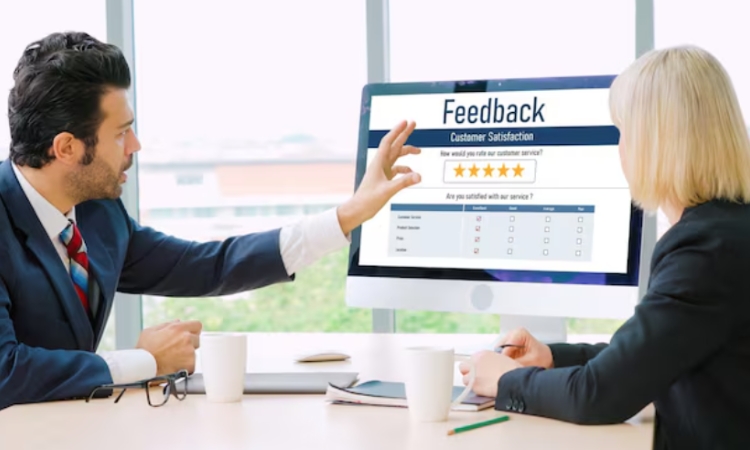
Generating reviews is not enough to boost your hotel’s online reputation. A 2026 BrightLocal study has claimed that 89% of consumers expect businesses to respond to reviews. This specific statistic reflects the rising service expectations of modern consumers.
How you’re addressing your hotel’s guest reviews showcases whether you value their feedback or not. It also reflects that your hotel is attentive, truly values guest experience, and is committed to resolving its guests’ concerns.
The following are tips and tricks to deal with positive and negative hotel reviews as part of your efforts for online reputation management for hotels.
- How to Respond to Positive Hotel Reviews?
Check out how you can respond to positive reviews you receive from your hotel guests:
- Always acknowledge the positive reviews and greet the guests by name.
- Thank them for taking the time to share their experience after their stay at your hotel.
- While responding, mention specific details that the guest has highlighted in their review.
- You can also promote your upcoming events and unique amenity of service launch, inviting them to your hotel for another stay.
- Positive Review Response Example
Here is a sample of a positive hotel review response you can take as a reference:
“Hey (guest name), thank you for your wonderful 5-star review! We are happy to know that you thoroughly enjoyed your stay at our hotel (your hotel name), specifically our (specific service/feature the guest has liked the most). Our team strives to offer top-notch hospitality for our guests, and it’s great to know we have served beyond your expectations. Can’t wait to welcome you back for another relaxing getaway!”
- How to Respond to Negative Hotel Reviews?
You cannot expect all your guests to be satisfied with your services and leave a glowing rating for your hotel. It’s common to receive a negative review! However, a strategic response to a negative review can turn a poor guest experience into an opportunity to regain their trust.
Now we will talk about how you can respond to negative hotel reviews:
- Be prompt in responding to a negative review and aim to respond within 24-48 hours.
- Don’t hesitate to apologise for the inconvenience caused to the guest without being defensive.
- Don’t forget to provide a direct phone number or specific email ID so that the guest can contact you privately to discuss their concerns.
- You can also briefly mention how you have planned to resolve their issues. Assure them that you’re taking necessary action to offer a resolution at the earliest.
- Negative Review Response Example
Below, we have provided you with a sample of a negative hotel review response:
“Hello (guest name), we’re sorry to hear that you didn’t like our (specific issue mentioned by the guest) during your recent stay at our hotel. This is not the hospitality standard our team aims to provide to our hotel guests. We have shared your feedback with our (specific team) to address the issue immediately. Feel free to contact us at (your hotel’s email ID/contact number) to discuss the issue with our team. We truly value your opinions and hope to have the opportunity to earn back your trust.”
Strategy 4: Maintain Consistency across All Channels
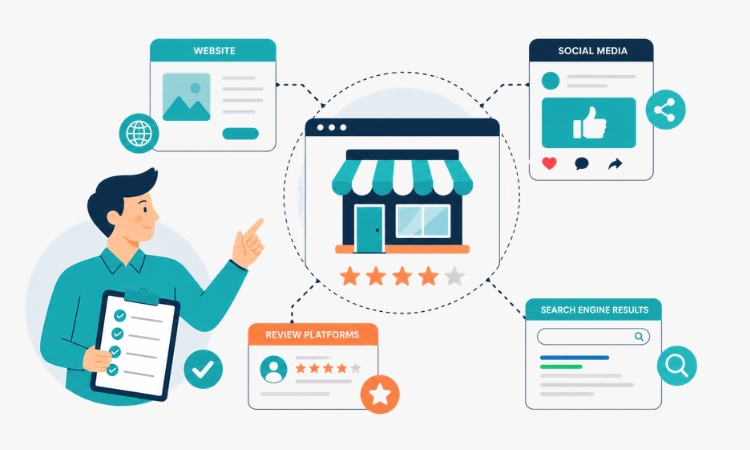
If you are focusing on only one platform to target your potential guests, it may not have a bigger impact.
Maintaining consistency in terms of brand presence is crucial to reputation management for hotels. It clears confusion and increases consumer trust. You must align your brand, pricing, and messaging across every touchpoint. It can help you drive direct bookings for your hotel.
- Website
Do you have a website for your hotel? If not, you must consider developing a well-optimised and user-friendly website that perfectly features your hotel’s accurate contact information, a secure booking system, and high-quality, attractive visuals. Hotel business owners must add a dedicated testimonial page to showcase their glowing guest reviews and enhance transparency.
- Social Media Channels
Your hotel’s presence across popular social media channels like Facebook, Instagram, and X (Twitter) is crucial to building an online community. Ensure that your hotel’s social media presence reflects the same branding, logo, and comment/brand mention response time across all channels. Don’t forget to promote user-generated content and positive guest testimonials on your hotel’s social media business pages.
- Review Platforms
Always monitor and respond to the comments and guest feedback you receive on major industry-specific review sites like Google Business Profile, TripAdvisor, and Yelp. You can employ tools to stay organized with your guest review management.
- Search Engine Results
You should maintain an optimized Google Business Profile and implement relevant keywords in your website content to rank your hotel higher in search engine results for trending user queries. This will help your potential guests easily find your hotel online by searching on search engines like Google.
- OTA Platforms
Don’t forget to regularly audit your hotel’s listings on OTA platforms like Booking.com and Expedia. We suggest that you add your hotel room descriptions, rate parity, and high-resolution photos to your business profiles on these OTA platforms. Ensure these details are completely aligned with your direct hotel room booking channels.
Strategy 5: Regularly Monitor Brand Mentions
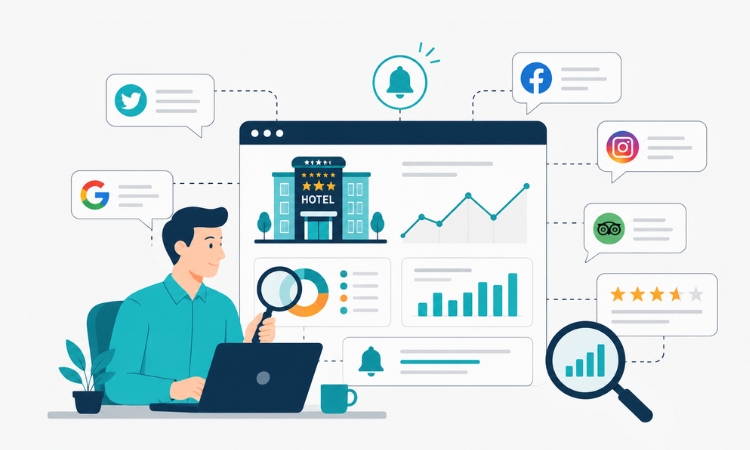
You must monitor your brand mentions across online platforms.
This monitoring is far beyond just responding to your Google reviews and TripAdvisor pages. Regularly monitoring your online mentions helps you to capture guest sentiment. Here’s how you can effectively monitor online brand mentions of your hotels:
- You can centralize your monitoring efforts by using specific industry platforms like Revinate and Hootsuite. These tools will automatically track brand mentions across more than 100 web channels, OTAs, and forums in a single dashboard.
- Reputation management for hotels requires your team to evaluate the intent behind the online brand mentions to understand the service trends, such as delicious breakfast, long check-in waits, and room cleanliness.
- Your team shouldn’t just focus on counting the number of social media posts where your hotel’s name is mentioned. They prioritize setting up instant notifications to resolve complaints in real time and capitalize on organic social sharing.
- You need to track the untagged social media conversations by monitoring the keywords, location tags, and hashtags. Because many guests often mention hotels on social media platforms regarding their stay without tagging the hotel’s official social media handle.
Strategy 6: Showcase Guest Testimonials
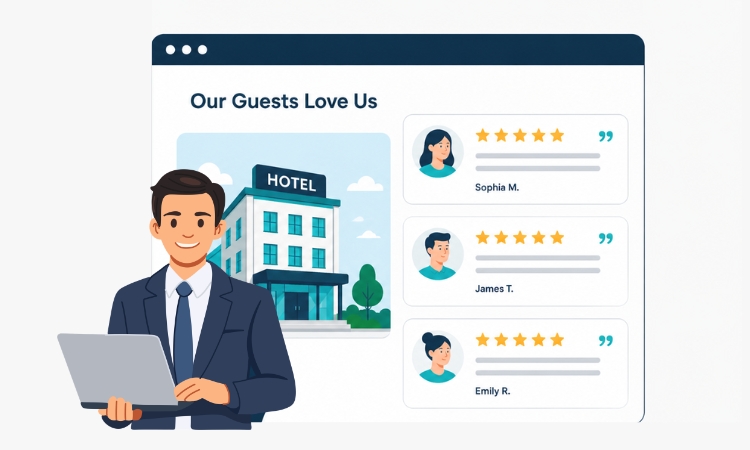
Generating good reviews is not enough to grow a hotel’s reputation. Effective online reputation management for hotels requires you to promote the glowing reviews and showcase how satisfied your existing and previous guests are with your hotel services.
Do you know that 95% of consumers are more likely to read reviews before making a purchase decision?
Modern consumers heavily rely on existing customers’ real experiences with a business rather than on traditional word-of-mouth recommendations.
- Tips to Showcase Your Hotel Guest Testimonials
- Social Media: You can share your glowing reviews on your hotel’s social media business pages on Facebook, Instagram, X, and even LinkedIn.
- Website Widget: You can also embed a dynamic review widget on your website’s homepage. It will allow you to provide immediate and verifiable social proof to your potential guests.
- Dedicated Testimonial Page: We suggest that you create a dedicated ‘Guest Stories’ or ‘Testimonials’ section on your website. You can also share high-quality images of your guests’ experiences to support those reviews.
A Tip for You! Hotel business owners must request permission from their guests before using their reviews for promotional purposes.
Strategy 7: Optimise Your Hotel’s Online Presence for SEO
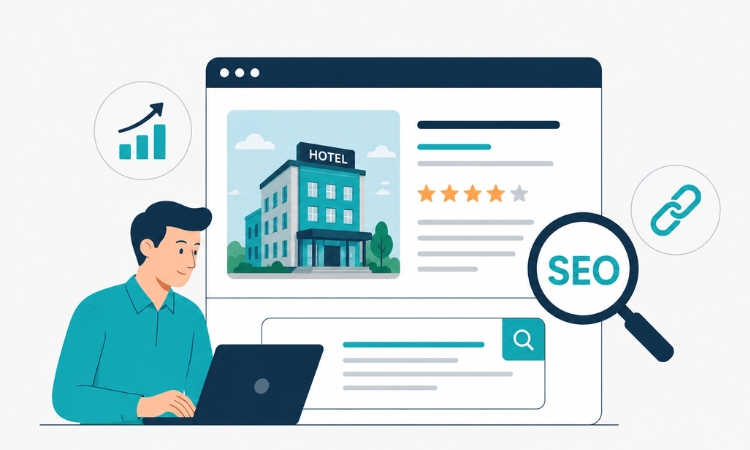
Now it’s time to make your hotel rank higher on search engine results pages for relevant user queries.
For this, you need to optimize your hotel’s presence to boost its SEO. This will help your potential guests easily find your hotel on search engines like Google.
- Leverage Local SEO
Firstly, you need to ensure that the out-of-town prospects who are actively searching for the best accommodations in your hotel’s location can easily find your property online. Hotel businesses that want to drive local foot traffic must consider leveraging local SEO.
- As local search is the primary way your potential guests will find your hotel online, you must claim and optimise your Google Business Profile with accurate NAP details like the name, address, and phone number (NAP) of your hotel.
- Don’t forget to update your hotel amenities and high-quality photos on your Google Business Profile.
- Always ensure your NAP details are accurate and consistent across all your online directories.
- Focus on driving reviews from your local guests and promoting those on your website.
- Implement relevant local keywords in your website content to make them rank for ‘near me’ searches.
- Optimise Your Hotel Website
We have already mentioned that you must implement local and other relevant keywords in your website content to make them appear for relevant user queries. Optimising your hotel website – the digital storefront of your hotel – is important to boost your efforts for online reputation management for hotels.
Don’t forget to integrate those keywords into your website’s meta title, meta description, and overall page content.
- Always highlight guest feedback on your website’s homepage or a dedicated testimonials page.
- You must consider implementing structured schema markup to allow search engines to showcase your hotel’s star ratings, positive guest feedback, and FAQs in their results.
- Prioritise the User Experience of Your Hotel Website
The experience your visitors gain after scrolling through your hotel website is crucial to determining their booking decisions.
Thus, you must prioritise the user experience of your hotel website.
- Ensure your website functions perfectly across all mobile screens. More than 50% of hotel bookings are now completed via mobile devices, as the 2024 GuestCentric study has revealed.
- Prioritise improving your website page speed, as it will prevent your visitors from bouncing to a competitor’s site.
Strategy 8: Utilise Social Media to Strengthen Hotel Reputation
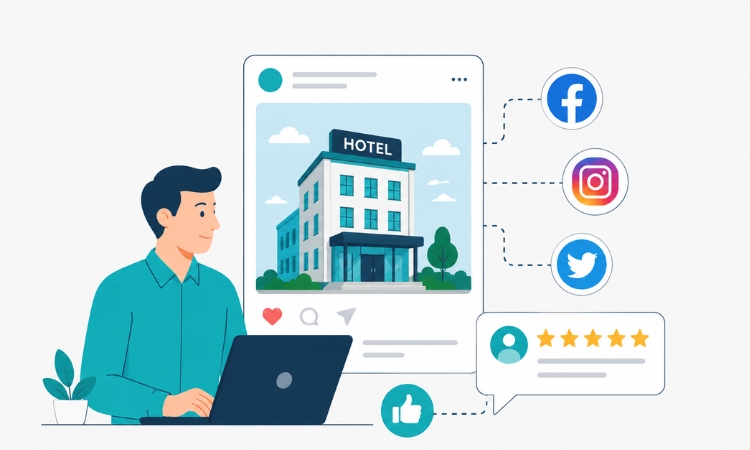
Social media management plays a vital role in strengthening your reputation management for hotels.
Through social media platforms, hotel businesses can transform their passive online profiles into active reputation management tools. Here’s how you can leverage social media platforms to strengthen your hotel’s reputation online.
- Share Authentic Guest Experiences – Always share tagged guest experiences, glowing reviews, and repost other user-generated content on your hotel’s social media business pages. These real experiences will serve as genuine social proof for your hotel.
- Post Behind-the-Scenes Content – We suggest that every hotel business must humanise its property by posting behind-the-scenes content involving every team member, from the executive chef to the housekeeping staff.
- Partner with Social Media Travel Influencers – Host popular social media influencers for a stay at your hotel. This will help you generate high-quality visual content and target their followers as well as their broader audience demographic.
- Share Engaging Video Content – Always prioritise sharing short-form engaging video content on your social media profiles, such as Instagram Reels and YouTube Shorts, to highlight your hotel property, rooms, and local travel guides.
Strategy 9: Measure Your Hotel Reputation Management Success
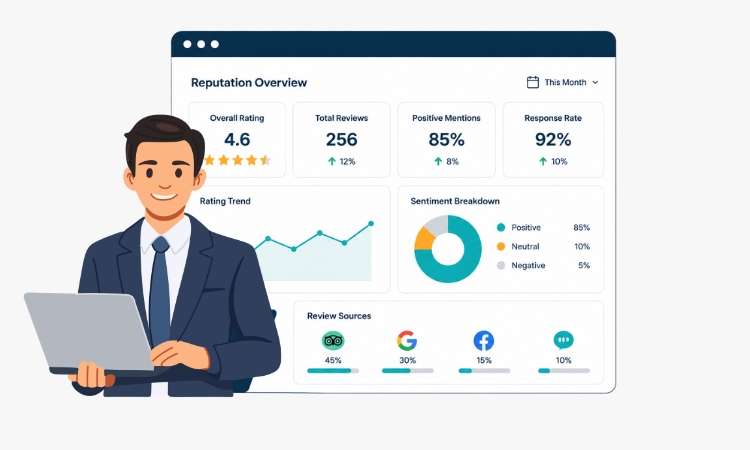
Last but not least, a hotel must measure its reputation management efforts. Tracking certain key performance measures can help you identify the areas for improvement and strategies that are performing well to grow your hotel’s digital image.
Key Performance Indicators (KPIs) to Track:
The following are some key performance indicators you must track to measure your ORM efforts:
- Online Reputation Score (ORS) – An aggregate index that involves your hotel’s ratings across all the major online review and OTA platforms.
- Net Promoter Score (NPS) – How likely your hotel guests are to recommend your hotel to their friends or colleagues.
- Review Volume and Velocity – The quantity of online reviews your hotel has received over a specific period, and how frequently the reviews are published.
- Review Response Rate – The percentage of online guest reviews your team actively responds to.
- Review Response Time – The average time it takes for your hotel’s management team to post a reply to a new guest review.
- Guest Satisfaction Score – The specific experiences during a guest’s stay at your hotel, typically collected via post-stay email surveys.
5 Best Reputation Management Tools Hotels Must Employ
We know that online reputation management for hotels is quite tricky. It requires you to follow a strategic approach. But employing some helpful tools can make the process more seamless and help achieve more reputational benefits for your hotel.
Below, we have enlisted the top 5 most reputation platforms or tools you must prioritise for your hotel:
| Tools Name | Features to Use |
| ReviewTrackers | Allows deep customer sentiment analysis and review analytics Gathers online reviews from hundreds of websites and analyses guest sentiment, helping hotels to pinpoint operational strengths and weaknesses |
| Birdeye | An all-in-one automation and multi-location franchise hotel’s online reputation Automatically triggers review requests post-checkoutsHelps route negative feedback to your hotel’s staff Centralises messaging between hotel staff and guests across various channels |
| Review Pro | Allows hotel business owners to benchmark their hotel property’s reputation against competitors using data from platforms like Google, TripAdvisor, and Booking.com Breaks down guest feedback into actionable data and helps staff correlate satisfaction with specific services, amenities, and room quality \Allows creating personalised surveys that you can send at any point during the guest journey to collect direct feedback |
| Hootsuite | Ideal for large-scale social listening and crisis preparedness Tracks broader hospitality trends, competitor activity, and real-time conversation monitoring Allows your hotel’s marketing team to swiftly address PR concerns and engage with travellers in their specific regions |
| Sprout Social | Allows social-centric listening and community engagementAllows hotels to track brand mentions on social media platforms Ideal for monitoring untagged feedback and running social customer service |
5 Common Mistakes to Avoid while Managing a Hotel’s Online Reputation
Till now, we have been talking about how hotel business owners can master managing their online reputation. It requires them to ensure consistent engagement and deliver proactive services for their guests.
But making certain common mistakes can ruin your entire effort for online reputation management for hotels. In this section, we will discuss the 5 most common mistakes hotel businesses often make while managing their digital image:
Mistake 1: Ignoring or Delaying Review Responses
Are you leaving your guest reviews unaddressed or taking a lot of time to respond? If yes, this practice may showcase that you don’t value your guests’ time or feedback.
The Fix: You should build a daily and weekly routine to track and respond to both positive and negative guest feedback. We suggest that you respond to all the reviews within 24-48 hours to demonstrate that you strive to promptly solve your guests’ concerns and that you truly value their opinions.
Mistake 2: Arguing with the Guest Defensively
Don’t get defensive or blame the guest for sharing a negative review, as it can even escalate the situation. In the hospitality industry, you cannot expect all your guests to be satisfied with your services and share glowing reviews for your hotel.
The Fix: Do you know that 97% of review readers also read business responses? So it’s more likely for them to see how a business is handling negative guest experiences. You must keep calm and politely respond to unfavourable reviews by acknowledging the guests’ concerns, apologising if necessary, and inviting the guests to have an offline conversation with your team.
Mistake 3: Forgetting to Promote Positive Feedback
Generating positive reviews from your satisfied guests is not enough if you don’t promote them across your online profiles. If your prospects are not aware of your existing guests’ satisfaction with your hotel services, even receiving a large number of positive reviews is of no use. Many hotels commonly focus on damage control and often forget to promote their 5-star reviews.
The Fix: You should always leverage your positive guest reviews for building guest trust. You should always promote your best guest reviews through your website’s testimonials and consider sharing them across your social media channels.
Mistake 4: Not Prioritising Guest Experiences
Many hotels often fail to focus on providing the best experience for their guests. They think that sharing a great and meaningful response can mitigate the impact of a negative guest experience. But this is not always the case! Effective reputation management for hotels requires you to prioritise guest experience before expecting glowing reviews from them.
The Fix: When you strive to provide exceptional guest services, it naturally encourages satisfied customers to share positive reviews for your hotel. You can train your hotel staff to offer the best possible services to the guests by meeting their requirements and prioritising fixing even the minor grievances to avoid further escalation.
Mistake 5: Neglecting Social Media Interactions
Managing a hotel’s online reputation extends well beyond handling communications on major travel sites like TripAdvisor and Booking.com. If you fail to monitor your interactions across social media platforms like Facebook, Instagram, and X, it can leave your hotel business vulnerable to unmanaged guest complaints or viral PR crises.
The Fix: You must establish an omnichannel approach to effectively engage with your hotel guests. We suggest that you implement social listening tools or assign a dedicated team to handle direct messages, social media brand mentions, and tags. So that you can promptly respond to those interactions in real-time.
FAQs
The following are some frequently asked questions and answers related to online reputation management for hotels:
Ans. Yes, you must prioritise hiring a professional online reputation management agency based on your budget and other requirements. Especially if your hotel lacks an internal online reputation management team and your budget allows investing in professional ORM services, you must consider partnering with an agency to effectively manage online reputation management for hotels.
Ans. A hotel should respond to its guest reviews within 24-48 hours after receiving them. Especially for negative reviews, you must address the issue within 24 hours and offer a suitable solution at the earliest. It is critical to show your team’s accountability and prevent potential guests from booking any other hotels.
Ans. If you seek professional hotel reputation management services from a globally renowned ORM agency, it may cost you between $499 and $15,000 or more per month. On the other hand, it may cost less if you hire the same services from a local ORM service provider. The estimated cost completely depends on the scope of the work and your hotel’s online reputation needs.
Ans. Effectively managing a hotel’s online reputation takes 6-12 months to show a desirable outcome. After the mentioned time frame, you can expect to witness measurable results like improved search rankings of your hotel’s web content, increased booking conversions, and compounding revenue.
Ans. No, absolutely not! You must not offer discounts, freebies, or any other complementary facilities to your guests during their stay at your hotel in exchange for positive reviews. This specific practice violates the terms of service of major review platforms like TripAdvisor and Google Reviews.
Conclusion
Today’s digital age demands a digital-first approach. You also need a digital strategy plan to build and manage your hotel’s reputation online. Effective online reputation management for hotels requires you to follow a strategic approach; it’s not something you can expect to achieve measurable results overnight. From managing guest feedback across various sites to boosting direct booking numbers by enhancing online search visibility, ORM for hotels is quite a complex process.
We hope that our comprehensive guide will help you navigate the tricky process and build a desirable online image for your hotel business. Following our strategies can help you turn your digital presence into a growth accelerator for your hotel.
Consider seeking tailored online reputation management services to seek their professional assistance if you want your hotel to transform from just a place to stay to a one-stop destination for a premium hotel experience.

