






SEO used to concentrate on ranking for a few high-volume keywords. Now, with users doing more specific searches, there are a lot of chances to get relevant organic traffic. It can be difficult and time consuming to make pages for every search. Programmatic SEO solves this because businesses can now use automation. Instead of creating many URLs, businesses should publish useful and meaningful content that ranks over low value content.
After updating their search in 2024, Google showed that there was a 45% decrease in the amount of low-quality content posted by users compared to their baseline. This captures the importance of prioritizing quality when creating pages. In this blog, we will discuss programmatic SEO and how you can implement it in your website. Let’s dive in:
What Is Programmatic SEO?
Programmatic SEO is the creation of mass pages through automation. It provides the foundation for quickly creating SEO pages through the use of search intent, structured data, and reusable page templates. The framework can be built once and used multiple times to create multiple pages. This is much faster and more efficient for businesses to increase their visibility within organic search. Unfortunately, there is always a trade-off when something becomes easier to scale and automate. The focus must remain on the quality, relevance, and user value of the pages to ensure the increased scale isn’t vaporware.
Amplify your search visibility through our Programmatic SEO. We integrate automation, search intent, and scalability in page creation to assist you in capturing more keywords and increasing organic traffic.
How to do Programmatic SEO
Programmatic SEO has its phases involving demand, data, content, and automation. It begins when repeated keyword patterns are identified and the searcher’s intent is understood.
When the opportunity is validated, the data is collected and added to the automation system and a page template is created. When the template and dataset are connected, each individual page can be created automatically.
Step 1: Keyword Research
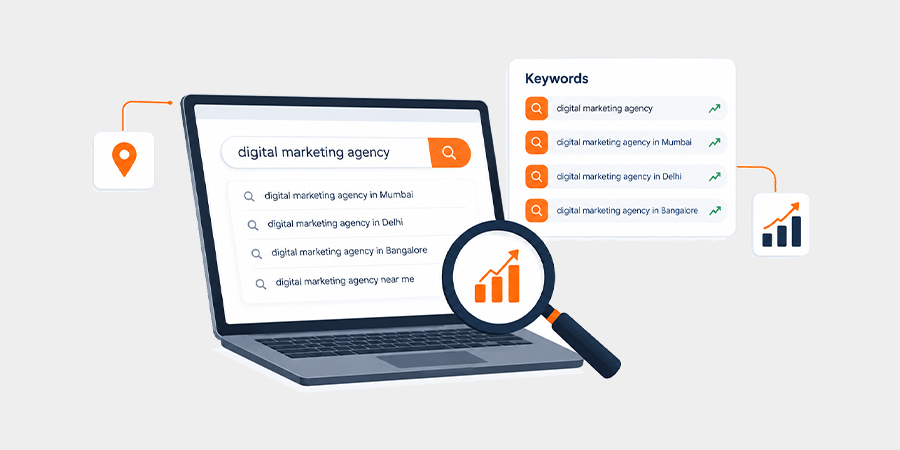
Start looking for search patterns used to formulate numerous keyword variants that will result in many semantically relevant pages. A good example would be the keywords “digital marketing agency in Mumbai,” “digital marketing agency in Delhi,” “digital marketing agency in Bangalore,” etc. where the location is the variable.
To aid in the discovery of these patterns utilize keyword research tools, Google Search Console, internal site-search data, and analyze your competitors as well as your customers’ queries. Place related keywords into groups based on search intent and assess each in terms of search volume, relevance, and overall impact on the business.
Step 2: Collect Structured Data
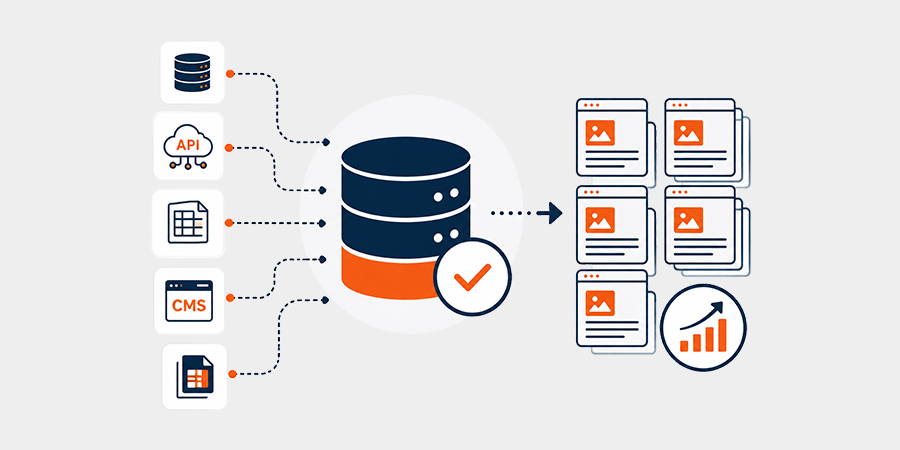
Identify the database that holds the data you will need to build the pages. This could be a product database, CRM, API, inventory system, CMS, or your spreadsheets/databases.
For each page, determine the data needed and ensure data is complete, accurate, and up to date. For instance, a job posting site may need job details such as company, job title, location, salary, and skills, and a product site may need product specs, price, and availability, reviews, and product categories.
Prior to automating the process, clean and validate the data. Poor quality data will be repeated and distributed to thousands of pages; automation will not clean the data for you.
Step 3: Create Page Templates
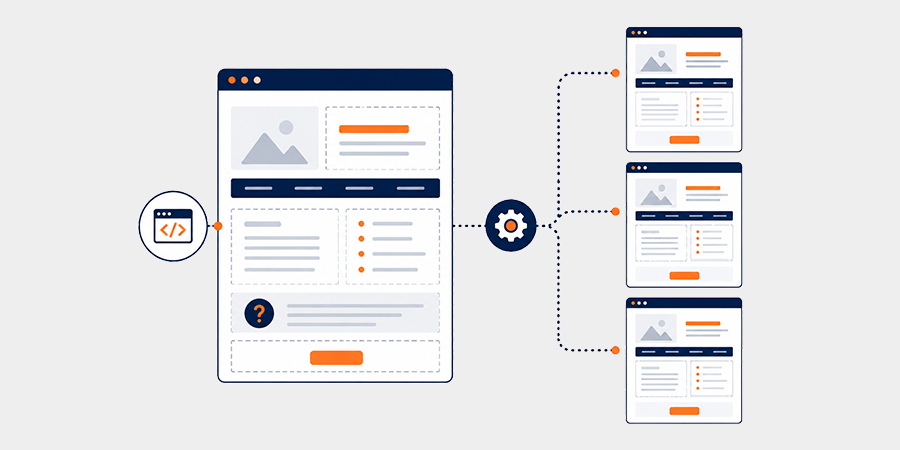
Create reusable templates for each group of pages to be built. Provide a design where each page includes a title, URL slug, headers, a main content section, supporting detailed content, questions and answers (FAQ), links to related pages, and a call to action.
Next, determine which sections should be fixed and which should be flexible depending on data for the page. Validate the template by generating a few sample pages using different data sets. This will help you ensure that your pages have all of the information that they need, don’t have duplicate information, don’t have broken information, and have all relevant information.
Step 4: Combine Templates With Data
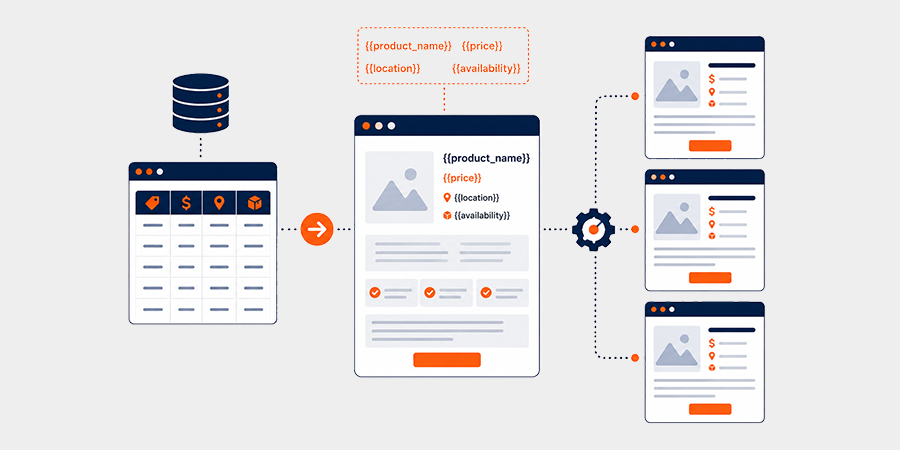
Begin by including placeholders on the page template that include {product_name}, {price}, {location}, and {availability}. Next, map these placeholders to the corresponding columns or fields in the structured dataset. When the page has been generated, the system fills in the placeholders with the related data to that row.
As an example, the field labeled Product Name is pulled into the {product_name} placeholder, and the Price field is pulled into the {price} placeholder. Therefore, each row of data is able to generate a complete page using the same template. Each page should be reviewed for fields that are missing, as well as for data that is combinations of incorrect fields or irrelevant content, prior to publishing the page.
Step 5: Generate and Optimize Pages

Create a data table in which each row represents information about a single page that defines the following fields: keyword, URL, title, product/location name, description, page content, etc.
Create a page template with dynamic fields and link it to your CMS or page-generation tool. Create rules for each placeholder for URLs, meta titles, meta descriptions, and H1s; define Schema.org markup.
Generate the pages for each row in the data table, crawl a random sample of the output, and address any missing data, duplicate content, incorrect metadata, broken links, or keyword discrepancies. Once resolved, publish all pages. Monitor the performance of newly published pages based on rankings, indexing, and organic traffic. Update pages if needed based on the performance of newly published pages.
Step 6: Publish and Index Pages
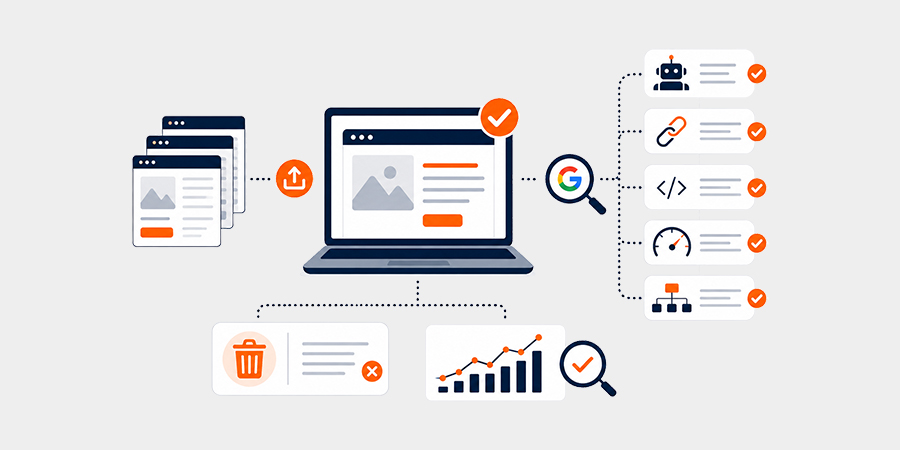
Don’t publish thousands of pages across the site all at once. Instead, publish a smaller sample to test the site and determine how search engines will interact with it.
See how the technical aspects of publishing a page perform. Test the crawling and indexing functionality. Check if the canonical tags are working properly. Ensure that internal links and metadata are correct. Check if pages render correctly and load quickly and if URLs are not duplicated. Use XML sitemaps to help search engines find important pages.
Check for and remove pages with little to no value.
Step 7: Monitor and improve Performance

After the page is published, monitor its performance using a variety of metrics, these include impressions, crawl activity, rankings etc. Analyze the performance of individual and template basis. Look at individual pages and see what templates are attracting search traffic and what are not.
- Metrics to Monitor Performance
Analyze both SEO performance and business metrics. A page count metrics, in themselves, do not reflect success.
- SEO Metrics
- Organic traffic: Measure the search traffic driven by programmatic pages and compare these page groups to one another. Analyze the number of times pages have been seen in search results.
- Impressions:Find out how many times your programmatic pages appear in search results, regardless of if users click the page.
- Rankings: Monitor the rankings of targeted keyword groups for all page types.
- CTR: Titles and meta descriptions should be optimized if your CTR is low.
- Indexed Pages: Check for published vs. indexed pages. This can help spot technical issues or quality problems.
- Crawl Statistics: Analyze statistics to determine if search engines are crawling intended pages or wasting their time on unimportant pages.
- Business Metrics
- Leads: Monitor inquiries, contact form fill-outs, calls, and any other actions that may generate leads.
- Conversions: Track the desired action taken on a programmatic page by Organic search users.
- Sign-Ups: New users, free trials, or new accounts can be tracked by SaaS business.
- Purchases: Organic users creating purchases on your e-commerce pages can be tracked.
- Revenue: Connect SEO visibility to actual business success. A page that has low traffic may drive conversions that are more valuable than a page that has high traffic and no conversions.
Pros and Cons of Programmatic SEO
A business may already have the data needed to target thousands of relevant searches. This data may include locations, products, services, specifications, categories, etc. Programmatic SEO prescribes an approach for building search pages for each relevant target. The opportunity extends well beyond high-volume terms. Ahref’s 2026 U.S. database has over 2.3 billion keywords with search volume below 10 per month. Programmatic SEO allows businesses to operate on a large scale for these specific and often low-volume queries.
- Advantages of Programmatic SEO
- Scales Content Creation: It has multiple advantages. For one thing, you can scale content creation with Programmatic SEO. Instead of manually creating each page, you can create a page using a template for multiple variations. For example, a business owner can create 500 pages, one for each city, using 1 template.
- Targets Long Tail Keywords: This sort of SEO is helpful in targeting long-tail keywords. Long-tail keywords have strong user intent and less search volume. “SEO agency for startups in Mumbai” is better than “SEO agency” because it states the exact location the service is for.
- Saves Time & Resources: It also saves time and resources because you don’t need to add page elements one at a time. Example: You can develop thousands of product pages and automatically insert product information.
- Expands Organic Visibility: Programmatic SEO can make your page visible to more search queries. Related pages for different keyword variations make your page relevant and improve SEO.
- Enables Easy Updates at Scale: With this type of SEO, it’s easy to make changes on a large scale because you can make changes to the template or data. It automatically updates pages to reflect the changes. An example is updating all product pages to reflect changes in price.
- Disadvantages of Programmatic SEO
- Thin Content Creation: Programmatic SEO has some disadvantages. If pages have thin content, which usually means a lack of unique and useful information, it becomes a waste of space for both the user and the website. An example is 500 city pages where the only variation between them is the name of the city.
- Duplicate Content: Programmatic SEO can also generate duplicate content. Relying on one template can result in multiple pages having almost identical content. A service page for each different city can result in 500 almost completely identical pages.
- Poor data can multiply errors: Automation can copy incorrect or outdated information to many different places. Example: A wrong price for a product displayed on hundreds of automatically generated pages.
- Requires technical expertise: Implementation often requires a developer and SEO team to deal with databases, templates, URLs, APIs, indexing, and other technical issues. Example: connecting a product database to an SEO page template.
- No guarantee of rankings: Increasing pages does not lead to rankings and subsequent traffic increase. Pages still have to have a purpose and add value. Example: A site possibly creates 5,000 pages, but Google may only index or rank a few of these pages.
Programmatic SEO vs. Traditional SEO
| Factor | Programmatic SEO | Traditional SEO |
Keyword Targeting | Identifies large groups of long-tail keywords that follow a similar search pattern. These keywords are usually more specific & reflect clearer search intent. E.g., hotels in Mumbai, hotels in Delhi, hotels in Jaipur. | Focuses on one or two keywords (or keyword phrases) at a time. E.g. “Best hotels in Mumbai.” |
Content Creation | Creates many pages using templates and schema markup, like creating 500 location pages from a single template. | Each page is researched, written and optimized separately. E.g. Writing a page about hotels in Mumbai. |
Scalability | Ensures easy creation of thousands of pages with minimal effort. | Scaling is slow. Each new page requires new effort. |
Automation | Automation plays a huge role in creating URLs, meta descriptions, page content, and creating links throughout the site. | Requires a lot of hands-on work for researching, writing, optimization and updates. |
Best Suited For | Big websites that use a lot of structured data like e-commerce websites, classifieds websites, catalog websites, and travel websites. | Blogs, service websites, corporate websites, and pages requiring more customization. |
Examples of Programmatic SEO
This sort of SEO can help websites with a lot of structured data and predictable search demand. This is most seen in travel websites, e-commerce, real estate, job sites, SaaS, directories, and multi-location businesses, among others. Here are some examples where Programmmatic seo is used:
- Travel Websites
Travel sites can use automated SEO to create travel guides for different travel destinations and accommodation. One example is Tripadvisor, which collects information for different destinations and hotels and pulls in reviews, bookings, location, and other available trip amenities.
Travel sites can pull together information for travel destinations and provide travelers with useful travel data, giving site visitors a reason to visit the destination other than simply ranking for a location keyword.
- E-Commerce Websites
Programmatic SEO can be used to create different pages to sell products and provide information on product categories, brands, features, product descriptions, and intended product usage. For inspiration, we can look at Amazon. They have pages on individual products and combination pages on categories, brands, features, and product usage.
Searching for “men’s running shoes”, “running shoes”, “waterproof running shoes” or any combination of these keywords, can bring up different pages for products, features, and categories.
- Real Estate Websites
Real estate websites can use programmatic SEO to create pages for location, types of property, price, apartment size, buying versus renting, etc. Sites like 99acres and Magicbricks provide search pages that bring together location and property search criteria with live listings.
A page for “2 BHK flats for rent in Gurgaon” can provide information on available properties including price, amenities, location, and other relevant data. Since the page will be used for a short period of time, this data also needs to be updated frequently.
- SaaS Websites
SaaS companies can use automated SEO to create pages for integrations with other softwares and systems, different industries, product features, alternatives, and comparisons. One of the more popular sites for this is Zapier, and they have different pages centered around different integrations.
One advantage of using this type of SEO is specificity. Searching for a Google Sheets + Slack integration brings up a page all about that combination rather than a general integrations page.
- Job Boards
SEO pages can be built around job title, location, company, industry, experience level, and employment type. Indeed and LinkedIn Jobs have programmatic pages as well, and help users easily conduct, what can be a burdensome, highly specific job search.
A target page for “data analyst jobs in Bangalore” should encompass job listings and provide employer info along with salary, required skills and experience, job type, and other details. Like the rest of the job listings on the site, outdated and expired job listings should be deleted or replaced.
- Directories
SEO pages can be built around business/service, profession, industry, and location. Yelp has categorized location pages that help users identify businesses like restaurants, professional service listings, or salons.
One of the few useful pages is “restaurants in Bandra.” That page should have real listings, ratings, user reviews, hours, and location information that users can easily access.
- Local Businesses
A chain with several locations can have SEO pages built for each location or region. Starbucks has each of its locations’ pages with info like the store’s address, hours, services offered, and location-specific information.
Each location page should strive to be useful. Simply swapping in a city name won’t provide extra value to the page.
Common Programmatic SEO Mistakes
Scale over usefulness is where most businesses begin to run into issues with programmatic SEO. Just because you can make thousands of web pages doesn’t mean you should. Automating things will most likely get things wrong, as one problem can impact a ton of URLs. These are the common mistakes that you should avoid:
- Ignoring Search Intent
Targeting keywords based on search volume without consideration for search intent results in pages with no relevance and, more importantly, no audience. A high search volume keyword will not be useful if what you have built does not satisfy the searcher’s intent either for a service, a product, information, or a location. Keywords must be relevant along with clear intent in order to have positive results.
- Poor Internal Linking
Large programmatic websites can create pages that are difficult for both the users and the search engines to find. A strong internal linking structure helps to create a hierarchy of pages. Use relevant categories, parent pages, breadcrumbs, navigation, and contextual links to connect important pages.
- Indexing Low-Value Pages
Not every page needs to be displayed for search. Pages made from templates can quickly become duplicates, empty pages, outdated pages, or even extremely thin pages with poor value. Programmatic pages need to be reviewed to determine whether they should be left as is, deleted, redirected, consolidated, or improved to ensure they do not get indexed.
- Automating Without Quality Checks
Automating can quickly produce errors as it can useful pages. Errors can quickly affect thousands of pages. One incorrect data field or broken template can quickly affect thousands of URLs.
FAQs
Ans: Structured data is pulled using APIs and programmatic pages are created. Consider a travel site or a job site. The travel site uses the API to pull data for hotels. Job sites use APIs to pull data for job listings. APIs lower the level of effort that would be needed for data entry and help sites stay up to date. APIs can’t improve the quality of the data.
Ans: Yes. A small business can execute this sort of SEO when they repeat opportunities such as having multiple locations, services, product offerings, or customer divisions. Consider an agency that has multiple established locations. In that case, the agency’s online presence can include service pages for each location that are beneficial and unique.
Ans: No. There are several ways to execute without web development. Some businesses can build pages using CMS along with spreadsheets, databases, automation, or other available integrations. Smaller implementations can be done without development. For larger implementations, development is needed to add additional components that integrate APIs, databases, templates, and publishing systems.
Ans: Answers can be found in repeatable search patterns. Searchers desire multiple instances of the same information. Look at data availability and competition for those search patterns. Each page must provide sufficient content to be saved as a unique URL.
Ans: Programmatic pages have the ability to rank for competitive keywords; however, automated page creation is not a rank signal. Instead, the relevance score, content quality, SEO best practices, authority, internal links, user experience, and site structure are the walking variates of the competitive keyword game. In this type of SEO, long-tail and structured searches benefit the most.
Conclusion
As every new search opportunity means making a new page from scratch, organic growth can become challenging. Fortunately, Programmatic SEO provides a solution. The best strategies aim for quality at scale; they find relevant search opportunities and up usability of each search page through performance analysis. If executed to its fullest potential, it can reach organic opportunities to grow while maintaining each page to be useful and worth finding.
Explore our programmatic SEO services that make it possible for your businesses to get the high-intent search campaigns up and running using landing pages based on data. The process starts from the moment we map keywords and build the landing pages.

