





Targeting numbers of similar keywords, one page at a time, often causes several issues like duplicate topics, keyword cannibalization, bloated content plans, wasted writing efforts, etc. Keyword clustering resolves these issues.
The major purpose of clustering keywords is to group related search terms based on several factors like SERP overlap, search intent, topical relevance, etc. This makes it easy to understand which keywords are on the same page and which are not. In this post, we will talk about how to perform keyword clustering for improved SEO performance.
What is Keyword Clustering?
Keyword clustering is a process that involves creating a group of similar search terms that have the same search intent and can be targeted on a single page together. It’s an important SEO technique that prevents any confusion when targeting keywords together, which have different search intent on a single page.
For example, when a user searches for “king size bed”, the result appears as follows.
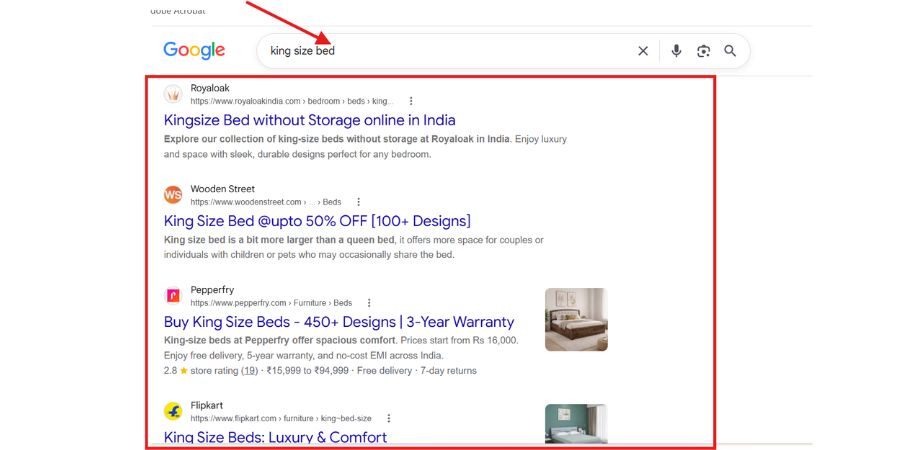
In the above result, you can see some similar search terms related to the main search term. These variations of terms are as follows:
- King Size Bed Without Storage
- King Size Bed
- Buy King Size Beds
- Buy King Size Beds with Storage Online
- King Size Bed in Fleet
- King Size Bed with Storage
While doing keyword clustering, you will be able to target mainly a primary keyword and many secondary keywords on a single page.
Apart from this, targeting a large number of terms on an individual page lets you get certain benefits from those terms that combine various search volumes as well. Even though an individual query may have lower search volumes, they could have an important potential to boost visibility together.
Google mainly emphasizes search intent instead of exact keyword matches — a strong page tends to rank for several closely related queries. Surfer’s 2025 analysis of 1 million SERPs found that pages using keyword variations rather than repeatedly targeting exact-match terms performed better.
What are the Benefits of Keyword Clustering for SEO?
Keyword clustering brings the possibility of turning keyword research into a highly focused content strategy. It’s done by connecting related topics, search terms, user needs, etc. Some other benefits are discussed below:
- Build a Topical Authority
When you group certain related keywords and cover them completely on a single page, you show Google your understanding of a topic in-depth. You should have a complete and meaningful page that answers a range of questions people should have.
With time, this pattern across your website indicates to search engines that you are a trustworthy source on the topic. It helps you find related pages that rank better rather than just one.
- Provide Better Audience Insights
Another benefit of keyword clustering is that it helps you visualize the actual pattern in terms of how people actually search for it. You find the exact words they actually use, their queries, and how they look at information.
It lets you find a lot in terms of what they actually want, not just do everything based on your assumptions. These insights are useful, especially when you plan to craft content and structure your pages. It also helps you shape your products and services around real search behavior.
- Maximize Your Searchability
When you craft just one strong page by implementing a well-researched cluster, it can easily rank for multiple and also the related keywords at once. In this case, it doesn’t compete against itself with several thin pages.
You can easily visualize clustering as a perfect method to snag different rankings, provided you can easily spend both your energy and time on even a couple of pages. Clustering like terms indeed works in the most effective way — similar pages work most for enhancing visibility in AI systems, including ChatGPT.
You just create one powerful page to highlight a large number of phrasings and search terms. This indicates major chances to appear in search results even without creating a larger volume of content.
- Helps Create Quality Content
Once you are aware of those keywords that belong together, it prevents you from guessing what to write about. Clustering allows you to have a clear and complete picture of what a page requires to cover to answer a topic.
Surfer reveals that they analyzed their high-performing pages covering almost 74% of important facts and subtopics identified with competitor analysis, when compared with 50% for the bottom of 10 pages.
It helps you create content that’s perfectly organized, complete, and also quite useful instead of content stuffed with keywords across different posts with little bit variations.
One of the major advantages of the cluster approach is that it works better to ensure your content reads naturally and thus prompts you to include some vital subtopics. It, of course, boosts content quality.
- Improve User Experience
As mentioned, clustering ensures your website is organized well. It also ensures that the related information is available in just one place rather than being scattered across a large number of the same pages. This makes it convenient for visitors to discover what they require without clicking numerous posts that all describe the same thing.
A clear structure not just makes navigation of your website simple but also allows users to stay on your website longer. It also minimizes the possibility that they will leave and search elsewhere for an improved answer.
How is Keyword Clustering Different from Topic Clustering?
Keyword clustering is the process of grouping individual search terms based on similar intent and SERP overlap. On the other hand, topic clustering is a vast content architecture that organizes numerous pages across a central subject, supporting cluster pages and through linked pages together. Let’s have a detailed comparison between both:
| Factors | Keyword Clustering | Topic Clustering |
| Application | Page level | Site level |
| Major Goal | Which keyword a page should target. | Organize different pages into a connected content structure. |
| Output | An individual optimized page targets a set of clustered keywords. | A pillar page linked either with a supporting or cluster page. |
| Scope | Narrow | Vast |
| Based on | It’s mainly based on SERP similarity, search intent, semantic relevance, etc. | It’s mainly based on content hierarchy, subject relevance, internal linking, etc. |
| Benefits | It helps you avoid keyword cannibalization. | It creates a topical authority. |
What are Important Types of Keyword Clustering?
While selecting, you will come across many important types of keyword clustering. The right choice depends on your core objectives and also the tools available. The following are some of the most important types:
- Semantic and Search Intent-Based Clustering
Semantic clustering is one type of clustering that involves grouping those keywords according to their exact meaning instead of the wording. It leverages Natural Language Processing (NLP) to check keywords that are related to each other conceptually.
For instance, “running shoes for men” can be grouped with similar keywords such as men’s running shoes, men’s best running shoes, and men’s athletic footwear.
In this type of clustering, keywords are grouped based on what users seek to achieve, which can be either navigational, informational, commercial, or transactional. For example, “how to select running shoes” and “buy running shoes online”. The first one is informational, and the second is transactional.
Best For: Semantic clustering is good for crafting comprehensive content that includes a topic from different angles. It aligns perfectly with content type and searcher expectations, minimizing bounce rates and increasing conversions.
- SERP-Based Clustering
This is an important approach that is based on comparison of Google’s actual search results for a range of keywords. If various keywords return extensively the same type of top-ranking pages. They are mainly grouped. The reason is that Google treats them as equivalent.
For instance, keywords such as “best clustering software” and keyword clustering tools reflect overlapping URLs in the SERP, and thus they are from one cluster.
Best For: It’s good for data-driven clustering according to real ranking behavior instead of assumptions.
- Hybrid Clustering
As the name suggests, hybrid clustering is a combination of two or more than two methods. It’s basically a semantic similarity plus SERP overlap for creating reliable and accurate clusters. For instance, keeping all those keywords that share overlapping SERPs and are similar semantically.
Best For: It’s the most suitable option for large-scale SEO campaigns where both content efficiency and precision are important.
How to Perform Keyword Clustering for Improved SEO Performance
Keyword clustering is a strategic process that focuses mainly on how to group similar keywords. It’s performed in different steps that are as follows:
- Create a Keyword List
When it comes to keyword research, it’s a crucial process to discover and analyze the terms your potential customers use in search engines to discover your brand. It’s the first and most crucial step to create a keyword cluster.
We will go through some important methods to discover relevant search terms:
- Search Keywords by Topic
To do it, you should first make a complete list of keywords that are related to your niche or industry. As far as the tools are concerned, Keyword Planner is one of the most tried-and-tested tools for finding relevant search terms.
The other important tool you can leverage is Keyword Magic Tool (SEMRush) for highly personalized information. To leverage this tool better, you need to first enter a main or seed keyword.
This means you can enter a broad term that should be related directly to your business. Along with the seed keyword, choose your targeted country, and then hit the “Search” button.
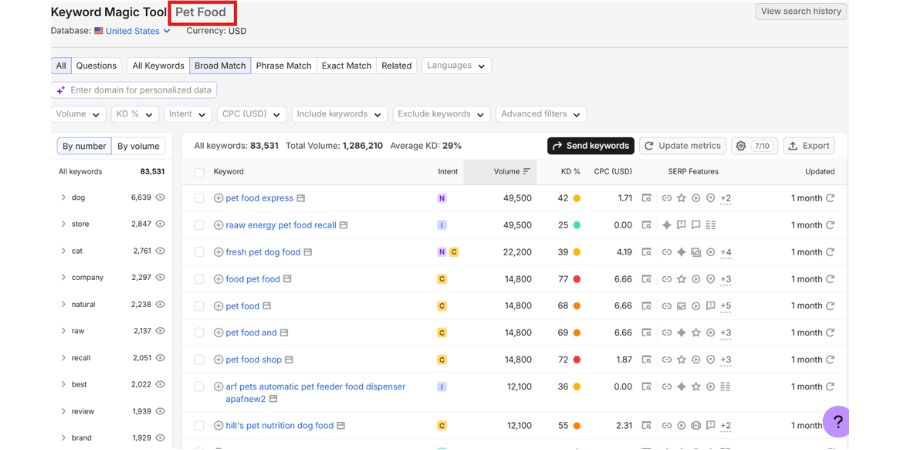
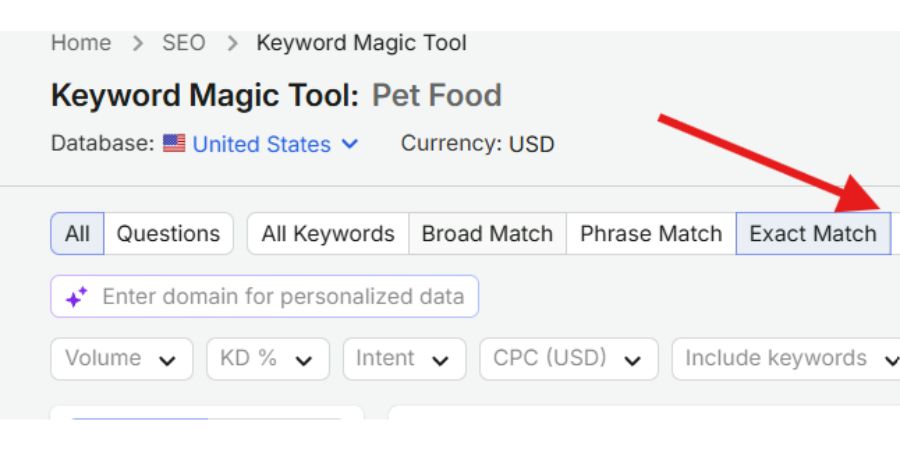
In the above search, we used the seed keyword “Pet Food,” and the result appears accordingly. It highlights a long list of related search terms with “Broad Matches”.
If you wish to explore many other keyword ideas, you can do it easily through different match types. All you need to do is to include options such as “Phrase Match” and “Exact Match” options.
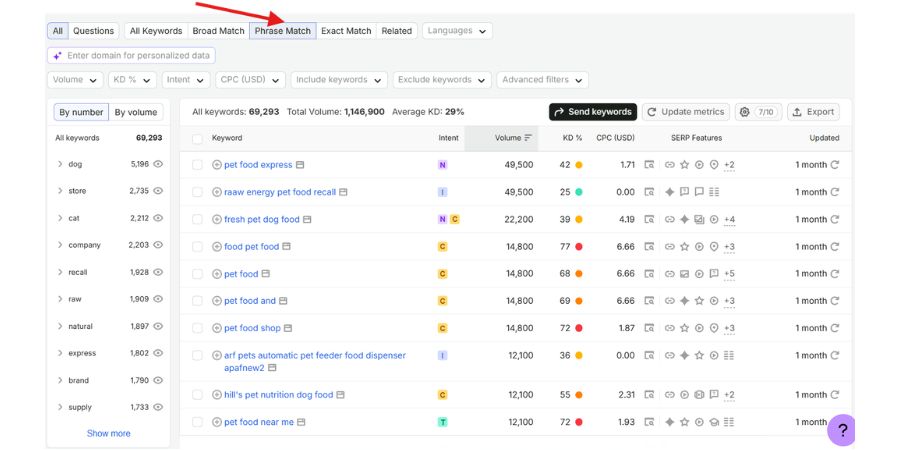
On the left side of this search result, you can see a list that enables you to find various subtopics according to modifiers. You can click the modifier to explore the result along with the term.
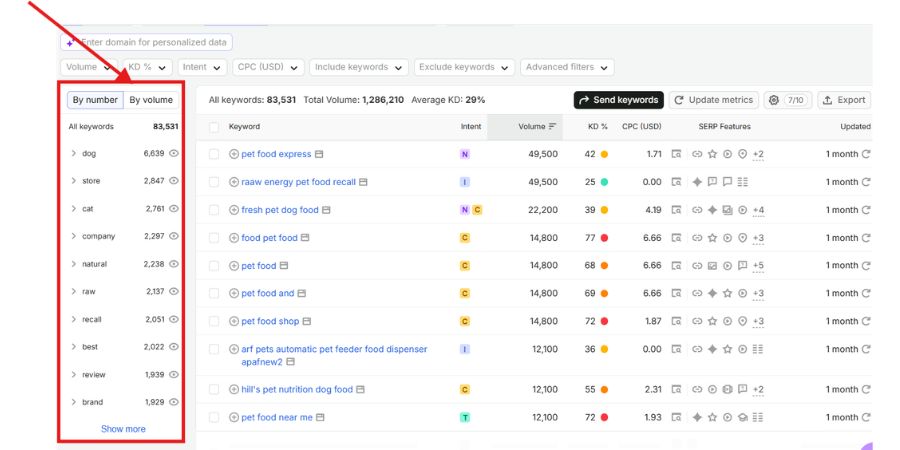
Once you find the appropriate keywords, you need to now hit the “Send Keyword” button. It helps you add them to your Keyword Strategy Builder.
So, you now have all related keywords. You can export the same to a spreadsheet with many important details, which are as follows:
- Volume
- Intent
- PKD%
Make sure you add a “category’ in the spreadsheet for clustering purposes. You need to repeat this process again and again with the use of additional seed terms.
- Do Competitor Research to Minimize Gaps
The next thing you can do is to look for keywords your competitors rank for. It’s indeed the most effective method to discover relevant and important keywords you can create clusters around.
You can harness tools like the Organic Ranking tool of SEMrush to visualize those keywords your competitors rank for. For instance, we have entered a rival name here, “https://carniwel.com/,” and the result appears as follows.
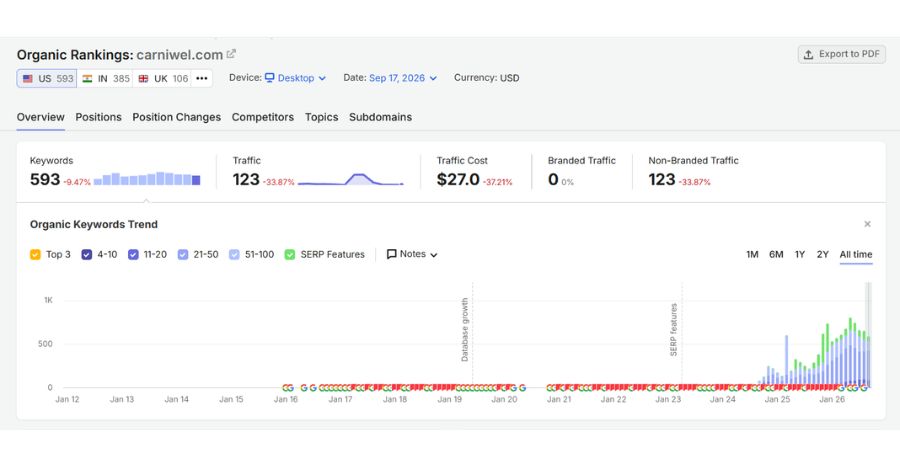
You need to then scroll over “positions” to analyze how your competitors rank.
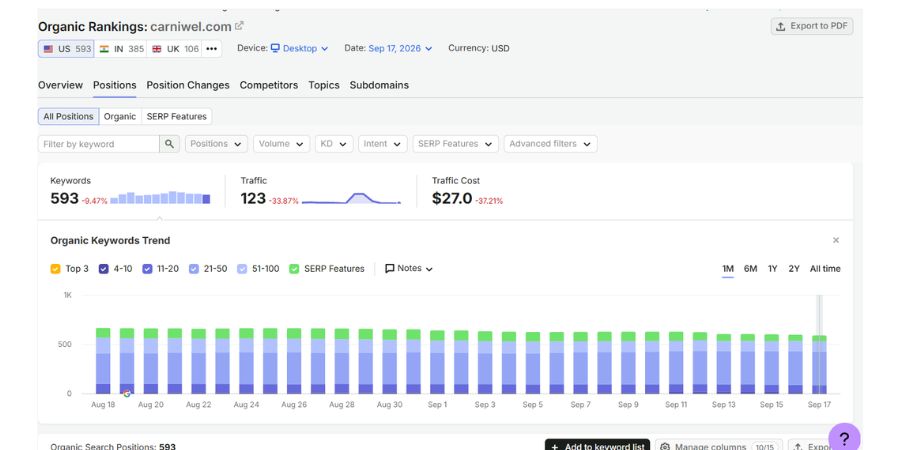
You should exclude those keywords you already included in your list. It’s crucial to opt for “Advanced filters”. Then select another important option in the drop-down. You can go to the ” Exclude ” option first and then select “Keyword” and “Containing”.
- Categorize Keywords
As we already discussed, keyword clustering is all about keeping the same search intent in the same grouping of terms. It clearly indicates you should always think about what users actually try to get. The following are some of the important types of search intent:
- Informational
- Navigational
- Commercial
- Transactional
Sometimes keywords lack a clear search intent, which causes huge difficulty to find out the best type of content to target .
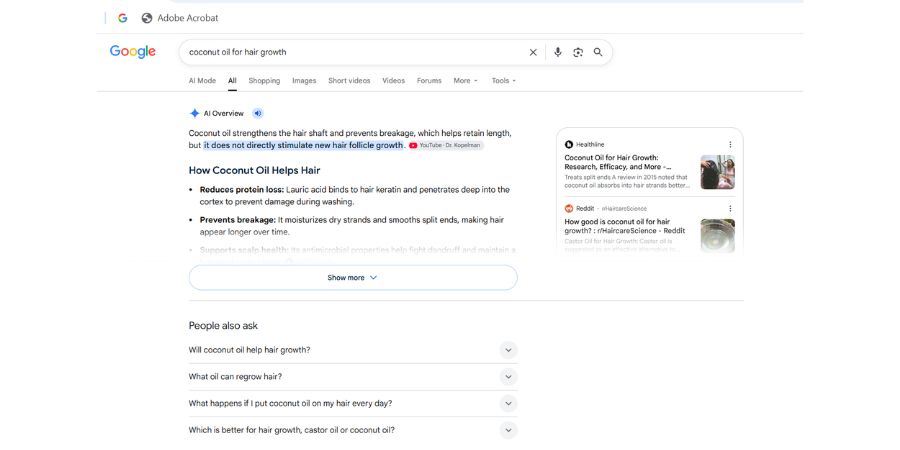
We will take an example of “coconut oil for hair growth” vs. “coconut oil hair growth products.” The first keyword reflects the searcher’s wish to understand the role of coconut oil in hair growth and also how to use it properly. So, the first one is the best example of informational keywords.
You can see with the following result. When we enter the keyword “coconut oil for hair growth”, the following result appears.
And when we enter the second keyword, the result will be as follows.
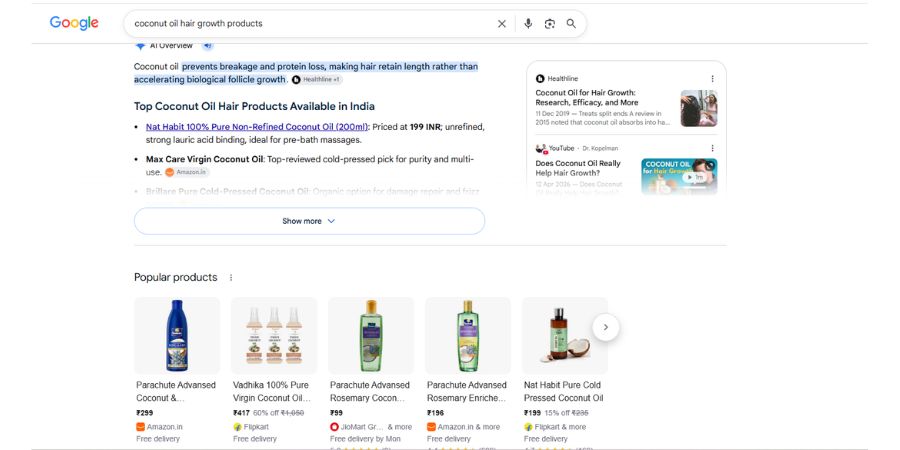
Google’s algorithm has the potential to detect even a small difference in search intent. So, if you find a search intent and then create keyword clusters across the same, you can perform it either manually or also by leveraging the keyword cluster tool. We will talk about each option one by one:
- Creating Keyword Clusters Manually
When it comes to creating clusters manually, you should always check search engine results pages (SERPs), which is also called SERP analysis. To know whether you can group several keywords, you should always consider the following crucial factors:
- Content Quality: You need to find out whether you can craft top-quality content for separate pages focused on different terms. If separate pages are very thin, then you can combine those important keywords. On the other hand, if a combined page is too vast, you need to separate them.
- SERP similarity: You need to check whether the same pages rank higher for those keywords. If yes, it’s indeed a great option for clustering keywords.
- User Journey: You should also check whether an average user seeks to explore all those topics included at the same time. If this is the case, you need to keep content on a single page.
Once you do it properly, you should open your spreadsheet. Apart from this, you should also consider a name for the keyword cluster and add this important information in the “category” column of your spreadsheet.
You should always check your list thoroughly and ensure you capture all those keywords that match perfectly within the same cluster. You can repeat the entire process for other important terms to create additional clusters.
With manual analysis, you have full control over your clustering. It’s indeed a time-consuming process with a large keyword list.
- Use a Tool
You can leverage SEMRush’s Keyword Strategy Builder for keyword clustering automatically according to SERP similarity and search intent to make the process quick. You need to just open the keyword list you created with the use of Organic Rankings and the Keyword Magic Tool.
After this, you need to hit “Cluster This List”. The tool has immense potential to group your terms into clusters, accompanied by a primary keyword and secondary keywords for every page.
- Plan Your Keyword Strategy Better
So, at this stage, you have already created your own keyword clusters. You need to also focus on them and then decide which ones to craft content for. Your next important task is to analyze whether you already have pages based on your clusters.
In case you already have a page, you should always optimize your existing page. If you don’t have one, you need to craft and then optimize your new page accordingly. You can make a final decision about the keyword cluster based on the following important factors:
- The total volume of content you craft, whether you create it yourself, using AI tools for assistance, or outsourcing it.
- An average volume of every term on the web page added together.
- How convenient it will be for you to appear at the top of Google in the organic results.
- Explore those topics that have potential to make a great impact on your business.
- Optimizing your existing page is smooth and convenient compared to crafting new pages.
One important method to select clusters that can impact your business is to emphasize those topics that are related to a service line or an individual product. Therefore, you will be able to develop your authority across many other platforms that both AI systems and search engines actually draw from.
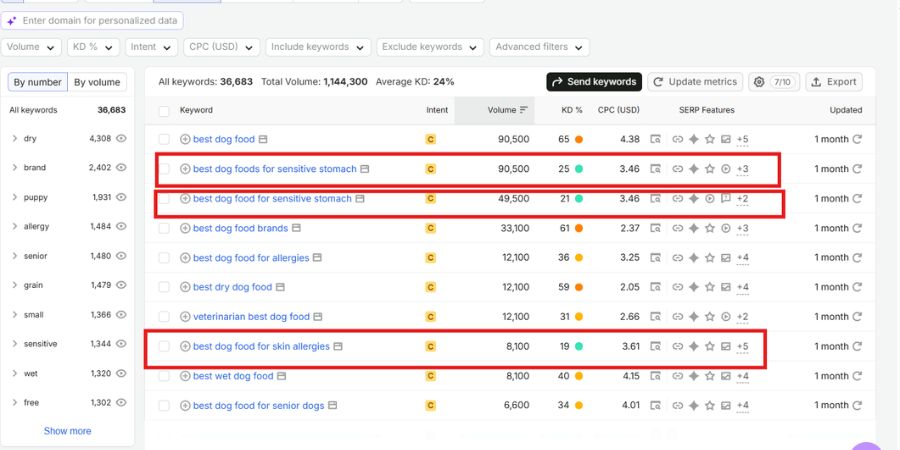
One thing you always need to keep in mind is that higher rankings generate more clicks. This clearly means it may be a great option to focus on a cluster that you stand a higher chance of ranking for, even if it has less search volume. If you find a low Personal Keyword Difficulty with higher search volume terms, they are indeed a great option.
To analyze this information better, you can use the “Keyword Magic Tool”.
- Craft or Optimize Content
When it comes to targeting keyword clusters, you should either create a new page or optimize your existing content. No matter what practice you adopt, you should implement the right SEO practices.
Apart from this, you should also implement the following important on-page SEO practices:
- Include the primary keyword in the first paragraph of your content. You should include this keyword in title tags, URL slugs, H1 tags, and meta descriptions.
- Include both primary and secondary keywords throughout your entire body content.
- You can also use your secondary keywords within subheadings.
- Also include internal links to the body of your content.
- Analyze Cluster Rankings
It’s vital to take an overview of your rankings on a daily basis to check whether your strategy works better or not. It also helps you understand whether or not you should make any adjustments.
You will be able to analyze your rankings for your cluster keywords with the use of Google Search Console (GSC). All you need to do is to log your GSC and then look for terms in your clusters.
Besides, you can also use the Position Tracking tool of SEMRush to check terms you already included in your clusters. Besides, you can also send clusters with the “Keyword Strategy Builder” directly by clicking the “Send Keywords” button.
When you do keyword clustering on your own without using any tool, you can add those keywords to the Position Tracking tool. You can also save it as a CSV file in the spreadsheet.
Once you complete the entire process to set up your pages, you can easily visualize your keywords and also check how your pages rank for these keywords in search engines.
Best Tools for Keyword Clustering
While searching for the right tools for keyword clustering, you will come across plenty of options. You can select the right option based on factors like SEO goals, company size, etc. The following are some of the important types of tools:
- SEMRush Keyword Strategy Builder
SEMRush Keyword Strategy Builder is an important tool that has the potential to cluster keywords automatically. It performs clustering according to SERP similarity, search intent, and more. With this tool, you can start from just a seed keyword.
The tool finally generates pillar pages, topics, subpages, etc., for you. This makes it perfect for planning a complete content structure instead of only single pages.
- Keyword Insights
Keyword Insights mainly uses live SERP data instead of semantic matching when it comes to grouping similar keywords. It groups keywords based on factors that Google ranks, rather than only similarity on paper.
The tool analyzes important search outcomes for every single keyword and groups them together when they share even a small portion of ranking URLs. It then classifies intent for every cluster.
- LowFruits
LowFruits is another keyword clustering tool that comes with two different approaches. The first one is those that groups keywords with shared SERP results, and others then groups them with shared semantic patterns.
It’s a perfect match for niche projects or even smaller sites where you also wish to find low-competition keyword opportunities along with your clusters. This is something that is the core speciality of this tool.
- Ahrefs Keywords Explorer
When it comes to Ahrefs, it generally takes a completely different approach. It groups keywords that come under a common “parent topic”. It’s generally the keyword that brings higher traffic to the page that ranks better.
It organizes those important keywords into clusters as per their parent topic. Besides, it also reflects the overall search volume for every cluster, which makes it convenient to decide which important keyword to target first and foremost.
Common Mistakes to Avoid When Creating Keyword Clusters
There’s no denying that keyword clusters play a vital role in highly effective content planning. But if it’s created poorly, it causes several issues and thus deprives you of getting the desired outcomes. We have discussed some of these issues along with their solutions as follows:
- Avoiding Search Intent
One common mistake SEO marketers make is grouping keywords simply because they contain similar words, without considering their search intent. They don’t even check if the keywords indicate the same thing to a searcher.
For instance, keywords like “Buy sports shoes for men” and “best sports running shoes for men” share the same words. Of course, both keywords have different search intent. So, when you group them, it will not work anyway.
Solution: Before keyword clustering, you should check intent properly for every keyword by searching for the type of content that ranks for it. You need to group only those keywords that genuinely match rather than just with words.
- Ignoring Competitors’ Pages
Many marketers often create clusters with the use of only keyword tool data even without analyzing those pages that rank already. This causes them to miss crucial subtopics covered by a large number of competitors and thus they often mispredict how much content a specific page requires to match search intent.
Solution: You need to always search your target keywords and then analyze those pages that rank higher. Besides, you should also take note of the headings, subtopics, formats, etc., they leverage. You can use the same for clusters and ensure the page includes everything competitors do.
- Neglecting Long-Tail Keywords
When you focus only on high-volume keywords and ignore long-tail keywords, it lets you miss certain opportunities to rank. Besides, it also causes certain gaps in a cluster that make the page less complete.
Solution: You should never forget to include long-tail keywords in even low-volume and cluster ones. They reveal certain specific use cases or questions your pages generally address.
- Poorly Structured Clusters
When you make a cluster too vast, your content may even lose its core focus completely. If the cluster is too narrow, the pages may have little important information. Both of these make it tough for your pages to rank.
Solution: You need to create a cluster around a clear intent. If a cluster covers a number of different intents or questions, you need to divide it into different and separate clusters and pages rather than focusing everything onto a single one.
- Avoiding Local Keywords
Businesses targeting some particular locations often use just general keywords, which is indeed a wrong practice. Due to this, they often miss important searches like “near me” and various other local search queries.
Solution: You need to create specific local clusters, especially when your business has certain local components. You can do the same with the use of “city name”, “regional terms”, and “near me”. You can consider them distinct from your generic clusters, as local intent calls for its own landing page.
FAQs
Ans: There are no fixed numbers of keywords placed in one cluster. You can keep practically 5 to 20 keywords that are closely related. It also depends on factors like topic depth, search intent, content scope, and competition.
Ans: Yes, both B2B and B2C sites should approach keyword clustering differently. B2B clustering mainly emphasizes complex and longer buying journeys. On the other hand, B2C clustering focuses on high-volume, intent-based keywords tied to emotions, immediate needs, and quick buying decisions.
Ans: It generally takes 3 to 6 months to see major improvements and results after implementing keyword clusters. Some pages may witness improvements within a couple of weeks, whereas others may take longer.
Ans: Yes, it’s certainly possible for one page to rank for different keyword clusters, especially when they have the same search intent. A fully structured page includes subtopics, related terms, variations, etc. They rank for various keywords even without making separate pages.
Ans: Keyword clustering emphasizes grouping various similar terms into topics. After this, schema markup labels topics for search engines through the use of tags such as Product, FAQ, etc. Combining them enables search engines to understand your content better.”
Conclusion
You need to understand that keyword clustering is much more than just a simple SEO technique. It’s, in fact, a practical and the most important method to organize content the way people search it actually.
Rather than crafting a range of pages for the same keywords, you need to create one meaningful resource that answers a shared search intent. This approach works effectively to boost topical authority, minimize keyword cannibalization, and offer a clear signal to search engines related to the actual purpose of every page.
Whether you plan to reorganize your existing website or your first content strategy, you should spend enough time on keyword clustering. Partnering with a renowned SEO company will help you do it with a strategic approach.

