






In today’s digital world, merely translating your website won’t reach global customers. The search behavior, languages, cultural preferences, and buying habits in each country are unique. This is where international SEO strategies come into play. They help search engines identify your site’s preferred version for different countries, increasing visibility, organic traffic, and conversions. A strategic global SEO campaign can open new markets and sustain growth for your e-commerce site, SaaS business, or global brand.
In this step-by-step guide, you will learn how to optimize your website for international audiences, how to avoid the expensive SEO pitfalls, and how to get your website ranked higher in international search results.
How do International SEO strategies work?
International SEO works to get your site to show up for people in other countries and who speak different languages. It instructs search engines which ‘version’ of your website to display to the visitor based on their location and language.
Suppose, for instance, you are involved in the business of selling sports shoes. A customer in the United States types in “running shoes”, but in Spain a person types in “zapatillas de correr” in Spanish. On the other hand, international SEO strategies mean that Google can provide the English page to visitors from the U.S. and the Spanish page to visitors in Spain.
International SEO is important for businesses because every country has its own way of searching. According to CSA Research, surveying 8,709 global consumers in 29 nations, 76% of online shoppers prefer purchasing items that have product details in their native language. In addition, 40% of shoppers refuse to buy products from foreign-language websites. The more people who can find your website, trust your content, and become your customers, the better. If you don’t use international SEO, your website might be visible to the wrong people or not visible to anyone in foreign countries, resulting in lost sales and international traffic.
- Example of International SEO strategies
Business: Nike sells shoes in the United States, Spain, Japan, and Germany.
- 🇺🇸 USA: Running Shoes
- 🇪🇸 Spain: Zapatillas de correr
- 🇩🇪 Germany: Laufschuhe
- 🇯🇵 Japan: Japanese-language product pages
Each country has its own language, keywords, currency, and customer tastes, even though the product is the same. International SEO helps search engines show people in every country the right version of a website.
International SEO Strategies vs Local SEO vs Multilingual SEO
| SEO Strategy | International SEO | Local SEO | Multilingual SEO |
| Goal | Rank in multiple countries. | Rank in one city or region. | Serve users in multiple languages. |
| Focus | Country + language + local search intent. | Local customers near your business. | Language only, not country. |
| Best For | Global brands and e-commerce. | Restaurants, clinics, and local services. | SaaS, blogs, and educational websites. |
| Example | A clothing store creates separate pages for the US, UK, and Japan with local keywords and currencies. | A dentist optimizes for “dentist in New York.” | A software company offers its website in English, Spanish, and French for users worldwide. |
- International SEO = Country + Language + Location
- Local SEO = One City or Region
- Multilingual SEO = Language Only
Why Do Businesses Need International SEO Strategies?
Here we discuss the top five reasons to implement international SEO strategies for your business:
- Reach Customers in Multiple Countries – You can connect with international audiences in multiple countries. SEO strategies for International website target your web page to improve its search visibility in search engines in more than one country.
- Connect With the Right Target Audience-The next step is to reach the appropriate audience. Once you have the right content, you need to reach the right audience. Each country distinctly uses search engines. SEO strategies for International audience help you to understand what your target audience is searching for, the language they use, and what they expect in your content. This means you’re targeting the right audience for your website, the ones who will become customers.
- Attract More International Visitors- The better you optimize your international website, the more chances you will have to attract international visitors via organic search. According to research, 70% of global consumers buy from retailers outside their country. Among these consumers, 45% make purchases from foreign retailers at least once a month. These statistics highlight the need to localize the user experience as part of international search engine optimization practices. Country-specific pages and localized content help search engines deliver the right page to the right user, increasing engagement and conversions.
- Make Better Decisions Through Market Research- Then you need to find out what people want before you spend money on it. Spend money on people’s wants and desires before they spend it on you.In order to do this, businesses need to conduct research to identify which countries have the greatest need for their products or services, and this is achieved through effective market research. It also shows you details regarding local rivals, popular search phrases, consumer preferences, and purchasing habits. This type of information can help you develop an SEO strategy that can yield better results in all markets.
- Improve User Experience With Localized Content- When people speak the same language, they may say different words and phrases. For instance, the users in the U.S. and the U.K. speak the same language (English), but they search in different ways. International SEO strategies ensure that your content resonates with what people search for in different countries, helping your website become more relevant, trusted, and understood by your customers.
How to Build an International SEO Strategies: 10 Steps to Rank in Global Markets
In this segment, we discuss all the necessary steps that you can implement to improve your website’s visibility globally with the help of international SEO strategies:
Step 1: Research Your Target International Markets

First, you need to evaluate whether your target market is interested in what you offer before you start building web pages or translating content. This costs money that you don’t need to spend if it’s not converting.
It’s best to first log in to Google Analytics and review the list of countries already driving traffic to your website. Next, Google Search Console provides country dimensions inside performance reports, but it doesn’t estimate keyword search volume.
Then, assess competition in each market. If local players already occupy all the top spots, then having high organic traffic potential is not of much use.
A good international SEO strategy is based on the markets where people are looking overseas, the competition is not too high, and the product you’ve developed fits the local market. International SEO success comes from data, not speculation, and the data focuses on market selection, not population or geography. Test first, build later!
Step 2: Conduct International Keyword Research

The next step is to carry out international keyword research. It can help you identify the relevant keywords your audience uses in various countries. Rather than translate keywords, you need to grasp the local context of language, culture, and search habits to bring in the right visitors.
- Why does direct translation fail? If you just copy and paste keywords, it is unlikely to be effective as people search differently in each country. For instance, someone looking for a vacation package in the United States won’t search for “vacation package,” but instead for “holiday package,” as the terms are used in the UK.
- Native Keyword Research- You should use local terms as keywords for research. Utilize country-specific keyword tools, Google Autocomplete, and native speakers to find natural terms instead of ones that were translated by a computer.
- Search Intent by Country- The intent of the search varies across different countries. The intent behind a keyword can vary from one market to another. Always research the search results to understand what users are looking for before producing content.
- Regional Variations- People from different countries speak the same language, but they use different words. For example, many people in the UK search for “trainers” and many people in the US search for “sneakers.” Optimizing for these terms will help you get more traffic.
- Local Slang & Colloquialisms- Users tend to use slang words and phrases when performing web searches. By knowing these phrases, your content will sound more natural and resonate with local readers.
- Seasonal Keywords- Search volume varies throughout the year. For example, you could search for the term summer holidays in months that are different in Australia and Canada, as they have opposite seasons. Plan a content calendar based on the seasons of each country.
- Search Volume vs Business Value– A chart that compares search volume and business value. Don’t just select keywords because they have good search volume. A less popular but higher-intent keyword can produce more leads and sales than a more popular, very competitive keyword.
- Long-Tail International Keywords- Long-tail keywords are three+ words that target specific searches. On another note, people who search for “best running shoes for marathon training in Canada” will be more qualified and will likely be easier to rank for.
- Competitor Keyword Gap Analysis- Identify the keywords competitors rank for in each target country, and check for any good keywords you aren’t ranking for. Filling out these keyword gaps can lead to higher quality content, more organic traffic, and improved international SEO.
Step 3: Choose the Right International URL Structure
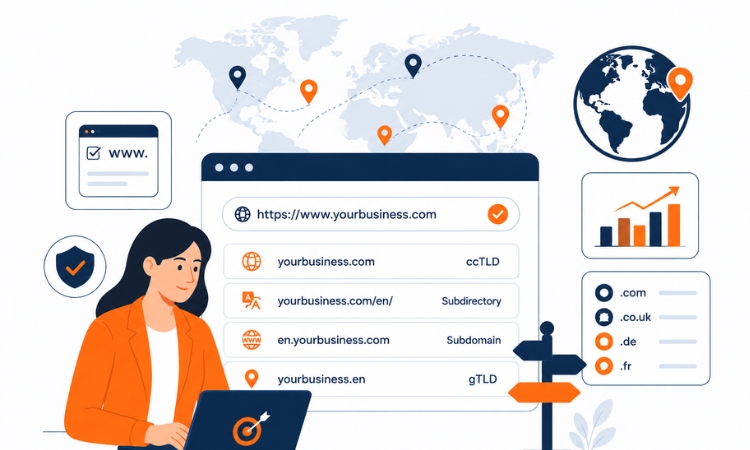
Your website’s URL structure plays a major role in international SEO. It helps search engines understand which pages are meant for users in different countries and languages. The right structure improves visibility in search engine results, supports local search, and helps your business achieve global reach. Since international SEO strategies focuses on delivering the most relevant content to each audience, choosing the correct URL structure is essential.
- ccTLD (.fr, .de, .jp)
A country-code top-level domain (ccTLD) uses a unique domain extension for each country, such as example.fr (France), example.de (Germany), or example.jp (Japan).
- Pros
- Strong country-targeting signal for search engines.
- Builds trust with local users.
- Great for businesses with dedicated country teams.
- Cons
- Expensive to manage multiple domains.
- Requires separate SEO efforts for each website.
- More technical maintenance.
Best for: Large businesses targeting multiple countries with localized content.
- Subdomains
A subdomain places each country on a separate subdomain, such as fr.example.com or de.example.com.
- Pros
- Easier to manage than multiple domains.
- Allows separate websites for different regions.
- Suitable for large international businesses.
- Cons
- Search engines may treat subdomains as separate websites.
- Link authority may not be shared effectively.
Best for: Companies needing separate websites for different markets.
- Subdirectories
A subdirectory keeps all country pages under one domain, such as example.com/fr/ or example.com/de/.
- Pros
- Easy to manage.
- Shares domain authority across all countries.
- Faster SEO growth.
- Cost-effective.
- Cons
- Slightly weaker country signal than ccTLDs.
Best for: Most businesses expanding internationally.
- Parameter-Based URLs
Parameter-based URLs use query strings, such as example.com?lang=fr.
- Pros
- Quick to implement.
- Minimal website changes.
- Cons
- Difficult for search engines to understand.
- Weak SEO performance.
- Poor user experience.
- Not recommended for international SEO.
Best for: Temporary testing only.
- Which Structure Google Recommends
For most websites, Google recommends using subdirectories because they are easier to manage, consolidate domain authority, and help pages rank faster. They also simplify technical SEO while allowing businesses to create localized content that matches cultural nuances and local search behavior. However, if your company operates independently in several countries with dedicated teams and branding, ccTLDs may be a better option.
- Decision Matrix
You can select the right URL structure that matches your business goals:
- Choose ccTLDs if you have separate businesses, budgets, and marketing teams in each country.
- Choose Subdomains if each country requires its own website or technical setup.
- Choose Subdirectories if you want the easiest, most scalable solution for targeting different countries and languages while building one strong domain.
- Avoid Parameter-Based URLs because they provide weak international SEO strategy signals and can limit visibility in search engine results.
Step 4: Implement hreflang Tags Correctly
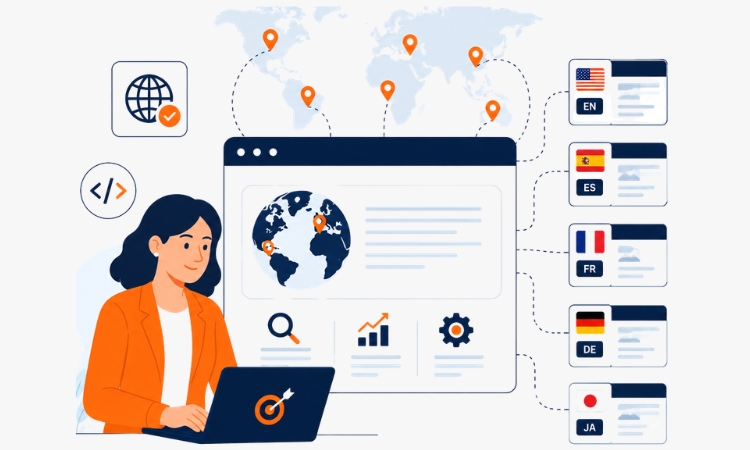
The hreflang attribute tells search engines which language and regional version of a page to show users. It helps Google understand that multiple pages contain similar content but target different audiences. For example, you might have separate pages for English speakers in the US, UK, and Australia. The hreflang tag makes sure visitors see the version that best matches their language and location.
- Why hreflang Tags Matter
Implementing hreflang is one of the most effective international SEO strategies for companies expanding their business globally. It prevents search engines from treating localized pages as duplicate content and improves the chances of showing the correct page on the search engine results page (SERP). As a result, users enjoy a better experience, engagement improves, and conversion rates often increase.
- Language Codes
Language codes follow the ISO 639-1 standard. Examples include:
- en – English
- fr – French
- de – German
- es – Spanish
- ja – Japanese
Always use valid language codes to help search engines accurately identify your content.
- Country Codes
Country codes use the ISO 3166-1 Alpha-2 standard. Combine them with language codes when targeting a specific region:
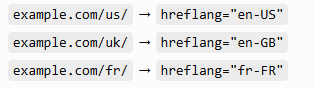
- en-US – English (United States)
- en-GB – English (United Kingdom)
- fr-CA – French (Canada)
- es-MX – Spanish (Mexico)
Before assigning country targeting, conduct thorough market research to ensure you’re optimizing for the right audience and search behavior.
- x-default Tag
The x-default hreflang value specifies the default page for users whose language or region doesn’t match any available version. It is considered one of the best practices for multilingual websites because it prevents users from landing on an irrelevant page.
- hreflang Validation Tools
After implementation, verify your tags using tools such as Google Search Console, Screaming Frog SEO Spider, Ahrefs Site Audit, or Semrush Site Audit. Validating your hreflang annotations on a regular basis will keep them correct as your website grows.
- Real Example
Imagine an online clothing brand with three localized pages:
Step 5: Create High-Quality Localized Content
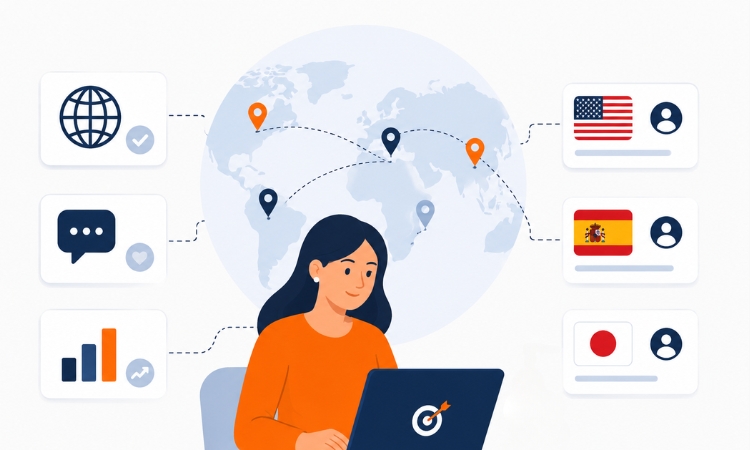
Making localized content is more than just translation. In order for your website pages to resonate with customers around the world, they should sound “local” to them. International SEO strategies require translating and optimizing content for the region, culture, and search habits. You can also pitch better against local competition with this approach.
- Translation vs. Localization- Translation changes content from one language to another; localization changes the overall user experience. This term means local language, cultural norms, and purchasing practices. If a page is localized, it appears as though it was developed specifically for that audience.
- Currency- Then you should use the local currency for prices, where possible. People will trust and buy from websites that have familiar prices compared to those that ask them to manually convert into the currency.
- Units of Measurement- Avoid confusion from using regional measurement systems. For instance, the UK and the USA typically measure distance in “miles” and weight in “pounds”, whereas most European countries measure distance in “kilometers” and weight in “kilograms.
- Date & Time Formats- Convert dates and times to local time. For instance, in the U.S., the date is written as MM/DD/YYYY, while in many countries, it is DD/MM/YYYY. The format of the time (12 hours/day or 24 hours/day) should also correspond to local expectations.
- Tone of Voice- Tailor writing to the audience. Certain places may respond better to a formal tone, while others may respond better to a friendly, casual tone.
- Cultural Relevance- Do not use idioms, humor, or references that may not be easily understood. Rather, use examples and messaging that are relevant to local traditions, holidays, and consumer behavior.
- Images & Visual Localization- Select images that depict the local community. The images of people, clothes, landmarks, color, and lifestyle should resonate with the place you are going to.
- Local Case Studies- Include success stories of businesses or customers in the target country. Examples from the local area help prove your credibility and demonstrate that your products and/or services are effective in that specific market.
- Local Testimonials- When possible, post reviews from the local audience from the region. Trust is boosted, and your visitors connect with your brand through authentic testimonials.
- Regional FAQs- Be able to respond to questions specific to the market, such as local shipping, taxes, payment methods, regulations, and/or customer support. Optimized regional FAQs provide a better user experience and enhance international SEO.
Step 6: Optimize Technical SEO for International Websites

International SEO strategies rely on technical SEO as their basis. Even perfectly localized content won’t rank well on search engines if they can’t crawl, index, and understand your international pages.
- Crawlability– Make sure that search engine spiders have access to all language/country-specific pages. Keep your internal link structure clear and free from broken links and the loss of crawl budget.
- Indexability- If you have localized pages, make sure they’re not accidentally excluded by a no index tag and that each version is indexed by Google. This facilitates good language targeting.
- XML Sitemaps- Generate XML sitemaps of all significant URLs. Submit them to Google and Bing’s Webmaster Tools to get them indexed sooner by Google and other search engines.
- International Sitemap Structure- Utilize separate sitemaps for different languages or regions, or organize them logically within one sitemap. This simplifies your international SEO efforts and helps search engines understand regional content.
- Canonical Tags- Use canonical tags to designate the preferred version of similar pages. It makes sure localized pages don’t appear to search engines as competitors.
- Duplicate Content Prevention- Don’t duplicate the same content in multiple regions. Rather, customize your content for local preferences, currencies, spelling, and culture while maintaining a distinct page.
- Core Web Vitals— Core Web Vitals are three key user experience metrics that impact how well a page performs in search. Largest Contentful Paint (LCP) should be within 2.5 seconds so the main content loads quickly. Interaction to Next Paint (INP) should stay below 200 milliseconds for fast, responsive interactions.Cumulative Layout Shift (CLS) should remain under 0.1 to prevent unexpected page movement. To get faster performance around the world, you can lower these metrics by compressing images, enabling browser caching, using lazy loading, minimizing JavaScript and CSS, and sending content through a Content Delivery Network (CDN).
- Mobile Optimization- Most international users browse from mobile devices. Make sure your website is responsive, touch-friendly, and has great mobile performance in every region.
- Structured Data- Apply schema markup to enrich your pages, products, reviews, and business information, making your pages more visible in search results.
- Robots.txt Best Practices- Use robots.txt carefully to block only unnecessary pages. Never accidentally block important localized content. If you’re using a country code top level domain (ccTLD), verify that each site’s robots.txt allows proper crawling. A well-configured technical setup ensures your international SEO strategies deliver maximum global visibility.
Step 7: Optimize On-Page SEO for Global Rankings
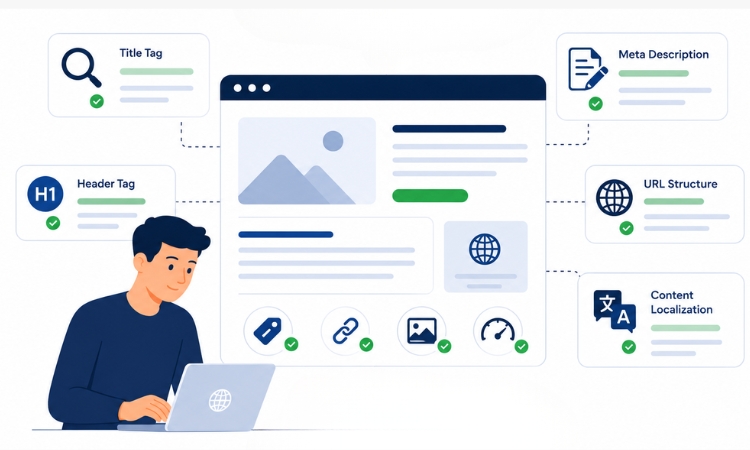
Achieving good on page optimization benefits search engines by enabling them to comprehend your content and enhances your user experience in multiple countries and languages.
- Title Tags- Create unique title tags for each localized page that are rich with keywords. Add target country/language modifiers when applicable to enhance regional relevance.
- Meta Descriptions- Make local language meta-descriptions that pop off the page. Target regional search with the user in mind and boost click-through from search results.
- Header Structure- Organize content in a logical manner (H1, H2, H3). Of course, you will have to add local keywords without keyword stuffing.
- Internal Linking- Connect relevant pages of your site in the same language/region. This enhances crawlability, authority, and visibility of relevant content to visitors.
- Image SEO- Optimize images for speed, make them descriptive, and provide visuals appropriate to local culture and audience.
- Alt Text Translation- Use alt text instead of the original language for website images. Localised alt text provides accurate details about an image and provides search engines with greater understanding of image content.
- URL Optimization- Create URLs that are clean and readable, containing the language or region, e.g. /fr/seo-guide/ or /de/produkte/. Stick to the minimum number of parameters wherever possible.
- Local CTAs- Manipulate the call to action for each market. Increase trust and conversion through local currencies, language, and culturally appropriate messaging.
Step 8: Build Country-Specific Authority

Local authority is vital because international SEO strategies focus on gaining trust in local areas, not in the world at large. Strong regional signals improve SEO performance and help increase organic traffic across multiple international markets.
- Local Link Building strategy- Gain high-quality local backlinks from reliable local sites, blogs, and publications to boost local search authority.
- Digital PR- Share news, research, or campaigns for your region, which will generate coverage in your target country’s media and industry sites.
- Country-Specific Directories- Ensure your business is listed in trusted local directories with uniform Name, Address, Phone (NAP) information to improve search visibility and reliability.
- Local Business Partnerships- Establish local partnerships with regional businesses, chambers of commerce and organizations to build relevant backlinks and enhance your global market visibility.
- Regional Influencer Outreach- You can work with local influencers in your target region who understand the language, audience, and cultural relevance. The website’s content can get you useful mentions, links, and referral traffic.
- Local Media Mentions: To increase brand presence and search visibility, publish content in local news media, including newspapers, magazines, news portals, and podcasts.
- Government & Educational Links: Through research, collaborations, scholarships, or community events, obtain links from government or educational websites when appropriate. These highly trusted links can greatly enhance visibility in various languages and areas of the world.
Step 9: Optimize International User Experience (UX)
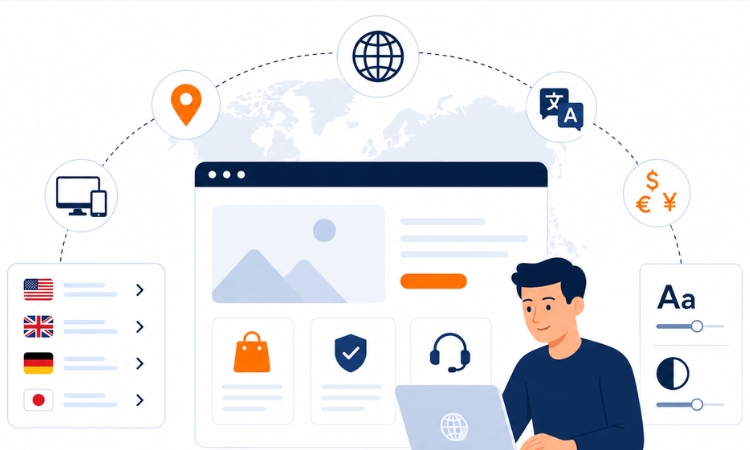
A localized user experience is one reason international SEO strategies are important for businesses expanding into new markets. When visitors can easily navigate your website, they’re more likely to stay longer, convert, and send positive engagement signals that support rankings.
- Language Switchers- Give users a clear way to switch languages without leaving the page they are on. This helps match user intent and regional search queries.
- Currency Selection- Display prices in local currencies so global customers can understand costs instantly and complete purchases with confidence.
- Regional Navigation- Customize menus, featured products, and content based on different regions to align with local interests and search trends.
- Local Contact Information-Show regional phone numbers, business addresses, and office hours to build trust and help users connect with your local team.
- Payment Methods- Support country-specific payment options, such as local digital wallets, bank transfers, or popular credit cards used in different markets.
- Shipping Information- Clearly display shipping costs, delivery times, taxes, and return policies for each target country to reduce cart abandonment.
- Customer Support Localization- Offer customer service in the local language through email, chat, or phone. This helps users feel valued while differentiating you from local competitors.
- Accessibility Standards- For all visitors to be able to access your content, make sure that your international websites follow best practices for accessibility. These should include keyboard navigation, fonts that can be read, accurate alt text, and enough color contrast.
Step 10: Measure International SEO Performance

Tracking performance is key to know if your international SEO strategy is paying off. Monitor key metrics for each country and specific language to identify growth opportunities and improve your international sites.
- Google Search Console International Data- Use Google Search Console to monitor impressions, clicks, click-through rates, and average positions for different countries and languages. This provides valuable insights into your website’s performance in local search results.
- GA4 Country Reports- Google Analytics 4 (GA4) lets you analyze users by country, language, device, and acquisition channel. Compare engagement across regions to understand how different audiences interact with your content.
- Country Rankings- Track keyword rankings individually for each target country. The same keyword can rank differently depending on location, search intent and competition.
- Organic Traffic by Region- Measure organic traffic for each country to determine which markets are growing and where additional optimization is needed to improve your website’s visibility.
- Conversion Rate by Country- Watch how well visitors from different parts of the world do what you want them to do, like make purchases, sign up for something, or ask questions. Localization or UX problems could be the cause of low conversion rates.
- Revenue by Country- For e-commerce websites, evaluate revenue generated from each country to identify your most profitable international markets and prioritize future investments.
- Bounce Rate Analysis- Review bounce rates by country and specific language. High bounce rates may indicate poor localization, slow page speed, or content that doesn’t align with local expectations and cultural context.
- Engagement Metrics- Look at average engagement time, engaged sessions, pages per session, and scroll depth, among other things. These useful insights show how well your content meets users’ needs and improves your site’s long-term search performance.
Advanced International SEO Strategies
As global search becomes more AI-driven, successful international SEO strategies need more than translating web pages. Businesses must optimize for user intent, semantic understanding, and localized search behavior while maintaining technical accuracy across countries and languages.
- AI-Assisted Localization
AI tools can accelerate content localization, but they should not replace human review. Use AI to translate drafts, generate localized ideas, and adapt product descriptions. Then have native speakers refine the content for cultural accuracy, tone, legal requirements, and local search intent. This approach saves time while ensuring content feels natural to regional audiences.
- Programmatic SEO for Global Markets
Programmatic SEO allows you to create thousands of high-quality, scalable pages using structured data and templates. For example, travel, eCommerce, or real estate websites can automatically generate location-specific landing pages for different cities, countries, or languages. Every page should contain unique content, localized information, and valuable user insights to avoid thin or duplicate pages.
- International Topic Clusters
Organise your content into topic clusters instead of publishing separate articles. Make an in-depth pillar page that covers a lot of ground, and then connect it to articles that focus on country-specific keywords, local rules, or regional use cases. This raises your topical authority and lets search engines know that you are an expert in more than one market.
- Entity SEO strategy
These days, search engines understand things like people, places, businesses, products, and ideas, not just keywords. To make it easier for people to find things, use structured data, knowledge panels, consistent brand information, and links to well-known companies, places, and things. Search engines will be able to read your site better if it’s written in more than one language.
- Semantic Search Optimization
Search engines now analyze context instead of relying solely on exact-match keywords. Build content around user intent by including related terms, synonyms, frequently asked questions, and naturally connected concepts. This improves your chances of ranking for a wider range of long-tail and conversational searches in every target market.
- International E-E-A-T Signals
Demonstrate Experience, Expertise, Authoritativeness, and Trustworthiness on every localized website. Publish author biographies, cite reliable sources, display customer reviews, maintain transparent contact information, and keep country-specific business details accurate. Trust signals become even more important when expanding into unfamiliar international markets.
- Voice Search Optimization
Voice searches are typically longer and more conversational than typed searches. Answering common questions in natural language and making FAQ sections that are specific to each language and region will help you improve your content. Include localized business information and structured data where it makes sense, since a lot of voice searches are local.
- AI Search Optimization (Google AI Overviews & LLMs)
Search is increasingly influenced by AI-powered experiences such as Google AI Overviews and large language models (LLMs). Ahrefs analyzed 38% of pages cited in Google AI Overviews also ranked in Google’s top 10 organic results. This shows that AI search is increasingly choosing authoritative, well-structured content that goes beyond traditional ranking positions, making entity optimization, semantic SEO, and E-E-A-T more important than ever.
- International Schema Markup
Implement structured data using Schema.org to help search engines understand your content. Use relevant schema types such as Organization, Product, Article, FAQ, LocalBusiness, Breadcrumb, and Review. For multilingual websites, ensure structured data accurately reflects each language and regional version of the page.
- Country-Specific Rich Results
Optimize pages to qualify for rich results that are relevant to each target country. Product pages can display ratings, prices, and availability, while articles may earn enhanced search features. Local business pages can showcase addresses, opening hours, and contact details. Continuously monitor search performance in each region because rich result availability and search features may vary between countries and search engines.
Common International SEO Mistakes to Avoid
- Using Direct Translation Instead of Localization – You should simply translate content, which ignores specific language nuances, local intent, and cultural differences, reducing relevance in search results.
- Skipping Local Keyword Research – The efficient international SEO strategies require conducting keyword research for every target country. Use tools like Google Keyword Planner to identify region-specific search terms.
- Ignoring hreflang Tags—If you don’t use hreflang tags or don’t use them correctly, search engines may show users the wrong language or regional page.
- Publishing Duplicate Content Across Regions – Reusing identical content for multiple countries can weaken search engine rankings. Localize content to better serve diverse global audiences.
- Neglecting Technical SEO – Poor site structure, slow loading speeds, broken internal links, and indexing issues can prevent international pages from achieving strong visibility and rankings.
Frequently Asked Questions
Ans. You may use ccTLDs for strong country targeting and local branding. And choose subdirectories if you want easier management and consolidated SEO authority.
Ans. Yes, but always combine AI translation with human editing to ensure accuracy, cultural relevance, and natural language.
Ans. You can create localized content, conduct country-specific keyword research, implement hreflang tags, and build local backlinks for each target market.
Ans. Yes. It helps small businesses reach new customers, expand into global markets, and generate long-term organic traffic.
Ans. No, machine translation doesn’t always get the local context right, which hurts the quality of the content and the speed of searches.
Ans. It depends on the competition, the quality of the content, and the technical SEO of the website, but most start to see improvements in 3 to 6 months.
Ans. Not all the time. Each country, language, and localization needs has its own set of costs, but the long-term return on investment (ROI) usually beats the cost.
Conclusion
International SEO strategies are powerful in getting the right web traffic in the right country. Important steps that can enhance your global presence include selecting an ideal URL setup for different regions, conducting keyword research, creating localized content, and employing hreflang tags. Prioritize user experience, technical optimization, and country optimization over just a translation. Regularly track and adapt using data. The right strategy can get you indexed in foreign search engines, drive targeted traffic, and grow your business organically into international markets.
Your next customers are already searching in other countries. Don’t let competitors reach them first. So you can take help from a professional SEO Services Provider to build data-driven international SEO strategies, avoid costly mistakes, and achieve sustainable organic growth across countries.

