





Digital marketing for industrial companies is the most significant internet marketing strategy for getting new leads and turning them into clients. Being an industrial business owner, you’re not getting clients, but you have good products and quality services. You did offline marketing, like spreading leaflets and posters, but in this digital era, word-of-mouth promotion is not enough. You should go one step further. You need to develop a strong digital presence through a website and a Google Business profile and have to optimize and maintain your online visibility with the best digital marketing tactics.
Here, in this informative guide, you learn all the important digital marketing strategies for industrial companies to improve search engine rankings. We delve deeper and give you real insights and strategies with the best digital marketing tools guide.
What is Digital Marketing for Industrial Companies?
Digital marketing for industrial companies is also known as industrial B2B marketing. It is an online marketing effort to reach more clients and improve the revenue of industrial companies. A solid digital marketing strategy for industrial companies is built on the following factors:
- Industrial buyers are seeking specifications, not fluff: The technical & regulatory content strategy, like compliance standards (RoHS, REACH or ISO), product data sheets, and technical cases with relevant details.
- Search Engine & Generative AI Optimization (SEO/AIO): These are the online processes to show up your industrial company’s website on search engines like Google, Yahoo, and AI-powered search engines like Google AI Overviews and OpenAI ChatGPT search, Microsoft Copilot.
- Account-Based Marketing (ABM) & Paid Media: ABM campaigns focus on specific high-value accounts, job titles, or companies, typically matching the exact Request for Quote (RFQ) profile announcement rather than standardized content distributed to a wider audience in paid ads, such as LinkedIn Ads and Google Search.
- Optimization of the RFQ Conversion Rate (CRO): An industrial website’s main goal isn’t usually to make a sale. Instead, it’s meant to collect technical questions that come in, which turns web traffic into valuable quote requests.
Why Industrial Companies Can’t Ignore Digital Marketing?
In this era, digital marketing is not optional. This is the most-required online marketing approach for attracting customers and getting qualified leads. According to Industrial Service Market research, the industrial market will reach USD 54.69 billion by 2030. So, in this huge industry, how will your company survive? Not only will traditional marketing methods give you the optimal results; you should also implement digital marketing.
Top 4 Importance of digital marketing for industrial companies
- Your Competitors Are Already Online – When your potential customers search for “Industrial products supplier” or “Industrial automation services” if you optimize your website, then your website will pop up, and likely you can be visible. If you don’t optimize the website correctly, then there is a chance your competitor can get the lead, which can be yours, if you maintain your online presence professionally.
- Digital Marketing Generates Qualified Leads – SEO, PPC ads, email marketing, and content marketing help attract targeted industrial clients who are actively searching for your services to increase the chance of conversions.
- Builds Brand Authority in the Industry – You should publish technical blogs, whitepapers, industry insights, and case studies to help position your company as an expert and dependable industrial solution provider.
- Measurable and Cost-Effective Marketing – Contrary to traditional marketing, in this digital marketing process, you can track website traffic, lead generation, conversions, and ROI. It will help you optimize campaigns for better business growth.
Top 7 Digital Marketing Strategies Industrial Companies Should Follow
Here, we discuss the best digital marketing strategy for industrial companies. You can follow these most important 7 tactics and make our industrial company more accessible and visible to your target audience:
- Understand Your Industrial Target Audience

The foundation of digital marketing for industrial companies is to find out who the prospective buyers are. If you don’t know who you serve, how can you craft digital marketing tactics? Most of the industrial companies generally target B2B buyers. These are procurement managers, factory owners, engineers, contractors, and operations managers because these people influence purchasing decisions.
- Key Perspectives to Understand Industrial Target Audience
- Type of business and its size
- Problems and pain points for buyers
- Decision-makers and purchasing authority
- Search behavior and keywords used
- Geographic target market and service area
- Budget, goals, and buying intent
- Building Your Industrial Digital Marketing Foundation
Before you spend money on any marketing or paid channel (Google Ads, LinkedIn posts, and trade shows), you need to make sure that three things are in place: your website, your presence in local search results, and how you track results. After that, everything else kind of builds on that.
- Your Website as a Sales Representation That Works 24/7
The website is the first real impression you make on your prospective customers. The industrial buyers (engineers, procurement managers, and operations leads) now do most of their supplier research online, well before attending a show or speaking with a sales representative. You should answer those technical questions quickly. If the company can’t, the buyer will immediately go back to a competitor.
- What an industrial website must have to convert organic traffic into Request for Quotation (RFQ) :
- Capability pages with specific specs — To begin with, you should say what your company does, who its clients are, where it operates, and what technical standard it follows. If you want to avoid being generic, say something like, “Our facility has 12 five-axis CNC machines that can meet ISO 9001:2015 requirements with ±0.002mm tolerances.” This transparency and detailing earn trust from engineers.
- Easy Request for Quotation (RFQ) forms — The number of submissions goes down with each extra field you add. As soon as you start, all you need is the person’s name, the name of your company, a brief description of the project, and a time frame for when you need it done. You can take care of the rest during a call.
- Featured certifications — Your ISO 9001, ASME, UL panel shop status, and other relevant credentials should be front-and-center on your homepage/capability pages (not buried three layers deep in an “About” tab). Procurement managers search for these before reading a single line.
- Actual images — Always upload authentic images of your shop floor, machinery, and team, outperforming stock photography in every B2B website conversion study. They signal capacity, cleanliness, and professionalism at a glance.
- Downloadable spec sheets as PDFs — Engineers mitigate risk by saving and sharing documents internally. Throughout the evaluation process, a technical sheet that buyers can download keeps you in the buying committee’s folder and at the forefront of their minds.
- Fast loading speeds and mobile responsiveness – According to Statista, mobile devices (excluding tablets) accounted for 52.27 percent of global website traffic in the first quarter of 2026. So most of the B2B research starts on a smartphone, so make your website mobile-friendly and fast-loading. Your site should not be fancy. It has to be transparent, brisk-paced, reliable, and made for motion.
- Google Business Profile for Industrial Companies
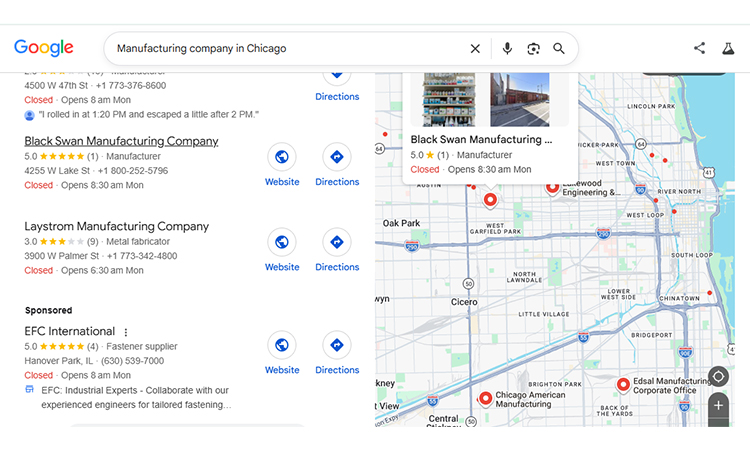
After creating a professional industrial company’s website, you can move forward to work on improving your local presence. Let’s understand through a simple example. Like, your potential customers can type “Manufacturing company in Chicago,” and if you correctly optimized Google Business Profile, then your brand can pop up like this-
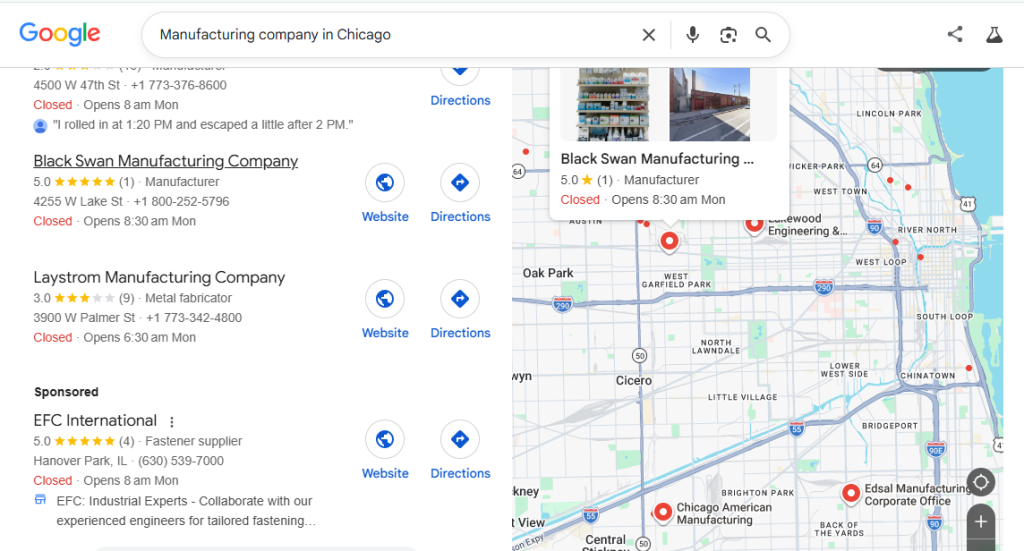
To optimize Google Business Profile, you can follow these simple steps:
- Go to https://business.google.com/en-all/business-profile/
- Then sign in with your professional mail ID.
- Add your business name and choose a service category
- Then add the phone number and address. Pinpoint the address on the map.
- Upload high-quality pictures and write a clear description of your business.
- Then submit, and Google verifies your business, and after that, your company name will be shown in local searches.
- CRM and Analytics Setup
You cannot market industrial companies if you actually don’t know what works. You need to know where your leads are coming from, so every budget should support a meaningful cause. Setting up CRM and analytics is the process of keeping track of leads, customers, website traffic, and how well marketing is working by using CRM tools and analytics platforms. It helps industrial businesses keep track of leads, figure out how customers act, and boost their marketing ROI.
- Key things to put in place:
- Integrate all RFQ forms with a CRM (HubSpot, Zoho, or Salesforce) and tag each lead by source—organic traffic, paid demand generation ads, trade show/event participation, or referral(s).
- Set up Google Analytics 4 and Search Console so that you can measure which pages or keywords bring real buyers.
- Then you need to evaluate pipeline value by channel. In this case, you need to keep track of both how many leads and how much money each marketing source brings in. In your CRM, label each RFQ with where it came from (Google, LinkedIn, a trade show, or a referral). Record the contract value against that source when the deal is done. Every month, add up how much money each channel brought in.
- SEO for Industrial Companies (The Highest-ROI Channel)
After creating a website where you can showcase your credibility and services or products and optimizing your Google Business Profile. It’s time to optimize search engine optimization (SEO) for industrial companies. You create a website, but if you do not optimize SEO correctly, your website can be buried on page 10 of Google search results. According to a HubSpot survey, 73% of U.S. SEO professionals believe that AI tools and SEO tactics are increasingly important for businesses to grow and improve their visibility on search engines.
- On-Page SEO for Industrial Pages
On-page SEO strategies for industrial companies will help search engines to better understand and rank higher, so your target audience can find your industrial company’s website easily. And this is the process of optimizing the website from the inside.
- Keyword research for industrial companies- Keywords are the search terms that your target audience uses to find you. Suppose one person types “OEM manufacturing company,” and if you add these keywords to your website properly, then it is possible to pop up your website on search engine result pages. You can check keyword research tools like Semrush, Ahrefs, and Google Keyword Planner.
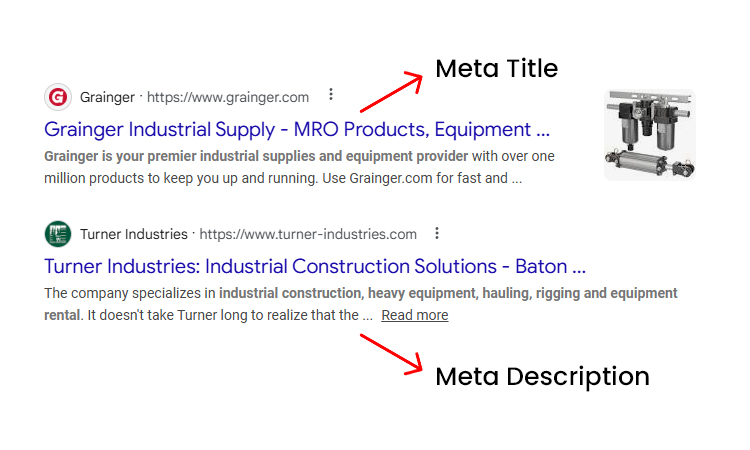
- Meta Title & Meta Description Optimization- Meta title is the first clickable blue link showing first at the Google Search Engine Results Page (SERP). The ideal word count should be 50-60 characters. The meta description is a summary of a web page. Try to write 150-160 characters for the meta description. It improves search awareness and click-through rates.
- Header tags (H1, H2, H3)- It makes Google understand the topic hierarchy. Header tags (H1, H2, H3) are HTML (HyperText Markup Language) attributes used to structure web content by defining headings and subheadings. H1 is the primary title of a page (a separate webpage needs one). H2 is the main section. H3 are the subsections.
- Internal Linking Strategy- As its name suggests, it connects one industrial service page to another. Or if you publish any informative blogs related to your service or products, you can link to other web pages within your website. It helps your website visitors to navigate other pages of your industrial company’s website.
- Optimized images- The image optimization means you make the image size compressed but do not compromise the quality. Also, add alt text. This text is the written description of the image. It helps Google to understand what the image is about. However, you can take help from TinyPNG, ImageOptim, and ShortPixel to reduce the image size so that your website loads more quickly.
- URL structure – The Uniform Resource Locator (URL) is the web address used to find specific web pages. It should be short, precise, and to the point for the web page feature. Do not use underscores, spaces, or special characters. Try to add main keywords and distinct words with hyphens (-).
- Off Page Search Engine Optimization for Industrial Companies
Off-page SEO for an industrial company is the process of optimizing your website from the outside. Like your promotion website through link building, guest posting, and engaging in community conversations. Here, we discuss the best off-page SEO strategies to improve digital marketing for industrial companies:
- Industrial Link Building
Industrial link building is the process of getting backlinks from well-known, niche-relevant engineering or manufacturing websites to increase domain authority. To get natural backlinks, you need to find partners you can trust, create useful content, and reach out to them in a planned way. For building links, you can use these professional platforms:
| Platform | Best For |
| Thomasnet | Industrial supplier listings & B2B backlinks |
| IndiaMART | Industrial product visibility & lead generation |
| TradeIndia | Manufacturing and industrial business promotion |
| GlobalSpec | Engineering and technical industry networking |
| Alibaba | Global industrial B2B exposure & export leads |
- Business Directory Listings
You can submit your company’s Name, Address, and Phone number (NAP) to trusted B2B industrial directories. The Business Directory Listings is the process of listing your industrial company in directories for visibility, local SEO, and leads. You can list on Google Business Profile and Justdial.
- Guest Posting on Industry Websites
Posting informative and technical articles on reputable industrial blogs or trade magazines run by other companies. It shows that you are an expert in your field and gets you strong, useful backlinks that send you high-quality referral traffic. Best tools you can rely on- BuzzSumo, Moz Link Explorer, Pitchbox.
- Digital PR & News Releases
You will notify major industry news outlets of significant company updates, such as new equipment, safety certifications, or facility expansions. In addition to securing high-tier editorial media links, this increases brand authority. You can get help from these platforms- PR Newswire, Prowly, and JustReachOut.
- Industrial Forum Participation
The Industrial Forum Participation means you are engaging in technical Q&A communities where engineers and plant managers solve operational problems. It provides helpful, non-promotional answers, establishes genuine brand trust, and positions your company as a go-to expert. You can communicate on Reddit, Quora, and LinkedIn Groups.
- Case Study & Whitepaper Promotion
Syndicating data-heavy research, compliance breakdowns, or successful project results to external industry resource libraries. This earns high-value citations from technical professionals who reference your data. Best Tools: Scribd, ResearchGate, SlideShare.
- Social Media Content Promotion
Sharing detailed product videos, corporate insights, and company achievements across professional B2B social channels. This amplifies content reach, encouraging organic sharing and natural back-linking across the web. Best Tools: Buffer, Hootsuite, Sprout Social.
- Influencer & Industry Collaboration
Partnering with respected industry voices, technical creators, or academic experts to co-create specialized webinars or reviews. This instantly expands your brand’s reach to a pre-built, highly targeted B2B audience. Best Tools: BuzzStream, SparkToro, Upfluence.
- Content Marketing to improve Industrial Digital Marketing
Content marketing is one of the best ways for industrial companies to use digital marketing because buyers in this field do a lot of research online before they contact a supplier or manufacturer. Good content helps bring in the right kind of visitors, improves your site’s search ranking, and earns the trust of engineers, purchasing managers, and manufacturing companies. This is an inbound marketing tactic to publish content that answers exactly what your buyer is searching for, and let Google deliver them directly to your capability pages.
In digital marketing for industrial companies, the best approach is to create educational and problem-solving content instead of only promotional content. Industrial buyers usually search for technical solutions, product specifications, pricing information, maintenance guides, and industry trends. Companies should focus on creating SEO-optimized content that answers these searches clearly.
- Best Types of Industrial Content
- Technical blogs
- Case studies
- Whitepapers
- Product comparison articles
- Industry reports
- FAQs and troubleshooting guides
- Manufacturing process videos
- Client success stories
- Industrial infographics
- Technical documentation
For example, an industrial automation company can publish blogs about “How Factory Automation Reduces Production Costs” or create case studies showing how their systems improved manufacturing efficiency. This type of content improves visibility and generates qualified leads.
Content marketing also supports SEO because search engines prefer websites with relevant, informative, and regularly updated content. Well-optimized content increases organic traffic and helps industrial websites rank for important keywords related to products and services.
- Best Tools for Writing & Optimization
- Surfer SEO — Content optimization and keyword usage
- Semrush — Keyword research and competitor analysis
- Ahrefs — SEO analysis and backlink research
- Grammarly — Grammar and readability improvement
- Google Trends — Industry search trend analysis
- Canva — Industrial graphics and infographic design
- Use Local SEO to capture regional industrial leads
Industrial buyers search with location intent. They mainly use “CNC machining services [city name],” “fabrication shop near me,” “hydraulic repair Houston”, these are high-converting searches from buyers ready to shortlist suppliers. Local SEO puts your business in front of them.
- How to capture regional industrial leads through Local SEO:
- Claim and fully optimize your Google Business Profile: You can add your exact capabilities, service areas, certifications, facility photos, and working hours. Incomplete profiles get ignored.
- Build location-specific landing pages on your website. A dedicated page for each city or region you serve dramatically improves regional organic rankings.
- Embed location keywords naturally across your capability pages. This is core to digital marketing for industrial companies that serve multiple regional markets.
- You can collect your client’s reviews. The procurement managers validating a new supplier always check Google reviews before filling an RFQ form.
- Technical SEO for Large Industrial Catalogs
Without technical SEO, your website cannot be well optimized for rankings. You need to maintain the following factors to get more organic site visitors and rank high on search engines.
- Site Speed Optimization- If your website takes more than three seconds to load, it is possible that your buyers may leave. Site speed optimization means improving how fast your pages load for both desktop and mobile users. This directly affects your Google rankings and your RFQ conversion rate. You can compress oversized product images. And remove unnecessary plugins and scripts. Then you should enable browser caching. Use a CDN (Content Delivery Network) to serve pages faster to regional buyers. Best tools: Google PageSpeed Insights, GTmetrix, Cloudflare CDN.
- Core Web Vitals- Core Web Vitals are Google’s three official page experience signals. LCP (Largest Contentful Paint) measures load speed. FID (First Input Delay) measures interactivity. However, note that Google has replaced FID with INP (Interaction to Next Paint) as a Core Web Vital because INP provides a more comprehensive measurement of page responsiveness. CLS (Cumulative Layout Shift) measures visual stability. Google uses these scores as a ranking factor. Industrial websites with large product catalogs and heavy spec sheets often fail these tests silently. Fix them, and you recover rankings your competitors are losing. Best tools: Google Search Console (Core Web Vitals report), PageSpeed Insights, Screaming Frog.
- Crawlability and Indexation- Search engines must be able to find and read your pages. Crawlability means Google’s bot can access your site without hitting blocked pages, broken links, or redirect chains. Indexation means your pages are actually stored and ranked in Google’s database. Many industrial websites have hundreds of pages that Google simply never finds. Submit a clean XML sitemap. Fix your robots.txt file. You should remove or redirect broken URLs. The best tools to optimize Crawlability and Indexation are- Google Search Console, Screaming Frog SEO Spider, and Sitebulb.
- Schema Markup- Schema markup is structured data code added to your pages. It helps Google understand exactly what your page contains. For industrial companies, the most valuable schema types are FAQ schema (wins featured snippets), LocalBusiness schema (boosts local search visibility), Product schema (shows specs in search results), and Review schema (displays star ratings). Schema does not directly help rankings, but it does increase click-through rates from search results. Best tools: Google’s Rich Results Test, Schema.org, Rank Math (WordPress plugin).
- Duplicate Content Management- Industrial companies with large product catalogs often create duplicate content accidentally. Same product listed under multiple categories. Google penalizes such behavior by splitting your ranking authority across multiple weak pages instead of concentrating it on one strong page. Use canonical tags to tell Google which version of a page is the original. Best tools: Screaming Frog, Ahrefs, Semrush Site Audit.
- Mobile Responsiveness- Google basically prioritizes mobile-first indexing. This means it ranks your site based on how it performs on mobile, even if most of your buyers use desktop. Your tables, RFQ forms, and PDF download buttons must work cleanly on a phone screen. Test every key page on a real mobile device, not just a browser preview. Best tools: Google Mobile-Friendly Test, BrowserStack, Google Search Console (Mobile Usability report).
- SSL Certificate (HTTPS)- Your website must run on HTTPS. Google treats HTTP sites as insecure and ranks them lower. Buyers also see a “Not Secure” warning in their browser. Get an SSL certificate from your hosting provider. Most offer it free.
- XML Sitemap Submission- A sitemap is a file that lists every important page on your site. Submitting it to Google Search Console tells Google exactly what to crawl and index. Best Tools: Google Search Console, Screaming Frog.
- Robots.txt Optimization-This small file controls which pages Google can and cannot crawl. A misconfigured robots.txt can accidentally block your entire website from search engines. Review it carefully. You can block only the admin and duplicate pages. You can take help from these tools: Google Search Console (Robots.txt Tester), Screaming Frog.
- Canonical Tags- When similar pages exist, canonical tags tell Google which version is the original. This prevents duplicate content from splitting your ranking authority. Tools: Ahrefs Site Audit
- Clean Site Architecture and Breadcrumb Navigation- You should keep important pages within three clicks from the homepage. Breadcrumbs help both Google and buyers understand where they are on your site. Tools: Screaming Frog, Sitebulb
- Proper 301 & 302 Redirects and Handling 404s- A 301 redirect permanently sends users and search engines from an old URL to a new URL. It helps preserve SEO rankings, backlinks, and website traffic after page changes or website migrations. A 302 redirect is a temporary redirect used when a page is moved for a short period, allowing search engines to keep the original URL indexed. A 404 error occurs when a webpage is missing or deleted. Proper 404 handling includes fixing broken links, redirecting outdated pages when necessary, and creating user-friendly error pages to improve user experience and maintain SEO performance. You can use Redirect Path (Chrome extension) to identify and monitor 301, 302, and 404 status codes.
- Use Paid Advertising to Generate Faster Industrial Leads
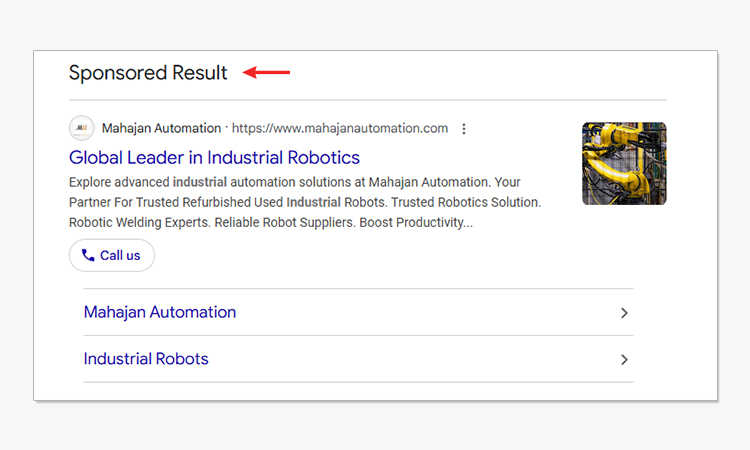
After creating a website and Google Business Profile and optimizing SEO, we can move forward to PPC ads. Organic SEO and content marketing build long-term momentum. But they take time. While your organic strategy grows, paid advertising fills the gap and gets your skills in front of the right buyers right away. For industrial companies, not every paid channel deserves equal attention. Here is what actually moves the needle.
- Google Search Ads — The Highest Priority
Industrial buyers begin their buying process on Google. They search for specific capabilities, certifications, and locations. The average Google Ads conversion rate is around 7.52% across industries.
Target bottom-of-funnel keywords where buyers show clear purchase intent:
- “CNC machining services Houston”
- “ISO 9001 certified fabrication shop”
- “industrial compressor repair near me”
Expert Tip- Try not to send ad traffic to your homepage. Build dedicated landing pages for each campaign that match the exact search term, display your certifications, and have a single clear RFQ call to action. This shortens the buyer’s journey from search to inquiry significantly.
- Meta Ads for Industrial Companies
Meta Ads are paid advertisements that run on Facebook, Instagram, Messenger, and the Meta Audience Network.
- These ads help to reach decision-makers based on industry, job role, interests, and location.
- It can increase brand awareness among potential B2B buyers.
- Promote industrial products, services, case studies, and events.
- Generate qualified leads through lead forms and landing pages.
- Retarget website visitors who did not convert on their first visit.
- Provide measurable results with data on clicks, leads, conversions, and ROI.
- LinkedIn Ads — Best for Reaching Decision Makers
LinkedIn lets you target by job title, industry, company size, and location. No other platform gets you directly in front of procurement managers, design engineers, and plant managers with this precision.
LinkedIn Ads work best at the top of the sales funnel to build awareness among buyers who do not know you yet. Use it to promote:
- Downloadable capability brochures
- Case studies with measurable results
- How-to videos demonstrating your process or machinery in action
Video content performs exceptionally well on LinkedIn for industrial brands. A 60-second shop floor walkthrough builds more credibility than any written ad.
- Retargeting Across Digital Channels
Industrial buying processes are long. A buyer who visited your website today may not submit an RFQ for four months. Retargeting ads follow those visitors across digital channels—Google Display, LinkedIn, and YouTube. It keeps your brand visible throughout their online research phase. Retargeting also works powerfully for existing customers.
Expert Tip: What to Avoid
- Do not spread the budget thin across every platform. Do not run ads without conversion tracking connected to your CRM. And never let paid advertising substitute for a weak website — no ad budget overcomes a site that fails to convert.
- Paid advertising accelerates a working system. It cannot build one. Invest in your foundation first, then use paid channels to scale what is already performing. Your company’s culture of quality and reliability must come through in every ad, landing page, and follow-up—because industrial buyers notice the difference between genuine capability and empty marketing claims.
- Email Marketing and Lead Nurturing

In digital marketing for industrial companies, email is the most underused and highest-ROI channel available. According to a recent Forbes report almost 81% of companies utilize email as part of their marketing strategy. Industrial sales cycles run 6–18 months. Most buyers are not ready to purchase when they first contact you. A consistent email strategy keeps your brand relevant throughout that entire research period.
What your marketing team should focus on:
- Segment contacts by persona, engineers get technical specs, procurement teams get lead times, and certifications.
- Automate drip sequences based on RFQ form submissions or content downloads.
- Deliver email marketing campaigns monthly, including case studies, capability updates, and industry insights.
Good manufacturing marketing doesn’t chase cold leads. It feeds warm leads with ongoing, relevant digital marketing until they’re ready to buy.
- Social Media Marketing for Industrial Companies

Most industrial companies waste time on the wrong platforms. Social media works, and it is one of the important strategies of digital marketing for industrial companies, but only when you choose channels your buyers actually use.
Best platforms for industrial companies:
- LinkedIn — The single most important platform. Engineers, procurement managers, and plant directors are active daily. Post capability updates, project completions, certifications, and case studies.
- YouTube — Second priority. Machine demonstrations, facility walkthroughs, and process videos rank on Google search and build deep credibility faster than any written content.
- Facebook — Useful for recruitment and local brand awareness. Not a primary lead generation channel for industrial buyers.
- Instagram — Works for showcasing shop floor culture and attracting skilled trade talent. Secondary channel only.
Focus on LinkedIn and YouTube first. Master both before expanding anywhere else.
- Account-Based Marketing (ABM)

Account-Based Marketing (ABM) is a B2B marketing strategy where businesses focus on a set of high-value target accounts or decision-makers rather than the broader market. It uses targeted marketing campaigns, advertisements, emails, and content to target and convert industrial clients and corporate accounts. It is highly valuable for digital marketing for industrial companies because they usually target a small number of high-value B2B clients instead of mass consumers.
- ABM helps industrial businesses focus on:
- Procurement managers
- Factory owners
- Engineers
- Corporate decision-makers
- Large manufacturing companies
- It works well for industries with:
- Long sales cycles
- Expensive products or services
- Custom industrial solutions
- Enterprise-level contracts
For example, if you are a company that specializes in industrial automation, you can create campaigns that target specific manufacturing companies or plant managers rather than running generic ads for all. This leads to better quality of leads, better conversion rates, and better ROI.
What Metrics and How to Measure Success in Industrial Digital Marketing?
| Metric | What It Means | How to Measure It |
| Qualified RFQs Generated | Number of authentic quote requests received from prospective buyers | Google Analytics 4 — track form submission conversions by channel |
| Cost Per Qualified Lead | How much you spend to generate one real RFQ | Total channel spend ÷ number of qualified RFQs from that channel |
| Organic Traffic Growth | Monthly visitors arriving through Google search without paid ads | Google Search Console — track clicks and impressions monthly |
| Keyword Ranking Positions | Where your capability pages rank for target industrial keywords | Ahrefs or Semrush — track weekly rank movement for core keywords |
| Website Conversion Rate | RFQ / Contact form submission as a percentage of visitors | Google Analytics 4 — sessions vs. form submission events |
| Email Open and Click Rate | How many recipients engage with your nurture emails | HubSpot, Mailchimp, or Zoho — campaign performance dashboard |
| Lead Source Attribution | Which channel produced each RFQ — organic, paid, email, referral | CRM (HubSpot or Zoho) — tag every lead by source at entry point |
| Pipeline Value by Channel | Total revenue potential of deals sourced from each marketing channel | CRM pipeline report — sum deal values grouped by lead source |
| Customer Acquisition Cost | Total marketing spend divided by number of new customers won | Total monthly marketing budget ÷ new customers closed that month |
| Return on Marketing Investment | Revenue generated vs. total marketing spend | (Revenue from marketing − Marketing cost) ÷ Marketing cost × 100 |
| Page Load Speed | How fast does your website load for buyers | Google PageSpeed Insights — check monthly, target above 90 score |
| Bounce Rate on Key Pages | Percentage of visitors leaving without taking any action | Google Analytics 4 — monitor capability pages and RFQ landing pages |
How to Build a Digital Marketing Budget for Industrial Companies?
You may start with your revenue target. If you want to generate ₹1 crore in new business, work backwards from there.
The standard B2B benchmark is allocating 5–10% of your target revenue to marketing. For an industrial marketing budget starting from zero digital presence, begin at the lower end and scale as channels prove results.
- How to split the budget practically:
- Website and SEO (40%) — This is your foundation. Capability pages, technical content, and on-page optimization deliver compounding returns over time.
- Paid Advertising — Google and LinkedIn Ads (30%) — For faster lead generation while organic traffic builds momentum.
- Content Marketing (20%) — Blog posts, case studies, whitepapers, and downloadable spec sheets that support both SEO and buyer trust.
- Tools and Analytics (10%) — CRM, Google Analytics, SEO tools like Ahrefs or Semrush, and email marketing software.
- Three rules to follow:
- Never run paid ads before your website is conversion-ready
- Measure every channel by RFQs generated, not traffic
- Review and reallocate the budget quarterly based on actual pipeline data
How to Future Proof Your Digital Marketing for Industrial Companies Before Your Competitors Do
The industrial companies winning online in the next five years are not the ones with the biggest budgets. They are the ones building smarter systems today. The foundation you build today becomes your competitive advantage tomorrow.
- Where to focus right now:
- Embrace digital marketing for industrial companies fully — not as an experiment but as a core business function equal to sales and operations. The buyers you want are already online. The only question is whether they find you or your competitor.
- Invest in a marketing automation tool — You can utilize platforms like HubSpot, Zoho, or ActiveCampaign to automate your follow-up sequences, score leads by engagement, and trigger RFQ nurture emails without manually managing every contact.
- Strengthen customer relationship management — Your CRM is not just a contact database. It is your single source of truth for every buyer interaction, deal stage, and revenue forecast. Industrial companies that use CRM data to personalise outreach consistently close faster than those relying on spreadsheets and memory.
- Build for AI search visibility — Google’s AI Overviews and tools like ChatGPT are now being used to shortlist industrial suppliers. Technical, authoritative content positions your brand to appear in these results.
Avoid the Most Common Industrial Digital Marketing Mistakes
Most industrial companies make the same preventable errors. Here is what to stop doing immediately:
- Sending paid ad traffic to your homepage — Always use dedicated landing pages built around a single offer and one clear RFQ call to action.
- Ignoring mobile optimisation — Over half of B2B research begins on mobile. A broken mobile experience silently kills conversions.
- Publishing thin, generic content — Industrial buyers are technically sophisticated. Vague content destroys credibility instantly.
- Tracking traffic instead of pipeline — Vanity metrics feel good. Qualified RFQs pay bills.
- Skipping CRM setup — Without lead source tracking, every budget decision is a guess.
- Treating social media as optional — Your buyers are on LinkedIn right now, evaluating your competitors.
Conclusion
Digital marketing for industrial companies is no longer optional; it is the difference between growing and being left behind. Every section in this guide is a proven system that successful industrial companies are already using to generate consistent RFQs, shorten sales cycles, and build supplier credibility online.
Your digital marketing efforts compound over time. The website you optimize today will continue to rank for years. The content you publish this month nurtures buyers six months from now. The CRM you set up this quarter gives you data that sharpens every future decision.
Ready to grow your industrial business online? Start your digital marketing audit today — and take the first step your competitors are already taking.
Most Asked Questions
Ans. SEO delivers the highest long-term ROI. LinkedIn is the strongest social channel. Email marketing performs best for nurturing leads through long buying cycles. The most successful marketing process combines all three into one integrated system rather than relying on any single channel alone.
Ans. Yes, Industrial buying cycles run 6–18 months. Buying committees involve 5–11 stakeholders. Content must be technically deep, not benefit-led. The entire digital marketing program must be built on trust, technical credibility, and long-cycle lead nurturing, not quick conversions.
Ans. You can start with your website. No online advertising process will work without a fast, credible, conversion-ready website behind it. Fix your foundation first—capability pages, RFQ forms, certifications—then layer SEO, content, and paid advertising on top.
Ans. Most of the time, you see early results from SEO and content within 60-90 days. Organic channels begin to bring in a steady stream of qualified RFQs in 3-6 months. “Built on the right foundation, a structured digital marketing program delivers compounding growth at 12 months.” There are two things you cannot compromise on: Patience and consistency.
Ans. The core KPIs are qualified RFQs generated, cost per lead, organic traffic growth, keyword rankings, website conversion rate, email engagement, and pipeline value by channel. Always measure revenue impact, not vanity metrics such as total page views or follower counts.

