






Publishing a piece of content is only the first step. Distributing content to other platforms can bring additional value. Thought leadership pieces, resource guides, research, and other content can bring value to an organization, but only if they are strategically distributed. Content syndication strategically republishes content to other valuable distribution platforms. This allows businesses to provide value to customers on platforms outside of their own.
A study of 341 business and executive news articles republished on MSN and Yahoo! found that syndicated articles received 41.8% more readership than their original versions, meaning the content reached 141.8% of the readership it received on the original publishing sites.
In general, a good publishing strategy and a trusted syndication partner can help businesses avoid control issues with their content. This article explains the concept of content syndication, its advantages, and when to implement it. Additionally, it provides information on republishing content without negatively affecting its SEO.
What Is Content Syndication?
Content syndication is a method of distribution in which a publisher allows a third party to post that publisher’s content on a different website. In this case, the publisher doesn’t produce a new version of the content. Syndication makes already published content available to a different audience.
In effect, the article is published on the two websites; however, the first publisher’s website is considered the article’s main or original website. From a syndication perspective, this provides the first publisher with the opportunity to increase the audience for that particular article.
Are you looking to widen the reach of your content? Our content marketing services can help you create strategic content and disseminate it widely through targeted syndication.
Major Benefits of Repurposing Content Through Syndication
According to a recent survey by Pipeline360, 34% of 424 B2B marketers in the U.S. and U.K.stated they syndicated the content for lead generation. Out of marketers who use content syndication, 78% were overall positive about the lead quality. The focus of syndication is on distribution. Therefore, the value of syndication is in making prior content available to the target audience, irrespective of increasing the number of ULRs where the content is published.
- Reach a New Audience
Different publication audiences are defined by their boundaries. As such, the audience of your website is likely different from that of an industry publication. By syndicating content to other publications, you can reach a different audience than the one you are able to capture on your website.
- Extend the Life of Existing Content
Evergreen content, like articles or reports, can be syndicated to publish elsewhere to be read by an audience outside of the original site.
For syndicating the content, a piece of published content is made available for publishing to another site. Because the content is already published, it can be read and shared by site visitors to generate additional leads. This way, syndication gives already published content a longer shelf life. From the content management perspective, this means that a business does not always have to create new content to post to new sites to be read and shared.
- Generate Referral Traffic
Content syndication provides opportunities for the original content to be published on other sites. Other sites may also publish content relating to the syndicated article. This provides an opportunity for your site to gain backlinks and other forms of traffic beyond organic search, social media and email.
- Strengthen Thought Leadership
Through syndication, expert commentary, technical explainers, research articles and other content authored by thought leaders gain distribution to professional audiences through established publication and repeated exposure, strengthening thought leadership.
- Increase Brand Visibility
It provides another channel for customers to discover the brand. Traditionally, the main way customers found brands was by visiting the brand’s website. Now, the brand can be published in the same places as customer content, whether that be in a blog, article, or other type of online publication.
How to Republish Content Without Hurting SEO
When the same content is posted on multiple pages, it can be difficult for search engines to determine the original content. This can negatively impact your SEO. In order to avoid this, you need to ensure that the page with the original content is identified, the right syndication partner is chosen, and strategies for managing republished content are developed.
Here are the key steps to republish content while protecting your original page and its SEO value:
Step 1: Publish and Establish the Original Article

Always publish a complete article on your site first. This gives you the ability to control the article’s first point of publication and establishes the article’s first URL. Once the final article is posted, check that everything is correct. This includes the article’s URL, title, byline, and the internal links and the publication date.
Step 2: Ensure the Original Article Is Accessible to Search Engines

After your article’s first publication, you should verify that search engines can access the article. In Google’s Search Console, you can verify an article’s first publication point & access status. You can also identify if search engines cannot access the article due to robots.txt file restrictions, and other database and site access limitations.
If your article has indexing limitations, search engines cannot access the article, and you wish to share the article with your content syndication partners, you should address the access and indexing limitations.
Step 3: Select a Responsible Syndication Partner

When selecting a syndication partner, you should evaluate if the publication covers your subject area, and is read by your intended audience. Reviewing 10-15 articles should give you insight into the coverage areas of the publication.
Review the quality of a publisher’s editorial environment. An industry-relevant, audience- engaged, and audience-reach-focused publication may provide better opportunities for content distribution than a large, audience-unengaged, general-interest website.
Step 4: Determine How the Publisher Deals with Syndicated Content
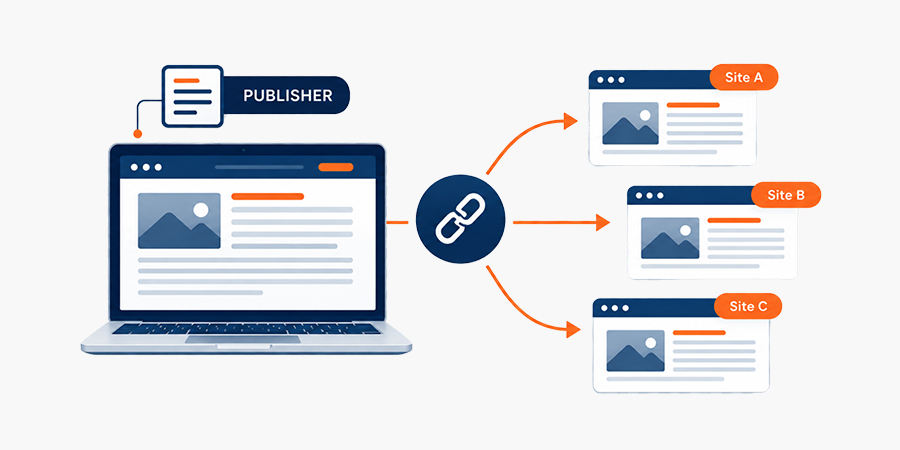
The Web has clear guidelines regarding duplicate content. Before you allow distribution of your content, ask the publisher how it deals with content syndication.
Before republishing, make sure the original publisher will use a rel=”canonical” tag to point to the original article. This indicates to search engines that your page is the primary version and gives the syndicated article a way to be found on the publisher website. A rel=”canonical” tag is the best way to protect the first copy of a page while giving that page’s link value to search engines.
Step 5: Give the Original Publication Information
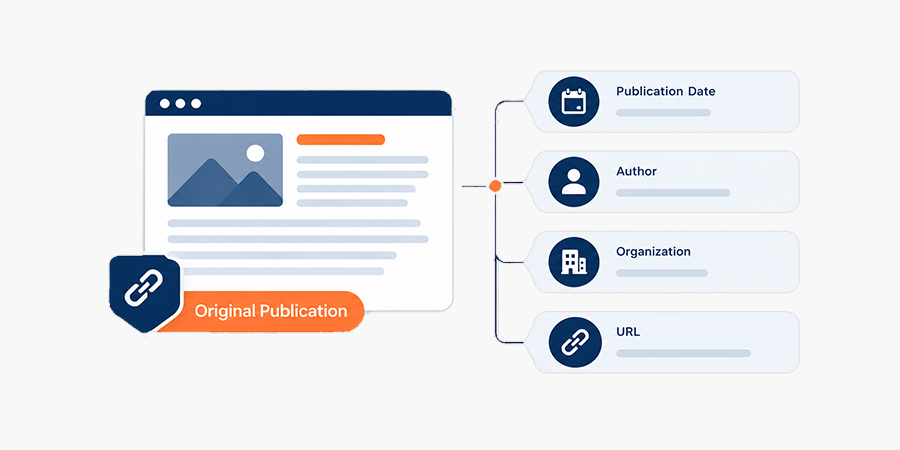
Give the publisher information that will assist it in crediting your publication correctly. Provide the publication date, name of the author, your organization, and the URL. Suggest language to the publisher for attribution, if available.
Step 6: Request a Link to the Original Article

Ask the publisher to ensure a link to the original article is published. The link should be valuable to the reader and lead to the original article or related content. Don’t use the article to post a long list of promotional links.
Link building should allow the reader to access the information they are interested in. For example, if the article refers to your business, the link should take the reader to your business webpage.
This takes a specific approach to determine the optimal places to build links and assess their relevance. This can be supported through link building services.
Step 7: Review the Content Syndication Page Once It Goes Live

Just because the article has been published, doesn’t mean the process is complete. The article may still contain inaccuracies or be published with errors in title and attribution. Check to make sure links are functional and the article has not been altered from the originally agreed upon content.
Step 8: Check that your SEO arrangement has been implemented

There are a few things you can check to make sure the publisher implemented your SEO arrangement. You can check to see if the publisher used the canonical meta tag and that it is pointing to the correct, original version of the article.
Even with a canonical in place, Google may disregard it, if it thinks it’s in the best interest of the user. Google also has documentation stating that blocking indexing of syndicated content is the best way to ensure that the content doesn’t show up in search results.
A good SEO strategy can help ensure that content syndication supports your broader search visibility objectives.
When Should You Syndicate Content?
Not all content should be syndicated. Factors such as value, the content aligned with the audience, the opportunities to distribute the content, and other business-related considerations should also be taken into account in addition to how many syndication partners are available.
- When the Content Has Strong Engagement Potential
If your article is about something that people are searching for, and the article performs well on your website, perhaps there is an audience beyond your website who would find the article helpful.
- When You Have Evergreen Content
Evergreen content stays relevant for a long time since it covers issues, queries, or requirements that are not likely to change. Content that is useful and informative, or which helps in answering the queries of the audience over and over again, continues to attract the audience even after being published. Such content gets more opportunities when syndicated.
- When the Goal is to Gain Referral Traffic
If you aim to get your article published in a place that brings qualified traffic to your website, choose a platform that lets readers access your article and shows your website as a reliable source for further information. Reach should be increased when your audience has an affinity with your service, product or subject.
- When You Have Valuable Research or Original Insights
The research your organization conducts and the data your organization compiles is a valuable resource. Syndicated content can help publish that information to places it may not ordinarily reach. Other organizations in your field may have information that complements yours, and Syndication can help provide that connection. The goal of content syndication is to have information published in as many reputable places as possible.
- When You Have Content That Supports Your Marketing Goals
Another use of syndication is repurposing information that helps you meet your business goals. Good information has many uses. Many organizations have websites to which only a limited number of people have access. Syndicated content can give your information a wider audience. It can help you connect your content to the audience that may benefit the most. For this reason, syndication is helpful to a limited degree for increasing web traffic and leads.
Canonical vs. Noindex for Content Syndication
Canonical and no index serve different purposes, so they should not be treated as interchangeable SEO settings.
| Aspect | Canonical | Noindex |
| What it does | Signals the preferred URL among similar pages | Tells search engines not to index the page |
| How it is used | A rel=”canonical” points to the preferred URL | A noindex directive is added to the syndicated page |
| Main purpose | Helps search engines understand URL preference | Keeps the page out of search results |
| Does it guarantee the outcome? | No. Google may select another canonical | No. Neither of the two techniques will produce an exact result each time. A canonical tag is a clue for Google to consider, while a noindex instruction will keep the article out of the search results in most cases if Google has access to the instruction. |
| Relevance to syndication | Can communicate the original source, but Google does not recommend relying on it to prevent syndication duplication | Google’s recommended approach when the goal is to prevent syndicated copies from appearing in Search |
Common Content Syndication Mistakes
Republishing articles is usually not the source of the problems that arise. More commonly, issues occur due to poor selection of publishers, ambiguous agreements, and failure to evaluate how articles are republished. Before you begin with syndicating your article, refer to below mentioned common mistakes that you need to avoid:
- Articles Republished Without The Original Source Identified
When the original publication of an article is not identified, the article may lose traffic and engagement. In addition, search engines may not be able to identify where the content was originally published.
Avoid it: Maintain a clear original URL, author information and publication record before syndication.
- Selecting a Publication Only for SEO Purposes
Choosing a publication only on the basis of domain authority or backlinks could place your content in front of an disinterested audience. Just because a publication has a high authority, doesn’t mean it’s an appropriate publication to work with.
Avoid it: A high authority publication does not mean it’s an appropriate publication to work with. Consider the audience, the quality and type of content the publication puts out, and the engagement it gets, to name a few.
- Syndicating Outdated Content
There are many reasons why posting outdated content can be detrimental to your audience and your authority. Outdated content can mislead your audience, and can also mislead you if you’re trying to promote or give recommendations for products or services that no longer exist.
Avoid it: Prior to posting, make sure you’ve updated your article. Thoroughly check examples, links, and citations to make sure they’re still accurate and relevant.
- Publishing Editorial Content that is Promotional
Because we all know what editorial content is not. Content written for advertising is not meant for publication in external sources. Articles containing excessive mentions of a brand or product, or containing promotional claims, are unlikely to be accepted for publication.
Avoid it: Always produce content that is educational and/or relevant. Although editorial content may be complemented with advertising, Google may penalize your site for deceptive practices.
- Failing to Verify the Published Content
Frequently, the published content will not match the approved content. Publishers typically alter the content to reflect their preferred style. Alterations may be made to formatting, style, punctuation, links, and the order of the content. These modifications may violate the terms of the syndication agreement.
Avoid it: After content is published, check to ensure that the modifications made to the syndicated content by the publisher did not alter the agreed terms of the syndication agreement. Contact the publisher to request that changes be made to restore the agreed terms.
- Publishing Content Syndication for Link Building
If your goal is to achieve a specific number of backlinks and the quality and relevance of the site and the information published is disregarded, there may be negative consequences to your business.
Avoid it: It is best to syndicate content after it has served its purpose and then determined that the audience would also find it valuable.
FAQs
Ans. SEO is only negatively impacted by content syndication if search engines are unable to determine which version of content is the original. In these cases, it is beneficial to the business to identify the original content and reach an understanding with the content syndicator on how to manage the syndication for search engine results.
Ans. There is no defined frequency for syndicating content. We can syndicate a piece as many times as there are quality publications to post it, so long as that content is still valid and relevant, and each of those publications reaches a different audience. Generally, we shouldn’t syndicate a piece more than once or twice because after that, it adds little to no value for the audience.
Ans. Different content forms can certainly be syndicated. Articles are the most common, but syndicated content can be used for research or other content forms such as guides, case studies, whitepapers, etc.
Ans. Yes, in some cases a syndicated version of your content may appear in search results instead of the original version. A syndicated version of your content may be selected as the canonical version, and therefore, the only version that Google displays in search results.
Ans. You can track content syndication using your web analytics service by reviewing referral traffic from the website where your content is published. To gain more detailed information, you can provide the publisher a copy of the content with a tracking code inserted by the publisher.
Conclusion: Republish Content in Order to Maintain Control
Content syndication is the one way to strategically expand your audience and maximize your site’s content. In order to maintain the value of your content, it is essential to strategically choose the outlets where your content is syndicated.
You should start by selecting reputable outlets and determine the terms of the syndication. Additionally, it is essential to assess how the syndicated content will be made available to readers, and determine how long the content will be available.
Want a more efficient method of disseminating your content? Our content writing services help clients create the content that their intended audience will find most interesting. Moreover, we ensure that content gets the widest possible distribution through content syndication.

