






The aviation industry has one of the most competitive digital search fields available. The competitive search field is due to the high-intent nature of the clients. Those that are searching for aviation services are often making high-stakes business travel decisions. Aviation Industry SEO has fast become one of the most important growth channels for aviation companies.
What is Aviation Industry SEO?
Aviation Industry SEO focuses on visibility for the most critical operational needs for the aviation industry. SEO is no longer about the user; it is about the needs of the customer. Searching for AOG support, MRO services, or a charter partner means that there is no time to search for general information. The aviation industry needs solutions. Any generalized searches are high-volume searches, but aviation industry searches are specific and have high-stakes.
Here, visibility alone won’t suffice. Trust-building through certification, paperwork, reliability, technical skills, recorded safety, and case studies happen in the background of every click for Aviation SEO.
Types of Aviation Businesses That Need SEO
The aviation industry SEO is unlike any other industry. Search intent is predominantly very technical, and usually concerns operational and financial issues. On the rare occasion someone is searching for an aviation service, there is likely a pressing concern such as balancing an aircraft’s operational status, moving valuable cargo, or making multimillion-dollar leasing decisions.
It is for this reason, aviation SEO is unlike any other SEO in that it must align with industry workflow and lead to critical decision-making rather than focus on high-volume keywords.
- Types of aviation business categories listed below, make its SEO a critical business strategy rather than a simple marketing strategy:-
- Private Jet Charter Companies
Search behavior for this segment is immediate and convenient. Searches are often specific to a given route and time and, as such, highly intent-driven. Availability of a convenient/private charter flight is more persuasive to a potential customer in the moment than any form of traditional advertising. Here, aviation SEO is all about converting the intent in the exact moment.
- Aircraft Maintenance Providers (MRO Services)
MRO services attract few customers. Their visibility relies more on trust and their operations. Searches are typically initiated by routine maintenance or by an unforeseen technical problem or AOG event. Good SEO allows visibility in any query, no matter the technicality, while certifying credibility in the ability to service/take on projects, the turnaround time, and the specialization of aircraft.
- Aviation Consultants
Trust is the most important factor in this category. Clients are not interested in what you have to say about general issues, they want your opinion on technical regulatory or operational matters. In this regard, SEO is a tool to build trust, where the depth of thought and technicality of the niche will define lead generation.
- Aircraft Leasing and Sales Companies
The decision process for this segment is long, and very costly and value driven. Only after prospecting aircraft specifications will they be able to leverage a leasing structure and forecast the exposure impact, will they reach out. SEO helps win the process by ensuring visibility throughout and certifying a credible market presence through logic and structured content.
- Cargo and Aviation Logistics Businesses
These businesses are concerned with the worldwide movement of time-sensitive materials and the need for delivery within a specific time frame. Searches are typically about routes, time, and reliability. Good SEO allows businesses to be present when demand shows, even if it is at different locations, while marking operational reach, efficiency, and specialization.
Why is aviation industry SEO important?
Search Engine Optimization is a must for every industry, and in B2B aviation, SEO is even more critical, as companies who provide operator demand services, such as charters and aircraft leasing companies, will not be able to do business with you, if you are not searchable online.
Search visibility means the difference between being contacted to provide business via a request for quotation (RFQ) and not being contacted at all.
AOG (Aircraft on Ground) recovery, aircraft leasing, and maintenance capacity planning are great examples of services that depend on decision-makers using specific search terms to identify potential providers.
- Captures high-intent aviation procurement searches
In aviation industry SEO, the search behavior of a potential customer is highly dependent on the intent to purchase a service. Most procurement search queries are not informational. Industry research shows that more than 70% of procurement searches in B2B aviation and aerospace occur prior to any communication with a specific vendor. At this stage of the procurement process, presence in the search results plays a critical role in determining if your service will be included in their request for quotation (RFQ) or charter request.
- Builds Trust and Credibility in a Competitive Industry
In aviation, operational authority, and service credibility, are heavily influenced through visibility, and both possess a high correlation. Substantial research in B2B shows that companies with a greater service depth are perceived as more trustworthy and have more operational capacity than those with a limited search presence. In other words, the depth of a service offering is in large part defined through the articulation of that service in the search results, and will ultimately drive a company’s competitive advantage.
- Generates Qualified Aviation Leads
Aviation industry SEO leads have a higher likelihood of conversion because they come from users with a specific use case. In B2B markets, SEO leads have a 14.6% close rate, compared to a 1.7% close rate for outbound leads such as direct mail and traditional advertising. This gap is much more pronounced in aviation because of the specificity of requirements.
Search-based users are often at the later stages of the purchasing process. As a result, the RFQs are highly defined in terms of the technical and regulatory requirements, and deadlines, which results in a high probability of closing.
- Supports Local Aviation Reach
The aviation market is highly fragmented, with demand concentrated in various areas. Each of these areas has a distinct search and keyword behavior.
According to SEO industry research, approximately 46% of Google searches have local intent, meaning users are often looking for information, services, or businesses connected to a specific location. For aviation businesses, this highlights the importance of location-focused SEO strategies, such as optimizing content around airports, charter services, aviation facilities, and regional operations to reach users with specific service needs.
Strategies for Aviation Industry SEO
In a broader sense, aviation industry SEO is concerned with situating a business at the right point in the aviation procurement decision process, at the time when search engines are being used to discover hard-to-find services.
Aviation SEO is about synchronizing opportunities for increased digital visibility, with demands for services such as aircraft chartering, aviation logistics, aircraft maintenance, and other services.
We want to ensure that aviation businesses are available in the same search spaces where customers are assessing capabilities, comparing options, and issuing RFQs.
- Optimize for International and Multilingual SEO
Creating pages in your local language isn’t enough when your customers span multiple countries. Create separate pages for each of your major markets. These will include the supported languages and currencies (English + Arabic; prices in AED), local laws and regulations you comply with (Complies with DGCA India Part 145), local search terms (private jet charter Dubai hourly rates) and answer any regional questions you may receive regarding visa, slot, or noise restrictions.
- SEO for B2B Aviation Searches
Business customers expect information that helps them understand the risks they may be taking. In aviation industry SEO, Service pages need to start with a one-sentence claim of the service offered (AOG turnaround: 6 hours) and include proof with easily downloadable documents such as spec sheets, service agreements, and case studies that provide real savings.
- SERP Ownership Strategy
Instead of just optimizing for one keyword, create several things so that your brand shows up multiple times in the search results for one specific query. Create a local landing page that has a lot of FAQ’s; update your Google Business Profile, publish a short YouTube case video with a transcript, write a press note of your newly formed partnerships, list your service in local industry, and connect all of these resources in a way that supports them and use the available metrics to collect and monitor which search ends up being the most clicked.
- Build Industry-Relevant Backlinks
Focus on gaining links from reputable aviation sites and do not rely on the generic directories. Good link partners include OEM portals, airport vendor lists, industry journals, safety bulletins, and trade associations. Offer valuable, linkable content such as anonymized maintenance datasets, performance benchmarks, or even interactive fleet tools. Editors like to see unique data and tools rather than basic tools.
- Technical SEO for Large Aviation Websites
Site health depends on clear, concise rules for large sites. Block crawling of duplicate and low-value pages and keep separate sitemaps for varying content types. Ensure aviation images load fast by serving the most modern, compressed image file types. For crawlers to better parse content, consider adding minimal structured data for company info, airport pages, FAQs, and videos.
How to Measure SEO in the Aviation Sector
One of the most competitive digital domains, measuring aviation industry SEO cannot rely on analytics for search volume, reach, and ranking. Searches for aviation services are made by multiple stakeholders taking part in a long, complex buying process, and searches are made using specific aircraft types, airport codes, and aviation jargon.
It is essential to have a clear understanding of these users’ needs when considering search benchmarks, as more general search benchmarks will not be as relevant.
- The tools and ways listed are the most instrumental to measuring SEO performance in aviation:-
- Analysis of organic traffic and user behavior

Tool: Google Analytics 4
GA4 must be established on your aviation website. Segments must be created to display only the data pertaining to organic traffic. Tailored reports for groups of pages (charter services, destination pages, pages for specific aircraft, and pages for specific airports) must be created to identify the groups of pages that are the most and least popular. Conversion events must be created on GA4 for form completions, as well as clicks to the booking page and phone calls. This analysis must be performed on a monthly basis to detect behavioral trends.
- Keyword Visibility Tracking

Tools: SEMrush, Ahrefs, Moz Pro
- Technical SEO Monitoring

Tool: Google Search Console
Verify your site in Google Search Console and upload your sitemap. In the Coverage Report, see which aviation industry SEO landing pages are indexed. Check for any missing or erroneous pages. From the Core Web Vitals report, see which pages are negatively impacting your rankings due to slow load speed or poor layout.
- Lead & Conversion Tracking

Tools: CRM + Analytics Integration
Chart every single interaction that can convert a site visitor to a customer. This includes charter inquiries, flight school applications, demo requests, phone calls, and chat interactions. All forms of interaction should be set up as conversion events within GA4. If you are using a CRM system like HubSpot or Salesforce, integrate it for the full visibility of the lead conversion cycle. Tag your organic traffic leads in the CRM so you can report how many leads were qualified from search.
- Competitor Benchmarking

Tools: SEMrush, Ahrefs, Similarweb
Choose 3-5 competitors in the organic search results. They may not be direct competitors in your business line. These competitors are the ones that consistently rank over you in the key search terms in aviation. Add these competitors in the tracking project in SEMrush or Ahrefs. Run a keyword gap analysis to find the terms these competitors rank for that you do not. Use this data to establish priorities for your links and your content.
- Local Search Performance
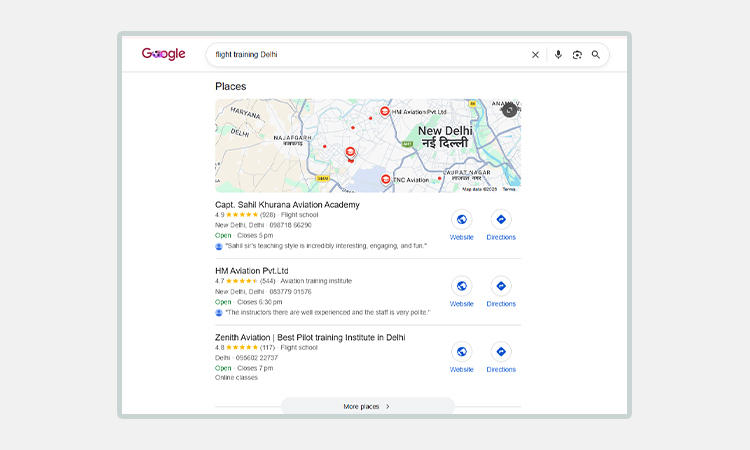
Tool: Google Business Profile + Local Rank Trackers
Claim your Google Business Profile and fully optimize it by adding your services, business hours, photos, and descriptions in the form of keywords. Choose the business category that best describes your business (e.g. airport, flight school, aircraft maintenance service). Use GBP Insights to see whether people found your profile through direct or discovery searches, and analyze calls, direction requests, and website visits on a weekly basis.
- Backlink & Authority Measurement

Tools: Ahrefs, Moz, SEMrush
- ROI-Based SEO Reporting

Tools: GA4, Looker Studio, CRM
Create a consolidated SEO report in Looker Studio. Combine data from GA4, Google Search Console, and your CRM. Focus first on the growth in traffic from your website’s visitors, the growth in visibility of your website’s keywords, the number of leads generated through website searches, and the value of revenue or the sales pipeline influenced by your website’s traffic. Distributing this report to your stakeholders on a monthly basis will allow you to shape a narrative that focuses on the value the business has gained over time.
Common Aviation Industry SEO Mistakes to Avoid
The aviation industry is one of those few verticals in which even the best SEO teams truly struggle due to the long sales cycle, focused and confined audience, and the extreme competitiveness of the industry.
The stakes are even higher due to the nature of the audience and the target market. Decision makers in the aviation space are extremely researched and vetted. They have no tolerance for websites that are either outdated in design or are unable to provide answers to the questions they have. Because of this, the cost to your business from one of these mistakes is exceptionally high.
SEO errors persist among even the most resourceful aviation companies, which stifles online visibility and leads. Here is a list of common pitfalls:-
- Targeting Vague or General Keywords
A common mistake among many aviation companies is targeting high volume keywords like “flights” or “aircraft services” and not the industry specific keywords that their audiences will be using. Typical, broad, or generic keywords will be impossible to compete for and may drive the wrong traffic to your site. Keywords for a specific aircraft, service, route, or a specific airport will yield better and more targeted traffic to your site.
- Overlooking Geographical Aviation SEO
It is a well known industry fact that aviation is location driven. Many businesses seem to ignore local aviation industry SEO. Not optimizing for searches that include a specific airport, or city, or region means missing out on potential customers looking for services in your area. For FBOs, MROs, and training centers, local SEO can be the difference between being discovered or being ignored.
- Posting Content that is Thin or Only Technical
Aviation companies tend to publish either thin content that is unable to rank or overly technical content. The ideal type of aviation industry SEO content will be technical but will also take into account the needs and questions of your audience, whether that is a travel manager, fleet operator or a pilot.
- Forgetting the Mobile User Experience
Mobile devices drive a lot of the current research activity in aviation. Websites that cannot be easily read, browsed, or manipulated on a mobile device not only push potential customers away, but they tell search engines that your website is of low quality. Mobile optimization is mandatory since it impacts website rankings and customers.
- Dismissing Outdated Website Designs for Aviation
An outdated website design can destroy your aviation industry SEO efforts because people do not trust outdated websites. If your website has slow load times, is cluttered, or has an old design, potential customers may think you haven’t modernized your business. If your website has a modern design and is well structured, that will help your SEO the most.
Conclusion
In the aviation sector, Search Engine Optimization (SEO) requires an approach that is as unique and specialized as the sector itself. Companies must work systematically and with great attention to detail to understand the searching, evaluating, and converting behaviors of aviation consumers.
There is great potential for differentiation as more companies utilize the correct tools, avoid the same errors, and focus on what is truly significant. The aviation companies that adopt a clear, insightful, and structured approach to SEO are the ones that have the greatest potential to win more clients in the future.
Expand your aviation market reach with strategic aviation industry SEO solutions that improve search visibility and connect your business with clients actively seeking aviation services.
FAQ
Ans. Companies can create landing pages that are focused on specific airports, routes, or regions and optimize those pages. Specific service offerings for that airport or region, as well as relevant, localized, and keyword rich content, can create a landing page that has a high degree of relevance for a specific location.
Ans. Yes. Actually, low search volume often means high intent in the aviation industry. Searchers looking for specific MRO services or specific aircraft type rating courses are usually serious and qualified. With niche aviation services, SEO aims at capturing low volume, yet high intent audience segments.
Ans. AI-powered search engines are changing result displays. These engines favor well-structured content over traditional keyword-based content. For aviation companies, this will mean more focus on building traffic for specific topics in aviation, obtaining relevant links, and developing clear content structures.
Ans. Airlines are after consumer search traffic, which is high-volume and transactional. B2B aviation companies have a much smaller, more focused search audience that includes procurement managers and operators of fleets, and aviation executives.
Ans. Expect to wait three to six months for an aviation SEO strategy to improve your search rankings. Six to twelve months is a more realistic timeframe for receiving the first qualified leads.

